


Blog
Building Smart Medical Devices With AI and Advanced Analytics While Maximizing Battery Efficiency
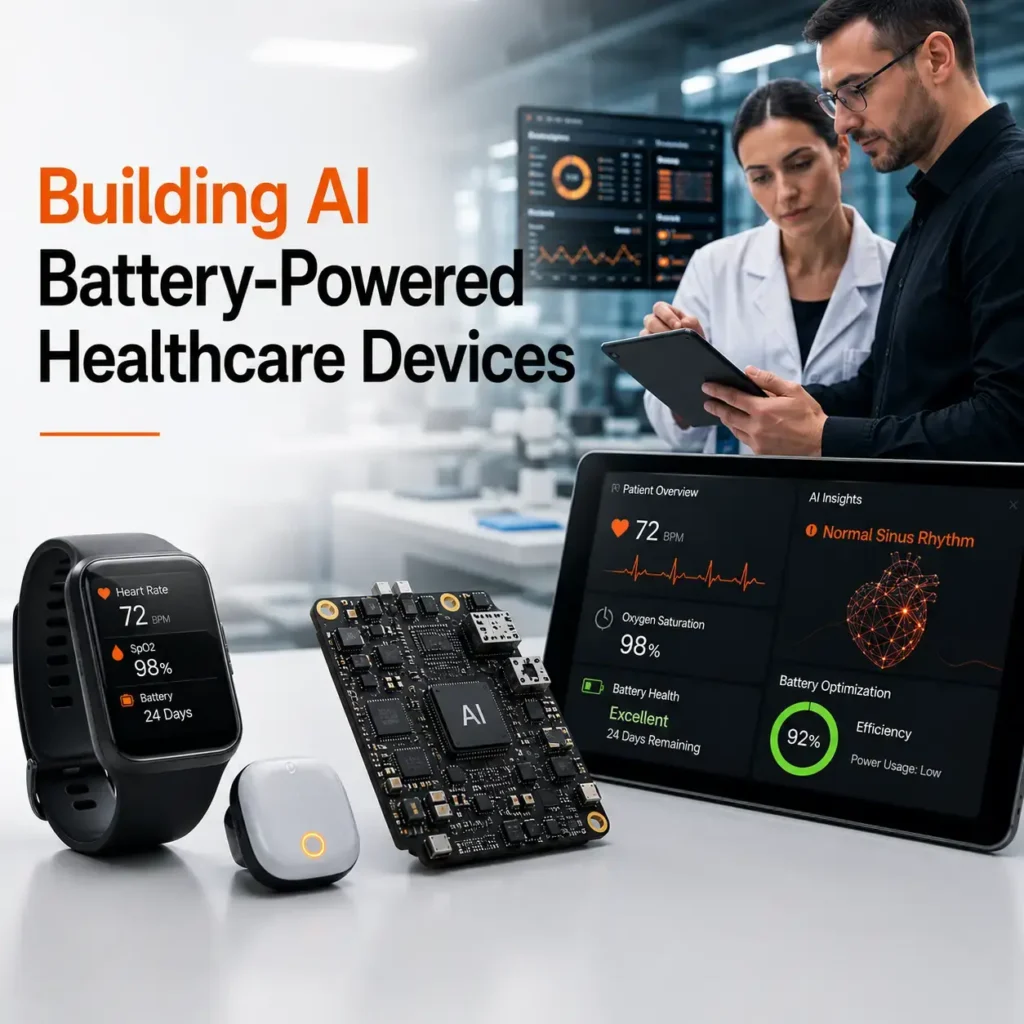
Healthcare technology is rapidly shifting toward intelligent, connected, and always-on experiences. From remote patient monitoring devices to AI wearable technology, modern healthcare solutions are expected to deliver real-time insights, predictive analytics, and seamless patient experiences while operating within strict power and performance constraints.
The challenge is no longer whether artificial intelligence belongs in healthcare devices. The real challenge is how to integrate advanced analytics in healthcare systems without compromising battery life, latency, reliability, or compliance.
As more healthcare organizations invest in smart medical devices and embedded AI systems, engineering teams must balance energy-efficient AI models, low-latency AI processing, and regulatory readiness from the earliest stages of product development.
Why AI Is Transforming Battery Powered Medical Devices
The demand for battery-powered medical devices is growing rapidly as healthcare shifts toward connected, portable, and patient-centric care. From wearable ECG monitors to intelligent insulin pumps, modern healthcare products now rely on advanced analytics in healthcare to deliver faster diagnoses, predictive alerts, and continuous monitoring.
At the same time, healthcare providers expect these devices to operate with minimal downtime, lower latency, and improved accuracy. This is where edge AI healthcare solutions are becoming essential. Instead of sending every data point to the cloud, devices can process information locally for faster response times and better patient privacy.
For companies building smart medical devices, integrating AI is no longer just a competitive advantage. It is becoming a core requirement for scalable and connected healthcare innovation.
Related Reading:
Core Design Considerations When Adding AI to Battery Medical Devices
Designing intelligent healthcare products requires more than adding machine learning capabilities to existing hardware. Successful AI medical device design depends on balancing performance, power efficiency, security, and regulatory compliance from the start.
Choosing Between Cloud AI and Edge AI Healthcare Architectures
Many healthcare applications now prefer embedded AI systems that process data directly on the device instead of relying entirely on the cloud. This approach reduces latency, improves reliability, and supports real-time decision-making in critical care environments.
For example, remote patient monitoring devices that depend on cloud-only processing may experience delays due to connectivity issues. In contrast, edge-enabled systems can analyze patient data instantly and trigger immediate alerts when needed.
Cloud AI | Edge AI |
Higher latency | Faster processing |
Constant connectivity required | Works offline |
Increased bandwidth usage | Lower power consumption |
Centralized processing | Real-time local analytics |
As healthcare products evolve, low-latency AI processing is becoming a major requirement for responsive and scalable patient monitoring systems.
Related Reading:
Energy Efficient AI Models and Battery Optimization
One of the biggest challenges in battery medical devices is running AI workloads without draining power too quickly. Healthcare devices must continuously collect, process, and analyze patient data while maintaining long battery life and reliable performance.
To achieve this, engineering teams are increasingly using energy-efficient AI models combined with energy-aware computing strategies such as:

- Model quantization
- Lightweight neural networks
- Adaptive sampling
- Sleep mode optimization
- Intelligent workload scheduling
These optimizations help reduce processing overhead while maintaining accurate analytics and real-time responsiveness. This is especially important for wearable and portable healthcare products that require continuous monitoring.
For companies developing low-power medical devices, battery optimization should be integrated into the architecture from the earliest design phase instead of being treated as a post-development fix.
TinyML Healthcare and On-Device Intelligence
As healthcare devices become smaller and smarter, TinyML healthcare solutions are enabling AI inference directly on ultra-low-power hardware. Instead of relying on cloud processing, TinyML allows medical devices to analyze patient data locally using compact machine learning models.
This approach is transforming:
- Wearable cardiac monitoring
- Glucose tracking systems
- Rehabilitation devices
- Fall detection wearables
- Smart respiratory monitoring
By enabling local processing, embedded AI systems can reduce latency, improve patient privacy, and extend battery life simultaneously. This makes TinyML particularly valuable for AI wearable technology that requires always-on monitoring and fast decision-making.
Healthcare companies investing in TinyML can also reduce cloud infrastructure costs while improving reliability in environments with unstable connectivity.
Related Reading:
Sensor Fusion Healthcare Systems
Modern smart medical devices rarely depend on a single data source. Instead, they combine information from multiple sensors to improve accuracy, reliability, and clinical decision-making. This process, known as sensor fusion healthcare, is becoming essential in connected care environments.
For example, wearable healthcare devices may combine:
- ECG sensors
- Accelerometers
- SpO2 monitoring
- Temperature sensors
- Motion tracking
By analyzing multiple data streams together, healthcare systems can reduce false alerts and generate more accurate patient insights. This is especially valuable in predictive analytics healthcare applications, where real-time patient behavior and physiological signals must be interpreted together.
For AI-powered monitoring systems, sensor fusion also improves the quality of on-device analytics while supporting faster and more context-aware healthcare decisions.
Low Latency AI Processing for Real-Time Clinical Decisions
In healthcare environments, delays in data processing can directly impact patient outcomes. This is why low-latency AI processing is a critical requirement for modern remote patient monitoring devices and connected healthcare platforms.
Applications such as:
- Arrhythmia detection
- ICU monitoring
- Fall detection
- Emergency response systems
- Chronic care monitoring
require immediate analysis and rapid response times.
Using edge AI healthcare architectures allows devices to process critical patient data locally instead of waiting for cloud communication. This not only improves response speed but also enhances reliability in low-connectivity environments.
For healthcare companies building intelligent monitoring systems, optimizing latency is just as important as improving AI accuracy. Faster processing leads to better patient experiences, stronger clinical performance, and more scalable healthcare solutions.
Related Reading:
FDA Artificial Intelligence Guidance and Regulatory Considerations
Regulatory compliance plays a major role in successful AI medical device design. As healthcare companies integrate AI into connected products, they must ensure their systems align with evolving FDA requirements for safety, transparency, and reliability.
According to recent FDA artificial intelligence guidance, manufacturers should focus on:
- Model validation
- Cybersecurity
- Data traceability
- Continuous monitoring
- Clinical accuracy
- Risk management
This becomes even more important for battery-powered healthcare devices that rely on autonomous decision-making or real-time patient monitoring.
Healthcare teams building Artificial Intelligence-enabled device software functions should also prioritize explainable AI models and secure data handling practices to support regulatory approvals and long-term scalability.
AI Healthcare Devices Examples Leading the Future of Connected Care
The adoption of AI in healthcare is accelerating across multiple device categories. Today’s leading “AI healthcare devices examples” combine intelligent analytics, edge processing, and real-time monitoring to improve patient outcomes and operational efficiency.
Some common examples include:
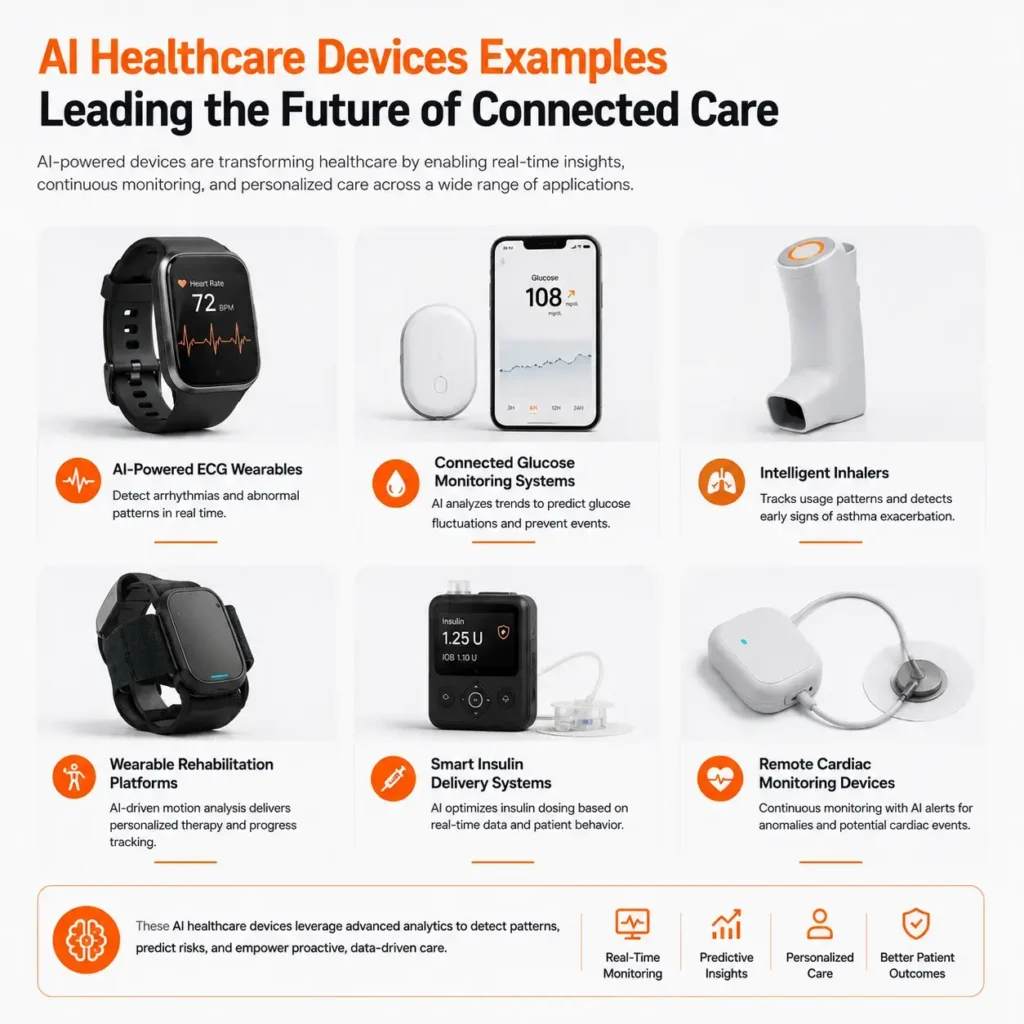
- AI-powered ECG wearables
- Connected glucose monitoring systems
- Intelligent inhalers
- Wearable rehabilitation platforms
- Smart insulin delivery systems
- Remote cardiac monitoring devices
These solutions rely heavily on advanced analytics in healthcare to identify patterns, predict health risks, and support proactive treatment decisions.
As demand for connected care continues to grow, companies investing in AI wearable technology and smart medical devices are better positioned to deliver scalable, patient-focused healthcare experiences.
Related Reading:
Common Mistakes Companies Make When Building AI-Powered Medical Devices
Many healthcare companies rush to add AI features without fully addressing the engineering and regulatory challenges behind connected healthcare products. This often leads to performance limitations, battery issues, and delayed product launches.
Some of the most common mistakes include:
1. Ignoring Battery Constraints Early
AI workloads can quickly increase power consumption if battery optimization is treated as an afterthought. Successful low-power medical devices require efficient hardware selection, optimized inference models, and intelligent power management from day one.
2. Over-Reliance on Cloud Processing
Cloud AI alone may introduce latency, connectivity risks, and higher operational costs. Many modern edge AI healthcare solutions now combine cloud intelligence with local processing for faster and more reliable performance.
3. Poor Sensor Integration
Weak sensor fusion healthcare strategies often lead to inaccurate patient insights and higher false-positive rates. Devices should combine multiple sensor inputs to improve reliability and clinical accuracy.
4. Lack of Regulatory Readiness
Many teams underestimate the importance of FDA compliance during development. Following FDA artificial intelligence guidance early can significantly reduce delays and future redesign efforts.
5. Failing to Optimize for Real-Time Analytics
Healthcare applications require responsive systems capable of low-latency AI processing. Delayed alerts or slow data interpretation can directly impact patient care outcomes.
Companies that address these challenges early are more likely to build scalable, compliant, and commercially successful healthcare solutions.
How CitrusBits Helps Companies Build AI-Enabled Healthcare Devices
Developing intelligent healthcare products requires expertise across AI, embedded systems, cloud infrastructure, and healthcare compliance. CitrusBits helps healthcare organizations design and develop scalable smart medical devices that combine real-time analytics with optimized performance and long battery life.
Our teams specialize in:
- AI medical device design
- connected healthcare platforms
- remote patient monitoring systems
- embedded AI systems
- IoMT solutions
- wearable healthcare applications
- scalable cloud and edge architectures
Whether you are building next-generation battery-powered medical devices or advanced patient monitoring solutions, CitrusBits helps accelerate development while reducing technical and regulatory risks.
Summary
Adding AI to healthcare products is no longer just about innovation. It is about delivering faster insights, better patient outcomes, and scalable connected care experiences while maintaining performance and battery efficiency.
Successfully integrating advanced analytics in healthcare requires a balanced approach to architecture, power optimization, compliance, and real-time processing. From embedded AI systems and TinyML healthcare applications to edge AI healthcare platforms, every design decision directly impacts usability, scalability, and long-term product success.
As demand for intelligent and connected healthcare solutions continues to grow, companies investing in efficient, secure, and compliant smart medical devices will be better positioned to lead the future of digital health.
Whether you are developing wearable monitoring systems, AI-powered diagnostics, or next-generation remote patient monitoring devices, partnering with experienced healthcare technology teams can significantly reduce development complexity and accelerate time-to-market.
FAQs
Q: What is edge AI in healthcare?
Ans: Edge AI healthcare refers to processing healthcare data directly on the device instead of relying entirely on cloud infrastructure. This approach improves speed, reduces latency, and enhances patient privacy.
Q: How does TinyML help battery-powered medical devices?
Ans: TinyML healthcare enables lightweight AI models to run on ultra-low-power hardware. This helps healthcare devices perform real-time analytics while preserving battery life and reducing cloud dependency.
Q: What are FDA requirements for AI-enabled medical devices?
Ans: The FDA expects healthcare companies to address areas such as model validation, cybersecurity, transparency, traceability, and patient safety when developing AI-enabled healthcare technologies. For more details, visit here: https://www.fda.gov/medical-devices/software-medical-device-samd/artificial-intelligence-and-machine-learning-software-medical-device
Q: What are examples of AI-powered wearable healthcare devices?
Ans: Examples include:
- AI-powered ECG wearables
- connected glucose monitors
- intelligent inhalers
- rehabilitation tracking systems
- remote cardiac monitoring devices
Q: How do battery-powered medical devices optimize AI workloads?
Ans: Healthcare devices optimize AI performance using:
- Energy-efficient AI models
- Model quantization
- Edge processing
- Adaptive power management
- Optimized embedded hardware
- Energy-aware computing strategies
Table of Contents
1) Why AI Is Transforming Battery Powered Medical Devices
2) Core Design Considerations When Adding AI to Battery Medical Devices
3) Energy Efficient AI Models and Battery Optimization
4) FDA Artificial Intelligence Guidance and Regulatory Considerations
5) AI Healthcare Devices Examples Leading the Future of Connected Care
6) Common Mistakes Companies Make When Building AI-Powered Medical Devices
7) How CitrusBits Helps Companies Build AI-Enabled Healthcare Devices
8) Summary
Innovate the Future of Health Tech
CitrusBits helps MedTech leaders build smarter apps, connected devices, and XR health solutions that truly make an impact.
