


Blog
Internet of Medical Things (IoMT): Uses, Benefits & Future
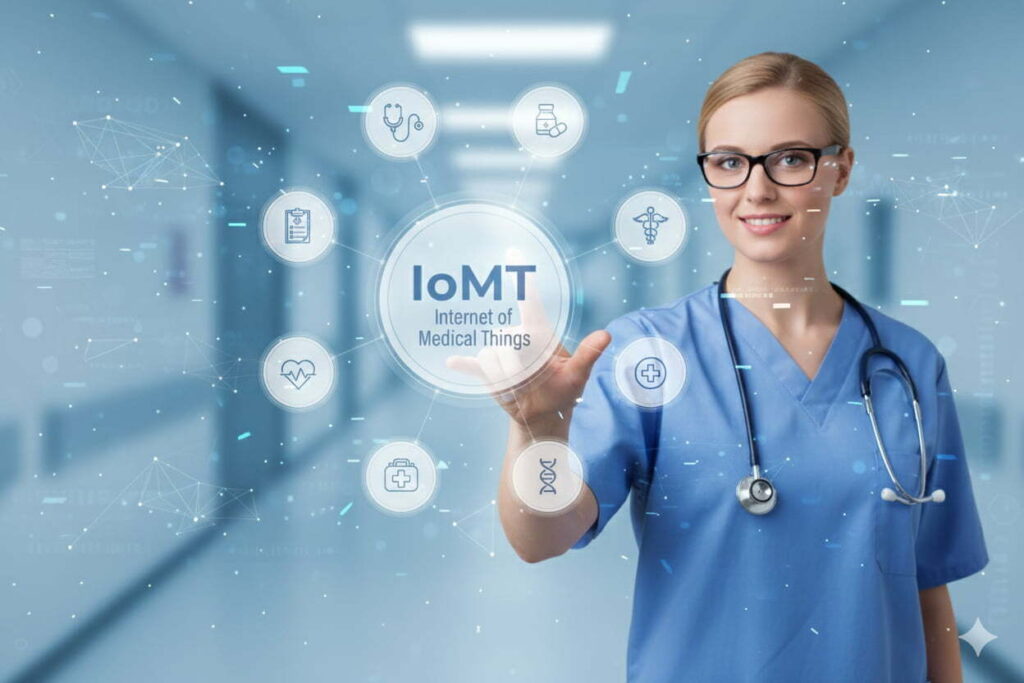
The Internet of Medical Things (IoMT) is quietly turning hospitals, clinics, and even our homes into smart, connected care environments. From wearables that continuously track your heart rhythm, to infusion pumps that adjust medication in real time, to hospital beds that alert nurses before a patient is at risk of falling, these aren’t sci-fi concepts anymore; they’re everyday realities.
Think of IoMT as the healthcare-focused branch of the wider Internet of Things (IoT in healthcare): a growing network of medical devices, apps, and systems that collect, share, and sometimes even analyze health data automatically.
For patients, that can mean fewer rushed hospital visits and more care from the comfort of home. For doctors and healthcare providers, it means faster, data-driven decisions instead of guesswork based on a single snapshot in time.
What Is the Internet of Medical Things (IoMT)?
The Internet of Medical Things (IoMT) refers to the rapidly expanding ecosystem of connected medical devices, healthcare applications, and digital systems that communicate over the internet. These devices collect, exchange, and sometimes analyze health data with minimal human intervention, helping doctors monitor patients in real time, improving diagnostic accuracy, and enabling faster, more personalized treatment plans.
In simple terms, IoMT is the healthcare-specific branch of IoT, designed to improve patient outcomes, streamline hospital operations, and support modern care models like telehealth and remote patient monitoring. Unlike general consumer IoT devices (like smart thermostats or home assistants), IoMT tools operate in a highly regulated, high-risk environment where data integrity, device uptime, and patient safety are critical.
Whether it’s a smartwatch that tracks heart rhythm, an insulin pump that automatically regulates dosage, or a connected MRI machine that sends scans directly to a specialist, IoMT ensures that vital medical data flows seamlessly from device to clinician, enhancing both the speed and the quality of care.
How Does IoMT Work?
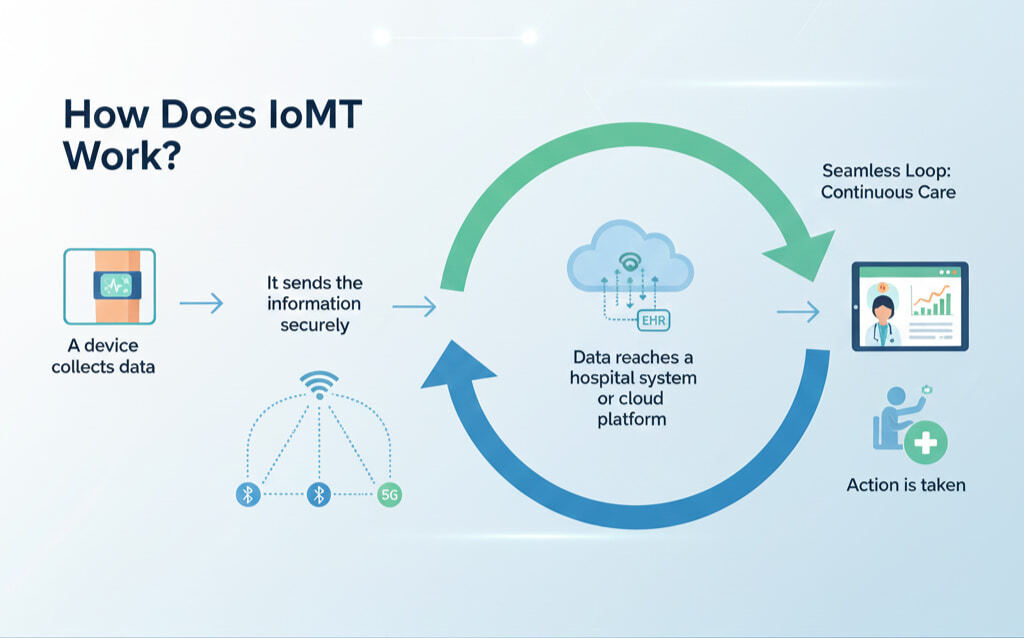
IoMT works through a combination of smart sensors, wireless networks, data storage systems, and analytics engines. Here’s a quick look at the typical workflow:
- A device collects data: (e.g., a wearable ECG patch tracking heart rhythm)
- It sends the information securely: Using Wi-Fi, Bluetooth, 5G, or medical-grade communication channels.
- Data reaches a hospital system or cloud platform: Where it’s stored, analyzed, and integrated with electronic health records (EHRs).
- Doctors and clinicians receive insights or alerts: Via dashboards, mobile apps, or automated notifications.
- Action is taken: Such as adjusting medications, scheduling a virtual visit, or responding to emergencies.
This seamless loop enables continuous care, faster intervention, and smarter, more efficient medical workflows.
IoT in Healthcare vs IoMT: What’s the Difference?
Although the terms IoT in healthcare and IoMT are often used interchangeably, they aren’t exactly the same. Both involve internet-connected devices, but IoMT is a more specialized, regulated subset of IoT designed exclusively for medical and clinical use.
Here’s what sets them apart:
What Is IoT?
The Internet of Things (IoT) refers to any network of everyday objects, like wearables, home appliances, vehicles, or smart sensors, that connect to the internet to exchange data. Examples include:
- Smart speakers
- Smart thermostats
- GPS trackers
- Smart watches for fitness
- Connected home security systems
IoT is broad, consumer-driven, and largely focused on convenience, automation, and efficiency.
What Makes IoMT Different From IoT?
IoMT takes the principles of IoT and applies them specifically to medical devices, hospital systems, patient monitoring tools, and clinical workflows. The key differences include:
- Purpose
- IoT: Convenience, automation, lifestyle improvements
- IoMT: Patient care, health monitoring, accurate diagnosis, life-critical operations
- Regulation
- IoMT devices must comply with HIPAA, GDPR, FDA guidelines, medical device standards, and strict cybersecurity protocols.
- Reliability & Accuracy
- IoMT devices must maintain near-continuous uptime and deliver precise readings. Lives may depend on it.
- Data Sensitivity
- IoMT handles PHI (Protected Health Information), some of the most sensitive data in existence.
- Risk Level
- A compromised IoT device may cause inconvenience.
- A compromised IoMT device may threaten patient safety, misreport vital signs, or halt essential care.
What Are the 4 Types of IoT?
To clarify the broader IoT landscape (and show where IoMT fits), here are the commonly recognized categories:
- Consumer IoT: Smart home devices, wearables
- Commercial IoT: Smart buildings, retail devices
- Industrial IoT (IIoT): Manufacturing sensors, robotic systems
- Healthcare IoT (IoMT): Connected medical devices and healthcare systems
IoMT is a category in itself because of its complexity, sensitivity, and critical role in modern healthcare.
Core Components of an IoMT Ecosystem
The Internet of Medical Things isn’t just about connected devices; it’s an entire end-to-end digital ecosystem that ensures patient data flows securely, accurately, and reliably between devices, clinicians, and healthcare systems. For IoMT to function properly, each component must work together seamlessly.
A failure in one part of the chain, whether networking, device firmware, data storage, or analytics, can directly impact patient safety and clinical decision-making.
1. Connected Medical Devices (Endpoints)
These are the physical devices that collect medical data from a patient or healthcare environment. Each contains sensors, processors, and connectivity modules.
Examples include:
- Wearable ECG patches
- Continuous glucose monitors
- Smart pill bottles
- Blood pressure cuffs
- Hospital beds with built-in sensors
- Infusion pumps and ventilators
- Connected MRI, CT, and ultrasound machines
2. Communication & Connectivity Layer
This layer ensures that medical devices can transmit data securely and consistently. In healthcare, network reliability and low latency are essential.
Common IoMT communication technologies include:
- Wi-Fi 6 (reliable in-hospital connectivity)
- 5G & private LTE (low latency, high bandwidth, ideal for mobile/critical care)
- Bluetooth Low Energy (BLE) (wearables)
- NFC & RFID (asset tracking, medication management)
- Secure VPN & TLS encryption (protects PHI in transit)
3. Edge Computing & Gateways
Healthcare environments often rely on edge computing to process data locally, especially when every millisecond counts.
Why edge computing matters in IoMT:
- Reduces dependency on cloud availability
- Enables instant alerts for life-critical conditions
- Minimizes latency
- Keeps systems operational even when connectivity is unstable (especially in rural or remote care settings)
4. Cloud Platforms & Data Storage
IoMT generates massive volumes of clinical data that must be stored securely and reliably.
IoMT storage requirements include:
- HIPAA/GDPR-compliant cloud environments
- Encrypted databases for edge deployments
- Redundant storage clusters for high availability
- Integration with EHR/EMR systems
- Audit logs for regulatory compliance
Types of stored data:
- Structured data (vitals, medication logs, diagnostics)
- Imaging files (MRI, CT, ultrasound)
- Unstructured data (clinical notes, continuous waveforms)
Healthcare providers rely on advanced cloud platforms to manage long-term medical records, device metadata, and operational logs.
5. Analytics, AI & Healthcare Integrations
The real power of IoMT lies in what happens with the data after it’s collected.
Modern IoMT ecosystems use:
- AI-driven clinical decision support
- Predictive analytics (early detection of deterioration, sepsis risk)
- Machine learning models for personalized treatment
- Integration engines (e.g., HL7, FHIR, DICOM)
- Real-time clinical dashboards for physicians
This layer transforms raw data into meaningful insights, enabling smarter diagnostics, proactive interventions, and streamlined hospital workflows.
6. Security & Governance Layer
Because IoMT deals with life-critical systems and protected health information, security isn’t optional, it’s foundational.
Key security components:
- Zero Trust access models
- Identity & access management (IAM)
- Strong authentication and authorization control
- Encrypted communication
- Device segmentation
- Continuous vulnerability scanning
- Remote device patching (when possible)
- Compliance monitoring for HIPAA, GDPR, FDA, MDR
How Does IoMT Affect Healthcare?
The impact of the Internet of Medical Things (IoMT) on modern healthcare is transformational. As healthcare systems move from reactive, episodic care to proactive, data-driven, and continuous care models, IoMT serves as the backbone that makes this shift possible.
By enabling real-time monitoring, remote diagnostics, and seamless information exchange, IoMT elevates both clinical outcomes and patient experiences while enabling hospitals and providers to operate more efficiently.
From Episodic to Continuous Care
Traditionally, clinicians would only receive patient information during scheduled visits or in emergencies. IoMT changes this completely by offering round-the-clock monitoring that provides a steady stream of actionable insights.
Example:
A patient with heart disease wears a cardiac patch that continuously tracks heart rhythms. If abnormalities occur, the system automatically alerts the clinician, enabling rapid intervention before complications escalate.
Better Clinical Decision-Making with Real-Time Data
When clinicians have access to ongoing, contextual medical data rather than single “snapshot” readings, they can deliver:
- More accurate diagnoses
- Earlier detection of deterioration
- Personalized treatment plans
- Higher quality of care with less guesswork
IoMT integrates with Electronic Health Records (EHRs), giving doctors a full timeline of patient data across different devices, visits, and conditions.
Enabling Telehealth & Virtual Care
Telehealth relies heavily on IoMT devices to create a complete remote care experience. Without IoMT, virtual consultations would be limited to conversations. With IoMT, clinicians can view objective medical data, vitals, glucose levels, oxygen saturation, activity levels in real time or on demand.
This makes telehealth more effective for:
- Chronic disease management
- Post-surgery follow-ups
- Elderly care
- Rural and underserved communities
Improving Access & Healthcare Equity
For people living in remote or low-access areas, IoMT-enabled telemedicine bridges the gap between patients and healthcare professionals. Patients no longer need to travel long distances for routine monitoring or consultations, improving outcomes and reducing costs.
Boosting Hospital Efficiency & Reducing Burnout
IoMT devices automate many routine tasks, such as vitals collection, patient tracking, equipment management, and medication monitoring, reducing staff workload and allowing clinicians to focus on complex, high-value tasks.
Uses & Applications of IoMT in Healthcare
IoMT isn’t limited to a specific department or type of patient, it spans the entire care continuum, from home-based monitoring to complex surgical procedures. Below are the primary, high-impact applications transforming healthcare today.
1. Remote Patient Monitoring (RPM)
RPM is one of the fastest-growing areas of IoMT. It enables providers to track patient vitals outside the hospital.
Common use cases include:
- Heart failure monitoring
- Diabetes management
- COPD and asthma monitoring
- Hypertension management
- Postoperative recovery
IoMT devices transmit data directly to care teams, enabling faster interventions and reducing hospital readmissions.
2. Medication Management & Adherence
Medication errors and poor adherence are major contributors to complications and hospitalizations. IoMT aims to fix this through:
- Smart pill bottles / smart pill dispensers
- Connected insulin pumps
- Ingestible sensors
- Digital medication reminders
These devices track doses, alert patients, and notify clinicians if therapy plans are not followed.
3. Telehealth & Virtual Consultations
IoMT enhances telehealth by providing:
- Vital signs during video visits
- Connected diagnostic tools (smart stethoscopes, otoscopes, EKGs)
- Real-time symptom tracking
- Secure data exchange
This creates a complete digital care loop, collect, analyze, consult, intervene.
4. Hospital Operations & Asset Tracking
Hospitals often lose time searching for equipment, managing inventory, or tracking patient location. IoMT solves this through:
- RFID-tagged equipment
- Smart supply cabinets
- Medication tracking systems
- Indoor location tracking for patients and staff
- Automated maintenance alerts for critical devices
This leads to reduced delays, fewer errors, and increased operational efficiency.
5. Diagnostics, Imaging & Robotic Surgery
IoMT-enabled diagnostic tools include:
- AI-enhanced imaging systems
- Connected MRI and CT scanners
- Smart biopsy tools
- Robotic surgical assistants
These devices capture data, sync it with provider systems, and help specialists interpret results faster and more accurately.
Benefits of IoMT for Patients, Providers & Payers
IoMT offers a wide range of advantages, not only for patients and doctors but also for healthcare institutions and insurers. These benefits make IoMT one of the most important technologies shaping the future of medicine.
Benefits for Patients
- Personalized Care & Precision Medicine: Continuous data allows clinicians to tailor treatments based on actual patient behavior and physiology, not assumptions.
- Reduced Hospital Visits: IoMT devices enable monitoring from home, decreasing unnecessary hospital visits and improving convenience.
- Improved Chronic Disease Management: Patients with diabetes, hypertension, asthma, and heart disease benefit from always-on monitoring and alerts.
- Empowerment & Engagement: Wearables help patients understand their own health metrics, creating more proactive self-care habits.
Benefits for Healthcare Providers
- More Accurate Clinical Decisions: Richer datasets mean better diagnoses and treatment decisions.
- Efficient Workflows: IoMT streamlines tasks like vitals tracking, documentation, and inventory management.
- Safer Patient Monitoring: Real-time alerts prevent clinical deterioration and improve outcomes.
- Better Interdisciplinary Communication: Shared dashboards and connected systems keep everyone aligned, physicians, nurses, pharmacists, specialists.
Benefits for Health Systems & Payers
- Cost Reduction: Remote monitoring reduces ER visits, readmissions, and costly late-stage interventions.
- Improved Population Health: Data analytics help identify high-risk groups faster.
- Predictive Care Models: Machine learning enables proactive, not reactive care.
Challenges and Risks of IoMT Implementation
Despite its potential, IoMT also brings significant challenges, especially around security, interoperability, regulation, and device lifecycle management.
1. Technical & Interoperability Challenges
Healthcare systems often use multi-vendor devices that operate on different standards. This causes issues such as:
- Inconsistent data formats
- Complex EHR integrations
- Limited compatibility with older systems
- Vendor lock-in
Without a unified strategy, IoMT deployments can become messy, costly, and inefficient.
2. Regulatory & Compliance Challenges
IoMT is subject to strict standards from entities like:
- HIPAA (US)
- GDPR (Europe)
- FDA (device certification)
- MDR (EU medical device regulation)
- AAMI and global healthcare authorities
Providers and manufacturers must ensure device safety, data privacy, and performance consistency.
3. Data Ownership & Governance
A common question arises:
Who owns IoMT data?
- The patient?
- The hospital?
- The device manufacturer?
- The cloud platform?
Clear governance rules are needed to protect patient rights and ensure responsible data sharing.
4. User Experience & Adoption Barriers
Poorly designed IoMT devices can create:
- Frustration for patients
- Workflow disruptions for clinicians
- Data inaccuracies due to improper use
Good design and training are critical to widespread adoption.
IoMT Security: Why Is It So Important?
Security is one of the most critical aspects of the Internet of Medical Things because a single vulnerability can impact both patient safety and sensitive medical data. IoMT devices often manage life-sustaining functions, like insulin delivery, heart monitoring, or medication infusion.
Which means a cyberattack could manipulate device behavior, expose confidential health information, disrupt essential medical services, or even result in life-threatening situations. This makes IoMT security fundamentally a patient safety issue rather than just an IT concern.
However, IoMT environments face significant risks. Many devices run outdated firmware, use default or hard-coded passwords, rely on insecure wireless connections, lack proper identity management, or suffer from unpatched vulnerabilities.
Weak authentication and poor network segmentation further increase the chances of attack, especially since many medical devices were never designed with cybersecurity in mind.
Strengthening IoMT security requires a multi-layered approach. Best practices include implementing Zero Trust architecture, enforcing strong authentication and role-based access, using end-to-end encryption, segmenting device networks, and maintaining secure connectivity via private LTE or 5G.
Continuous monitoring, auditing, lifecycle management, and remote patching (when possible) also play key roles. Providers like T-Mobile’s IoMT connectivity solutions add another layer of protection with managed, security-focused networks designed specifically for medical devices.
Future of IoMT: Trends, Innovations & Market Outlook
The future of IoMT is incredibly promising. As technology continues to advance, particularly in AI, networking, and medical device innovation, IoMT will become a core part of every healthcare system.
AI-Driven Healthcare: AI and ML will analyze millions of data points to identify early signs of disease long before symptoms arise.
5G and Ultralow-Latency Networks: 5G will enable real-time data exchange for remote surgeries, tele-ICU monitoring, and autonomous medical robotics.
Advanced Wearables & Implantables: Next-gen devices will offer medical-grade accuracy while remaining comfortable, discreet, and patient-friendly.
Improved Interoperability: FHIR-based APIs will improve device and software compatibility across the entire ecosystem.
Retail & Consumer Health Expansion: Tech giants and retail pharmacies are integrating IoMT into digital-first healthcare models.
Market Growth Outlook
Analysts project the IoMT market to grow to $800B+ by 2030, driven by:
- Aging populations
- Chronic disease prevalence
- Rising healthcare costs
- Digital transformation
- Growing acceptance of telemedicine
IoMT is not just a trend, it is becoming the foundation of modern healthcare.
How to Get Started with IoMT in Your Organization
Healthcare organizations looking to adopt IoMT should follow a strategic, step-by-step approach.
Step 1: Identify High-Impact Use Cases
Start with a focused initiative such as:
- RPM for chronic diseases
- Smart bed systems
- Asset tracking
- Connected infusion pumps
Step 2: Design a Secure IoMT Architecture
Map out:
- Connectivity (Wi-Fi, 5G, BLE)
- Data flow
- Security controls
- Device management
- EHR/API integrations
Step 3: Select IoMT Devices & Technology Partners
Choose devices that offer:
- Medical-grade accuracy
- Strong security
- Regulatory compliance
- Cloud and EHR compatibility
- Reliable vendor support
Step 4: Launch a Pilot Program
Pilot with a limited number of users before scaling up.
Step 5: Measure, Optimize & Expand
Use KPIs such as:
- Readmission reduction
- Patient satisfaction
- Cost savings
- Clinical outcomes
- Workflow improvements
FAQs
Q: What does IoMT stand for?
Ans: IoMT stands for Internet of Medical Things, a network of connected medical devices and healthcare systems.
Q: What is IoMT in healthcare?
Ans: IoMT in healthcare refers to connected medical devices that collect, transmit, and analyze patient data to improve diagnosis, treatment, and monitoring.
Q: What is the difference between IoMT and IoT?
Ans: IoT includes all connected devices, while IoMT focuses specifically on medical and clinical use cases with strict regulations and higher security needs.
Q: What are IoMT devices used for?
Ans: Monitoring vital signs, managing chronic conditions, supporting telehealth, diagnostics, emergency alerts, asset tracking, and medication adherence.
Q: What is an example of IoT in healthcare?
Ans: A smartwatch that tracks heart rate and shares data with a doctor’s dashboard is a common IoT-in-healthcare example.
Q: How is big data used in IoMT?
Ans: Big data analytics enable predictive insights, risk detection, population health management, and personalized treatment plans.
Q: Is IoMT safe?
Ans; Yes, when protected with strong encryption, network segmentation, authentication controls, and regular security updates.
Table of Contents
1) What Is the Internet of Medical Things (IoMT)?
2) IoT in Healthcare vs IoMT: What’s the Difference?
3) Core Components of an IoMT Ecosystem
4) How Does IoMT Affect Healthcare?
5) Uses & Applications of IoMT in Healthcare
6) Benefits of IoMT for Patients, Providers & Payers
7) Challenges and Risks of IoMT Implementation
8) IoMT Security: Why Is It So Important?
9) Future of IoMT: Trends, Innovations & Market Outlook
10) How to Get Started with IoMT in Your Organization
Innovate the Future of Health Tech
CitrusBits helps MedTech leaders build smarter apps, connected devices, and XR health solutions that truly make an impact.
