


Blog
IoT Shoulder Rehabilitation Device Powering Intelligent Connected Recovery
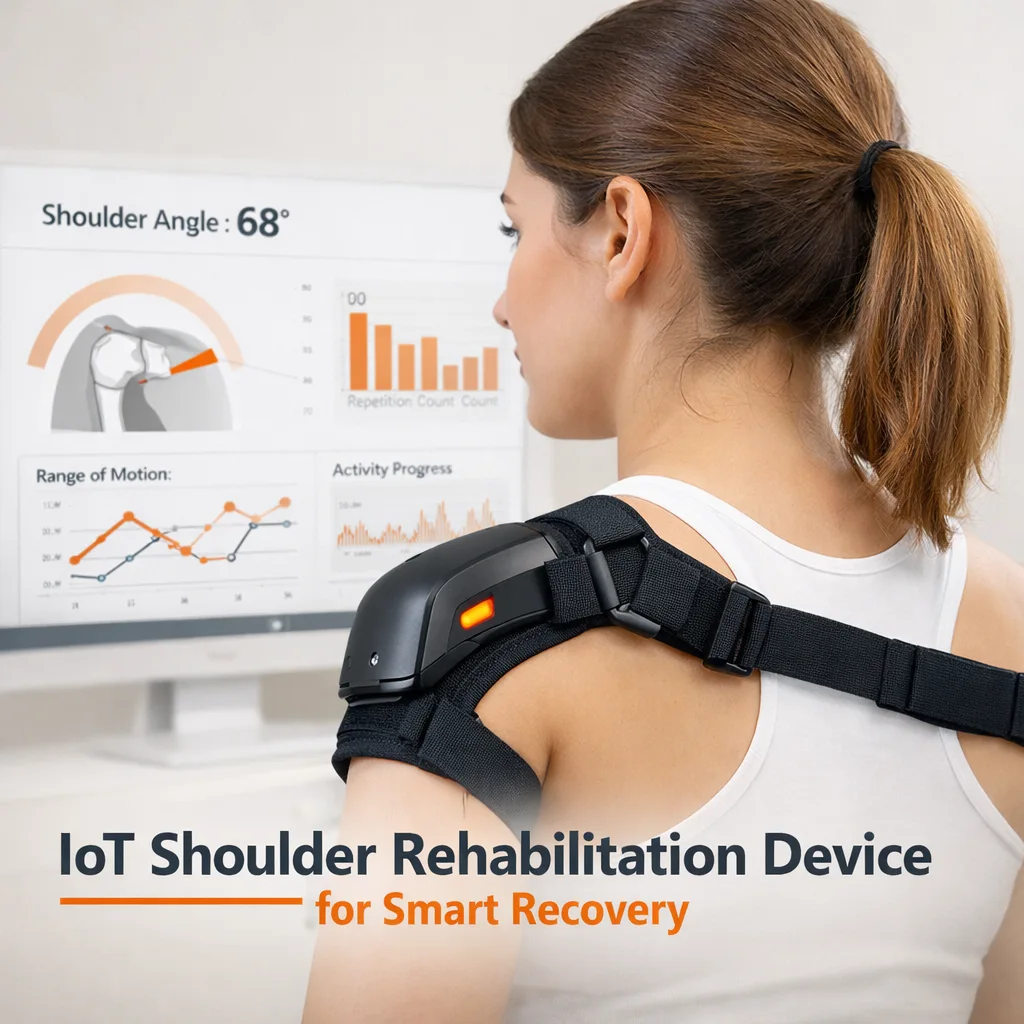
An IoT shoulder rehabilitation device is transforming how clinics, startups, and medical device manufacturers approach musculoskeletal recovery. Instead of relying on manual supervision and subjective assessments, connected shoulder rehabilitation systems now use real-time IoT sensors, cloud analytics, and software-driven insights to deliver measurable, data-backed outcomes.
The shift toward wearable shoulder rehabilitation technology is more than innovation. It is a strategic move toward scalable remote monitoring, regulatory-aligned SaMD integration, and performance-driven care delivery. From rotator cuff injury recovery to post-surgical mobility tracking, smart medical device shoulder recovery platforms are redefining what precision rehabilitation looks like in both clinical and home environments.
As investment in IoT healthcare devices accelerates globally, organizations that engineer cloud-connected rehab tech shoulder systems today will lead the next generation of orthopedic digital health solutions.
Core Technology Behind IoT Shoulder Rehabilitation Devices
An IoT shoulder rehabilitation device is a connected, sensor-driven system designed to monitor, analyze, and optimize shoulder mobility in real time. Unlike traditional pulley systems or passive rehab equipment, a connected shoulder rehabilitation system integrates hardware, embedded firmware, and cloud software to deliver measurable biomechanical insights.
For startups and device manufacturers, this represents the convergence of wearable shoulder rehabilitation technology and Software as a Medical Device capabilities. For clinics and hospitals, it means quantifiable recovery metrics instead of subjective range-of-motion assessments.
At its core, the system captures motion data, transmits it securely to cloud infrastructure, and provides actionable dashboards for clinicians and patients.
Components of a Connected Shoulder Rehabilitation System
A high-performance IoT shoulder rehabilitation system typically includes:
- Wearable IoT rehab modules with IMU sensors
- Gyroscopes and accelerometers for 3D motion capture
- Edge-processing microcontrollers
- Bluetooth Low Energy or Wi-Fi communication modules
- Cloud-based analytics platform
- Clinician dashboard and patient-facing mobile app
The device layer captures shoulder flexion, extension, abduction, and rotation angles with millimeter-level precision. Edge firmware filters noise and pre-processes signals before transmission, ensuring efficient and secure data flow.
How Shoulder Rehab IoT Sensors Capture Motion and Biomechanics?
Modern shoulder rehab IoT sensors rely primarily on inertial measurement units (IMUs), combining:
- 3-axis accelerometers
- 3-axis gyroscopes
- Magnetometers for orientation correction
Sensor fusion algorithms convert raw signals into clinically meaningful metrics such as:
- Range of motion
- Angular velocity
- Movement smoothness
- Repetition accuracy
- Compensation detection
This enables real-time tracking of shoulder rehabilitation programs with objective scoring rather than therapist estimation. For CTOs and product managers, validated biomechanical calibration is a competitive differentiator and a regulatory requirement under FDA and SaMD frameworks.
From Wearable Shoulder Rehabilitation Technology to Cloud Analytics
The true value of an IoT rehab device for shoulder mobility tracking lies in its cloud layer.
Once motion data is transmitted securely, the cloud-connected rehab tech shoulder platform performs:
- Data normalization
- Pattern recognition
- Compliance tracking
- Recovery trend analysis
- AI-based anomaly detection
Clinicians access dashboards that display longitudinal recovery curves, adherence rates, and performance benchmarks. Hospitals can integrate this with EHR systems to streamline documentation and billing workflows.
Why Smart IoT Shoulder Rehab Devices Outperform Traditional Equipment
Traditional shoulder rehabilitation equipment is mechanical, manual, and largely unmeasured. Progress is often evaluated visually by a therapist or through patient-reported feedback. In contrast, an IoT shoulder rehabilitation device delivers quantifiable performance metrics, remote visibility, and continuous optimization.
For hospitals and rehab clinics, this shift means better outcomes with lower operational friction. For startups and device manufacturers, it creates a defensible technology moat built on data, software, and compliance readiness.
Real-Time Tracking in Shoulder Rehabilitation
Real-time tracking of shoulder rehabilitation systems eliminates guesswork.
Using shoulder rehab IoT sensors, the device captures:
- Joint angle precision in degrees
- Velocity and acceleration curves
- Repetition quality and symmetry
- Micro-compensatory movements
Instead of reviewing patient performance days later, clinicians can monitor live sessions through connected dashboards. Alerts can trigger when movement deviates from prescribed parameters, reducing the risk of improper recovery patterns.
Remote Monitoring Shoulder Rehab Devices for Home-Based Care
Home-based recovery is no longer optional. It is expected.
A remote monitoring shoulder rehab device allows patients to perform exercises outside clinical settings while maintaining full clinician oversight. Through secure cloud infrastructure, motion data streams directly into centralized monitoring platforms.
This delivers measurable benefits:
- Increased patient adherence
- Reduced in-clinic visits
- Expanded geographic reach for hospitals
- Lower rehabilitation costs per patient
For enterprises scaling IoT shoulder rehabilitation systems for clinics, this creates new revenue pathways through remote therapeutic monitoring programs, subscription models, and value-based care alignment.
Data-Driven Recovery for Rotator Cuff and Mobility Injuries
Rotator cuff injuries demand precise load management and progressive mobility tracking. IoT rehab equipment for rotator cuff injury recovery provides granular analytics that traditional elastic bands or pulley systems cannot deliver.
With wearable IoT rehab for rotator cuff protocols, clinicians can:
- Monitor external and internal rotation accuracy
- Track incremental range-of-motion gains
- Identify stagnation trends early
- Validate compliance objectively
Clinical shoulder rehab IoT solutions also generate structured datasets that can support outcome studies, payer negotiations, and investor reporting.
Technical Architecture of a Cloud-Connected Rehab Tech Shoulder System
Engineering a scalable IoT shoulder rehabilitation device requires more than sensor integration. It demands a secure, compliant, and extensible architecture that supports real-time analytics, remote monitoring, and regulatory-grade software validation.
A robust connected shoulder rehabilitation system typically operates across four layers:
- Device layer
- Edge computing layer
- Cloud infrastructure layer
- Application and analytics layer
Each layer must be optimized for accuracy, latency, and compliance.
Medical IoT Sensors for Remote Shoulder Rehabilitation
The device layer begins with high-fidelity medical IoT sensors for remote shoulder rehabilitation.
Key components include:
- Multi-axis IMUs for 3D kinematic tracking
- Surface EMG sensors for muscle activation feedback
- Force or tension sensors for resistance-based exercises
- Temperature and battery monitoring modules
Sensor placement is biomechanically calibrated to capture shoulder flexion, abduction, adduction, and rotation with clinical precision. Signal filtering techniques such as Kalman filtering and sensor fusion algorithms eliminate drift and noise.
For device manufacturers, validated sensor accuracy is not optional. It supports regulatory submissions, clinical trials, and product differentiation in a competitive wearable shoulder rehabilitation technology market.
Edge Processing vs Cloud Processing in Rehab Devices
Edge processing plays a critical role in reducing latency and bandwidth consumption.
At the edge layer, embedded firmware performs:
- Signal preprocessing
- Data compression
- Motion event detection
- Immediate patient feedback generation
This ensures real-time responsiveness even in low-connectivity environments.
The cloud layer then handles:
- Longitudinal recovery modeling
- Population-level analytics
- Machine learning training pipelines
- Secure storage compliant with HIPAA and global data standards
For global and USA deployments, cloud architecture must align with data residency requirements and healthcare security regulations. Scalable microservices architecture enables multi-clinic rollout without performance degradation.
For investors, this layered approach transforms a smart shoulder rehab device into a scalable digital health infrastructure asset.
AI Algorithms for Shoulder Mobility Tracking and Compliance
The competitive edge of an IoT rehab device for shoulder mobility tracking lies in its intelligence layer.
AI-driven analytics can deliver:
- Automated range-of-motion scoring
- Repetition quality classification
- Compensation pattern detection
- Predictive recovery timelines
- Non-compliance alerts
Machine learning models trained on aggregated rehabilitation datasets allow the system to continuously refine therapeutic recommendations.
Clinical Benefits of IoT Shoulder Rehab Devices
For hospitals, rehab clinics, and orthopedic programs, technology adoption must translate into measurable clinical improvement. An IoT shoulder rehabilitation device delivers quantifiable gains in adherence, outcome tracking, and therapeutic precision.
Unlike passive rehabilitation tools, clinical shoulder rehab IoT solutions create structured datasets that support evidence-based care and operational transparency.
Improved Patient Adherence Through Smart Feedback
Non-compliance remains one of the largest barriers in musculoskeletal recovery. Patients often underperform exercises or abandon programs entirely once outside clinical supervision.
A remote monitoring shoulder rehab device addresses this through:
- Real-time corrective feedback during exercises
- Automated reminders and structured therapy schedules
- Performance scoring visible to both clinician and patient
- Gamified progress indicators to increase engagement
By integrating wearable shoulder rehabilitation technology with mobile applications, patients receive immediate reinforcement when movements are executed correctly and alerts when compensatory motion occurs.
Quantifiable Outcome Measurement for Clinical Directors
Objective metrics drive better clinical decisions.
An IoT rehab device for shoulder mobility tracking enables:
- Continuous range-of-motion progression graphs
- Velocity and control stability scoring
- Session-by-session performance comparison
- Data export for clinical documentation
Instead of relying on periodic manual goniometer measurements, clinicians can evaluate recovery trajectories in near real time.
This also strengthens payer negotiations and quality reporting. Quantified improvements in shoulder flexion, abduction, and rotational capacity provide defensible evidence of therapeutic effectiveness.
For enterprises deploying IoT shoulder rehabilitation systems for clinics, this data becomes a strategic asset supporting research publications and outcome validation.
Evidence from Wearable Motion Tracking Studies
Clinical studies on wearable motion sensors have demonstrated improved monitoring accuracy, better compliance visibility, and measurable functional gains in shoulder rehabilitation scenarios.
When applied to rotator cuff injury recovery and post-surgical protocols, wearable IoT rehab for rotator cuff programs provides:
- Early detection of plateau phases
- Reduced risk of overexertion
- Structured progression tracking
The clinical benefits of IoT shoulder rehab devices extend beyond convenience. They create a closed feedback loop between patient performance and clinician intervention.
Regulatory and SaMD Considerations for IoT Shoulder Rehabilitation Systems
For any IoT shoulder rehabilitation device operating in the United States or global markets, regulatory alignment is not optional. It determines market access, reimbursement eligibility, investor confidence, and long-term scalability.
When wearable shoulder rehabilitation technology incorporates software-driven diagnostics, performance scoring, or therapeutic recommendations, it may qualify as Software as a Medical Device. That classification significantly impacts the development lifecycle, validation, and documentation requirements.
For CTOs and founders, regulatory strategy must be embedded into architecture from day one.
FDA Medical Device Classes and Approval Pathways
In the US, smart medical device shoulder recovery platforms are typically evaluated under FDA medical device classifications.
Depending on intended use and risk profile, a connected shoulder rehabilitation system may fall under:
- Class I for low-risk therapeutic exercise tools
- Class II if incorporating performance monitoring, biofeedback, or therapeutic guidance requiring 510(k) clearance
When AI algorithms influence therapy recommendations or recovery scoring, additional scrutiny may apply.
Organizations developing IoT rehab equipment for rotator cuff injury recovery must:
- Define intended use clearly
- Conduct risk analysis under ISO 14971
- Perform verification and validation testing
- Maintain design history files and traceability
A clear understanding of the FDA medical device classes and approval process strengthens commercialization strategy and reduces time-to-market risk.
IEC 62304 and Medical Device Software Lifecycle Compliance
If the IoT rehab device includes embedded firmware, mobile apps, or cloud analytics influencing clinical decisions, IEC 62304 compliance becomes critical.
The IEC 62304 medical device software lifecycle standard defines requirements for:
- Software safety classification
- Architecture documentation
- Unit and integration testing
- Risk control traceability
- Maintenance and update management
For engineering teams building cloud-connected rehab tech shoulder platforms, compliance ensures software reliability and regulatory defensibility.
Understanding what IEC 62304 is and why it matters allows product leaders to structure development pipelines that align with global regulatory expectations, including MDR in Europe.
For investors, adherence to software lifecycle standards signals operational maturity and reduces regulatory risk exposure.
Data Security, HIPAA, and Global Regulatory Considerations
Because remote monitoring shoulder rehab devices transmit protected health information, cybersecurity architecture must meet stringent standards.
US deployments require:
- HIPAA-compliant data encryption
- Secure authentication and role-based access control
- Audit logging and breach response protocols
Globally, GDPR and regional data residency regulations may apply.
Engineering secure IoT healthcare devices requires:
- End-to-end encryption from device to cloud
- Secure firmware updates
- Vulnerability testing and penetration audits
- Zero-trust network architecture
For hospitals and enterprises, security posture directly influences procurement decisions.
A compliant, secure, and well-documented IoT shoulder rehabilitation system not only protects patients but also strengthens enterprise sales conversations and accelerates institutional adoption.
What Clinicians and CTOs Should Consider Before Choosing an IoT Rehab Device
Selecting an IoT shoulder rehabilitation device is a strategic technology decision, not just a procurement exercise. For hospitals, rehab clinics, and MedTech startups, the right platform must deliver biomechanical precision, regulatory readiness, and long-term scalability.
A poorly architected system can create compliance risk, integration bottlenecks, and limited clinical value. A well-engineered connected shoulder rehabilitation system becomes a competitive differentiator.
Sensor Accuracy and Biomechanical Validation
At the foundation of any wearable IoT rehab for rotator cuff or mobility therapy program is sensor reliability.
Decision-makers should evaluate:
- IMU calibration methodology
- Drift correction algorithms
- Clinical validation studies
- Range-of-motion measurement error margins
- Repeatability across patient populations
Medical IoT sensors for remote shoulder rehabilitation must demonstrate consistent angular accuracy and movement classification under real-world conditions, not just laboratory environments.
Interoperability with EHR and Telehealth Platforms
A remote monitoring shoulder rehab device should not operate in isolation.
Enterprise-grade systems must support:
- HL7 or FHIR-based EHR integration
- API access for third-party telehealth platforms
- Secure cloud data export
- Multi-user role management
Hospitals increasingly require interoperability before approving new digital tools. Without integration capability, even advanced IoT rehab equipment for rotator cuff injury recovery may face adoption resistance.
Scalability for Multi-Clinic Deployment
Startups and device manufacturers must think beyond single-site deployment.
A scalable IoT shoulder rehabilitation system for clinics should offer:
- Cloud-native infrastructure
- Multi-tenant architecture
- Remote firmware update capability
- Centralized device fleet management
- Usage analytics across facilities
For enterprises and investors, scalability directly impacts valuation. Subscription-based analytics, remote therapeutic monitoring, and cross-clinic benchmarking create recurring revenue opportunities.
A truly enterprise-ready smart shoulder rehab device is not just wearable hardware. It is a connected digital health platform capable of global rollout with regulatory alignment and operational efficiency.
Cost of Smart Shoulder Rehab Devices and ROI for Clinics
For decision-makers, adoption of an IoT shoulder rehabilitation device must be financially justified. While upfront costs exceed traditional mechanical rehab tools, the long-term return on investment is significantly higher when deployed strategically.
For hospitals, rehab networks, and digital health startups, cost should be evaluated across hardware, software, compliance, and revenue expansion potential.
Device Cost Breakdown
A smart shoulder rehab device typically includes:
- Wearable hardware unit with medical IoT sensors
- Embedded firmware and edge-processing module
- Mobile application for patients
- Clinician dashboard and analytics platform
- Cloud hosting and security infrastructure
- Regulatory and compliance documentation costs
Depending on feature depth and regulatory classification, pricing may range from mid three-figure per-unit hardware costs to subscription-based enterprise SaaS models.
Vendors offering IoT shoulder rehabilitation systems for clinics increasingly adopt hybrid models:
- Hardware purchase or lease
- Monthly analytics subscription
- Remote monitoring service fees
For startups, this model creates recurring revenue rather than one-time equipment sales.
Revenue Expansion Through Remote Monitoring
In the US market, connected wearable IoT solutions align with remote therapeutic monitoring reimbursement pathways.
By leveraging real-time tracking shoulder rehabilitation data, clinics can:
- Justify remote monitoring billing
- Expand services beyond geographic constraints
- Offer premium data-driven rehab programs
- Improve value-based care performance metrics
For founders and investors, the economics are compelling. A cloud-connected rehab tech shoulder platform generates:
- Subscription revenue
- Data-driven service upgrades
- Enterprise licensing opportunities
- Long-term patient engagement retention
An IoT rehab device for shoulder mobility tracking is not merely equipment. It is a scalable healthcare technology asset capable of driving both clinical improvement and sustainable revenue growth.
Best IoT Wearable Devices for Shoulder Rehabilitation
The market for wearable shoulder rehabilitation technology is expanding rapidly. For CTOs, clinical directors, and procurement leaders, evaluating the right IoT shoulder rehabilitation device requires comparing sensor accuracy, analytics depth, regulatory readiness, and integration capabilities.
Below are the leading categories and representative device types shaping the smart medical device shoulder recovery landscape.
1. IMU-Based Wearable Motion Tracking Devices
These are the most common IoT rehab devices for shoulder mobility tracking.
Core Features
- Multi-axis IMU sensors
- Bluetooth Low Energy connectivity
- Mobile app–based exercise guidance
- Real-time tracking shoulder rehabilitation metrics
Best For
- Post-surgical mobility tracking
- Rotator cuff rehabilitation
- Home-based therapy monitoring
2. EMG-Integrated Smart Rehab Wearables
These devices combine motion tracking with electromyography to monitor muscle activation patterns.
Core Features
- IMU + surface EMG sensors
- Muscle engagement analytics
- Fatigue detection
- AI-assisted recovery scoring
Best For
- High-performance sports rehabilitation
- Post-operative neuromuscular retraining
- Research-grade clinical shoulder rehab IoT solutions
3. Exoskeleton-Assisted IoT Shoulder Systems
More advanced connected shoulder rehabilitation systems incorporate robotic assistance.
Core Features
- Motor-assisted range-of-motion support
- Adaptive resistance
- Sensor-driven force feedback
- Cloud-based performance analytics
Best For
- Severe mobility limitations
- Stroke or neurological rehabilitation
- Institutional hospital deployment
These systems often require Class II regulatory pathways and robust software lifecycle compliance under IEC 62304 medical device software lifecycle standards.
4. Multi-Sensor Clinical IoT Platforms
Enterprise-grade platforms combine:
- Motion tracking
- Load sensing
- Cloud analytics
- EHR integration
- Multi-patient dashboard management
These IoT shoulder rehabilitation systems for clinics are built for scale. They enable fleet management, centralized monitoring, and data-driven performance benchmarking across facilities.
For buyers evaluating the best IoT wearable devices for shoulder rehabilitation, the decision framework should prioritize:
- Sensor precision and validation
- Cloud architecture scalability
- Regulatory readiness
- Cybersecurity compliance
- Interoperability
- Subscription revenue potential
The Future of IoT Healthcare Devices in Orthopedic Rehabilitation
The next evolution will extend beyond tracking into predictive and autonomous rehabilitation systems.
AI-Driven Predictive Recovery Models
Machine learning models trained on aggregated shoulder rehabilitation datasets can:
- Predict recovery plateaus
- Adjust therapy intensity automatically
- Identify early non-compliance risks
- Personalize exercise progression
For investors, predictive analytics increases defensibility and enterprise valuation.
Digital Twin Applications in Shoulder Rehab
Emerging platforms are experimenting with digital twin modeling, where a virtual representation of a patient’s shoulder biomechanics is created using sensor data.
This enables:
- Simulation-based therapy planning
- Stress analysis during movement
- Risk mitigation before injury aggravation
Such capabilities elevate wearable IoT rehab for rotator cuff and post-operative care into precision medicine territory.
Investment Trends in Connected Rehab Technology
Global funding in connected wearable IoT solutions continues to grow, driven by:
- Aging populations
- Remote care demand
- Value-based reimbursement models
- Expansion of Software as a Medical Device markets
Engineering the Next Generation of Connected Shoulder Rehabilitation
The evolution of the IoT shoulder rehabilitation device marks a structural shift in musculoskeletal care. Clinics gain measurable outcomes. CTOs gain scalable architecture. Founders gain recurring revenue models. Investors gain defensible, data-driven healthcare platforms.
As connected care becomes the standard, organizations that deploy secure, compliant, and AI-powered IoT shoulder rehabilitation systems will define the future of orthopedic recovery.
To build scalable, regulatory-ready medical IoT solutions, explore how our team at CitrusBits engineers secure, cloud-connected healthcare platforms.
Table of Contents
1) Core Technology Behind IoT Shoulder Rehabilitation Devices
2) Why Smart IoT Shoulder Rehab Devices Outperform Traditional Equipment
3) Technical Architecture of a Cloud-Connected Rehab Tech Shoulder System
4) Clinical Benefits of IoT Shoulder Rehab Devices
5) Regulatory and SaMD Considerations for IoT Shoulder Rehabilitation Systems
6) What Clinicians and CTOs Should Consider Before Choosing an IoT Rehab Device
7) Cost of Smart Shoulder Rehab Devices and ROI for Clinics
8) Best IoT Wearable Devices for Shoulder Rehabilitation
9) The Future of IoT Healthcare Devices in Orthopedic Rehabilitation
10) Engineering the Next Generation of Connected Shoulder Rehabilitation
Innovate the Future of Health Tech
CitrusBits helps MedTech leaders build smarter apps, connected devices, and XR health solutions that truly make an impact.
