


Blog
How Medical XR, AI, and Extended Reality Are Transforming Healthcare
Healthcare XR solutions are rapidly redefining how medical technology is designed, deployed, and scaled across modern healthcare systems. From medical XR platforms used in surgical planning to AI and XR in healthcare powering intelligent diagnostics, extended reality is no longer experimental; it is becoming a core component of regulated, enterprise-grade healthcare innovation.
Today, XR in healthcare spans far beyond immersive visuals. Organizations are using VR in healthcare for medical training and rehabilitation therapy, AR in healthcare for real-time surgical guidance, and mixed reality in healthcare to enable complex clinical workflows and medical device interactions.
When combined with data intelligence and compliance-driven development, extended reality in healthcare unlocks measurable clinical outcomes, operational efficiency, and scalable patient engagement.
What Is Medical XR in Healthcare?
Medical XR refers to the use of extended reality technologies, such as virtual reality (VR), augmented reality (AR), and mixed reality (MR), to enhance clinical workflows, medical device functionality, patient care, and healthcare education. Unlike consumer XR, XR in healthcare operates within regulated environments and must meet strict requirements for safety, data security, usability, and clinical validation.
In practical terms, XR med solutions enable healthcare organizations to visualize complex medical data, simulate procedures, guide interventions, and improve decision-making across the care continuum. These extended reality healthcare applications are increasingly embedded into healthcare XR platforms used by hospitals, MedTech companies, and digital health startups.
What distinguishes extended reality in healthcare from traditional medical software is its immersive and interactive nature. Instead of relying solely on 2D screens and static interfaces, medical XR allows clinicians to engage with 3D anatomy, device data, and patient-specific insights in real time, creating more intuitive and effective extended medical workflows.
As adoption grows, medical XR is no longer limited to pilot projects. It is becoming a foundational layer for XR medical device development, XR healthcare product development, and regulated SaMD XR solutions designed to scale across enterprise healthcare systems.
Types of Healthcare XR Solutions: VR, AR, and Mixed Reality
Modern healthcare XR solutions are typically built on one or more XR modalities, each serving distinct clinical and operational needs. Understanding these differences is critical when designing or investing in medical XR platforms.
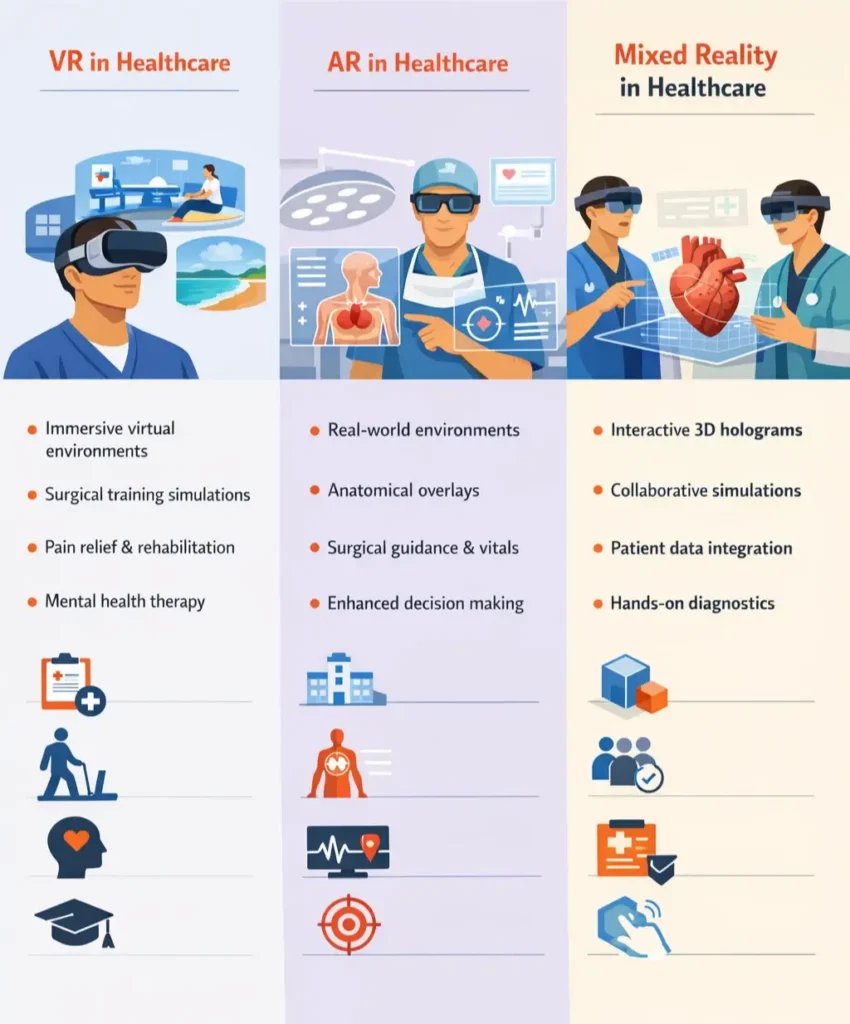
1. VR in Healthcare
VR in healthcare uses fully immersive virtual environments to simulate real-world scenarios or therapeutic experiences. It is widely adopted for:
- XR for medical training and education, enabling clinicians to practice procedures in risk-free environments
- XR rehabilitation therapy, supporting physical, neurological, and cognitive recovery
- Pain management, mental health therapy, and patient education
VR-based healthcare XR solutions are particularly effective when repeatability, immersion, and controlled simulation are required. These applications often integrate with analytics and AI to personalize treatment and training outcomes.
2. AR in Healthcare
AR in healthcare overlays digital information, such as anatomical structures, device data, or procedural guidance, onto the physical world. This modality is commonly used in:
- XR surgical planning and intraoperative guidance
- Diagnostic visualization and real-time decision support
- Medical device interaction and calibration
By enhancing real-world perception rather than replacing it, AR plays a critical role in XR surgical planning solutions and precision-driven clinical workflows. It is especially valuable for surgeons and interventional specialists who need contextual information without losing situational awareness.
3. Mixed Reality in Healthcare
Mixed reality in healthcare combines elements of both VR and AR, allowing users to interact with digital objects anchored in the physical environment. MR is increasingly used for:
- Complex procedural planning and collaboration
- Multidisciplinary care coordination
- Advanced healthcare XR platforms that integrate hardware, software, and real-time data
MR enables teams to manipulate 3D models of organs, devices, or patient data collaboratively, making it a powerful tool for both clinical and commercial healthcare XR solutions.
Extended Reality Images, 3D Visualization, and Medical Imaging
One of the most impactful aspects of extended reality in healthcare is the ability to work with extended reality images and 3D visualizations derived from medical imaging data. XR transforms traditional scans, such as CT, MRI, and ultrasound, into interactive, spatial representations that clinicians can explore from multiple perspectives.
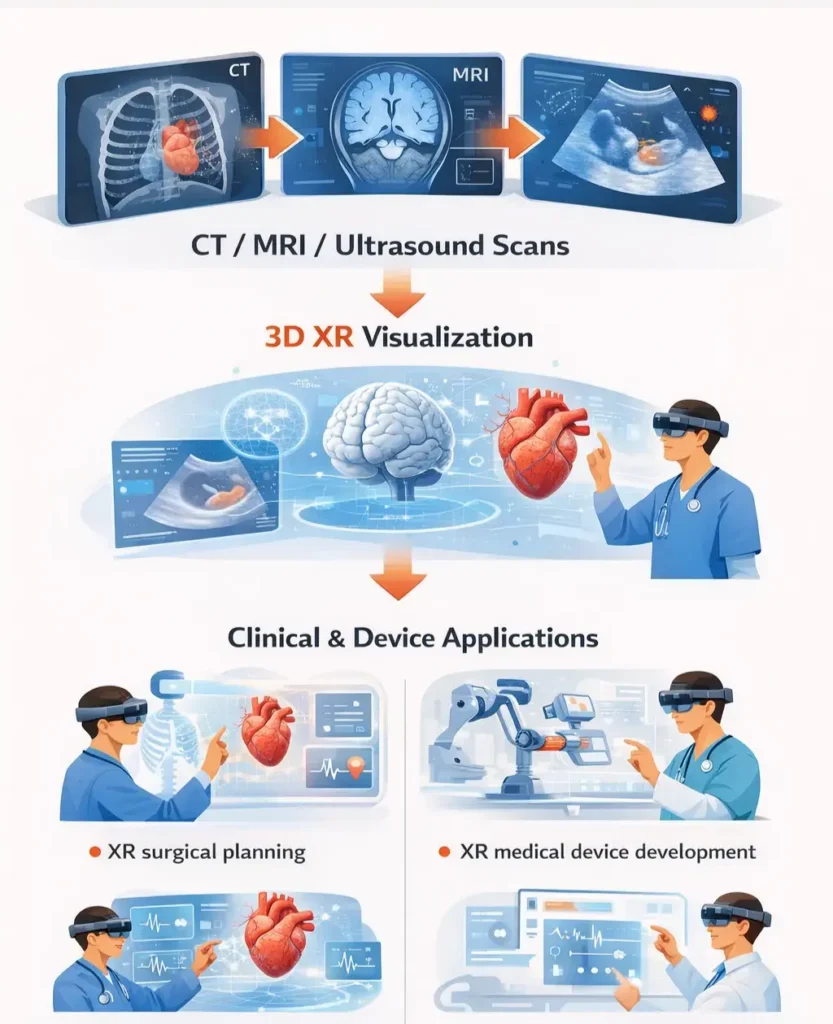
These extended reality healthcare applications improve understanding of complex anatomy, enhance preoperative planning, and support more informed clinical decisions. In XR surgical planning, 3D visualization helps reduce uncertainty by allowing surgeons to rehearse procedures using patient-specific data before entering the operating room.
For medical device manufacturers and digital health companies, XR-powered visualization also plays a key role in XR medical device development. Interactive models can be used to test device ergonomics, simulate real-world usage, and demonstrate value to clinicians and stakeholders.
As healthcare organizations increasingly adopt data-driven care models, extended reality images are becoming tightly integrated with analytics and AI, bridging visual insight with predictive intelligence and reinforcing the value of scalable healthcare XR solutions.
Key Healthcare XR Applications Driving Clinical and Business Value
The rapid adoption of healthcare XR solutions is being driven by tangible clinical outcomes and measurable business impact. Medical XR is no longer limited to experimentation—it is now embedded into core healthcare workflows across devices, software, and patient care.
XR Medical Device Development
XR medical device development is transforming how medical devices are designed, validated, and deployed. By integrating XR into device ecosystems, manufacturers can enhance usability, training, and clinical accuracy.
Common applications include:
- XR-enabled companion software for connected medical devices
- Interactive visualization of device behavior and patient data
- Simulation environments for testing ergonomics and clinical workflows
As many XR-enabled devices qualify as regulated software, teams must ensure compliance with standards governing regulated healthcare XR software and SaMD XR solutions. Medical XR platforms built for device manufacturers must balance innovation with safety, traceability, and regulatory readiness, especially when XR is central to diagnosis or treatment decisions.
XR Healthcare Product Development
Successful XR healthcare product development requires more than immersive visuals. It demands a deep understanding of clinical users, regulatory constraints, and interoperability within complex healthcare ecosystems.
High-performing healthcare XR platforms typically focus on:
- Clinician-first UX and workflow integration
- Secure handling of sensitive medical data
- Scalability across hospitals, clinics, and remote care environments
For digital health companies and SaMD innovators, XR adds a new dimension to engagement and differentiation. When designed correctly, XR healthcare product development enhances adoption while meeting the rigorous expectations of healthcare providers and regulators.
XR Surgical Planning Solutions
XR surgical planning is one of the most mature and high-impact uses of medical XR today. By leveraging 3D visualization, spatial data, and real-time interaction, XR surgical planning solutions allow surgeons to prepare for complex procedures with greater confidence and precision.
Benefits include:
- Improved anatomical understanding using patient-specific data
- Reduced intraoperative risk and variability
- Better collaboration across surgical teams
These solutions are increasingly combined with AI-driven insights and analytics, enabling predictive modeling and outcome optimization within extended reality healthcare applications.
XR Rehabilitation Therapy and Patient Engagement
XR rehabilitation therapy is reshaping how patients recover from injury, surgery, and neurological conditions. Immersive environments motivate patients, track progress, and personalize therapy programs, whether delivered in clinical settings or remotely.
In addition to rehabilitation, XR patient engagement solutions are being used to:
- Educate patients about procedures and treatment plans
- Improve adherence to therapy protocols
- Support virtual care and long-term condition management
By combining XR with connected devices and data analytics, healthcare organizations can deliver more engaging, measurable, and scalable care experiences, making XR a key component of modern healthcare.
AI and XR in Healthcare: Intelligent, Adaptive Medical XR Platforms
The convergence of AI and XR in healthcare is accelerating the evolution of medical XR from static visualization to intelligent, adaptive systems. AI enhances XR experiences by analyzing large volumes of clinical data and dynamically adjusting what clinicians and patients see in real time.
Key capabilities include:
- AI-assisted diagnostics within XR environments
- Predictive insights layered onto XR surgical planning
- Adaptive rehabilitation programs based on patient performance
When integrated into healthcare XR platforms, AI enables more personalized care, better clinical decision-making, and continuous learning across systems. This combination is particularly powerful for SaMD products, where analytics, automation, and immersion must work together within regulated frameworks.
Regulated Healthcare XR Software and SaMD Considerations
As XR becomes embedded in clinical decision-making, many solutions qualify as regulated medical software. Regulated healthcare XR software must comply with standards governing safety, effectiveness, data privacy, and lifecycle management.
For companies developing SaMD XR solutions, key considerations include:
- Regulatory classification and risk assessment
- Clinical validation and usability testing
- Secure data pipelines and auditability
Understanding the distinction between XR-enabled SaMD and traditional medical software is critical for successful commercialization. Organizations building medical XR solutions must align innovation with compliance from the earliest stages of development to ensure scalability and market approval.
Choosing the Right Healthcare XR Platform
Selecting the right healthcare XR platform is a strategic decision that impacts clinical outcomes, regulatory compliance, and long-term scalability. Not all XR solutions are designed for the complexity and constraints of healthcare environments, which is why medical organizations must evaluate platforms beyond visual capabilities alone.
Key factors to consider include:
- Regulatory readiness: The platform must support the development of regulated healthcare XR software and SaMD XR solutions, including documentation, validation, and audit trails.
- Interoperability: Seamless integration with EHRs, medical devices, and analytics systems is essential for real-world adoption.
- Security and privacy: Healthcare XR solutions must comply with HIPAA, GDPR, and other data protection standards.
- Scalability: From pilot programs to enterprise deployment, the platform should support growth across multiple care settings.
For MedTech companies and digital health startups, partnering with an experienced development team can significantly reduce risk and accelerate time to market, especially when building custom XR medical device development or XR healthcare product development initiatives
Challenges of Implementing XR in Healthcare (and How to Overcome Them)
Despite its potential, XR in healthcare presents unique challenges that must be addressed to ensure successful adoption and commercialization.

Technical and Infrastructure Challenges
Healthcare environments often rely on legacy systems, making integration with modern healthcare XR solutions complex. Addressing this requires modular architectures, cloud readiness, and strong interoperability planning.
Clinical Adoption and Usability
Medical XR solutions must fit seamlessly into existing clinical workflows. Poor UX or unclear value propositions can limit adoption, especially among clinicians under time pressure.
Regulatory and Compliance Complexity
Developing regulated healthcare XR software and SaMD XR solutions requires early alignment with regulatory standards. Teams must plan for validation, risk management, and ongoing compliance from day one.
Cost and ROI Considerations
Healthcare organizations need clear evidence of value. XR implementations that demonstrate improved outcomes, efficiency, or patient engagement are far more likely to scale.
By addressing these challenges strategically, organizations can unlock the full potential of extended reality healthcare applications and build sustainable, compliant solutions.
Why MedTech and Healthcare Companies Partner for Medical XR Development
As medical XR continues to evolve, many organizations choose to partner rather than build everything in-house. Experienced partners bring cross-functional expertise spanning healthcare UX, regulatory strategy, AI integration, and XR engineering.
Partnership-driven healthcare XR solutions enable companies to:
- Accelerate XR medical device development
- Build scalable XR healthcare product development pipelines
- Integrate AI and XR in healthcare responsibly
- Navigate regulatory requirements with confidence
For SaMD innovators, medical device manufacturers, and digital health companies, collaboration reduces risk while ensuring solutions are built for real-world healthcare deployment, not just technical novelty.
The Bottom Line
The future of healthcare is immersive, intelligent, and data-driven. From VR in healthcare and AR in healthcare to mixed reality in healthcare, medical XR is reshaping how care is delivered, experienced, and scaled. When combined with AI, analytics, and regulatory-ready development, healthcare XR solutions unlock new possibilities across medical devices, training, rehabilitation, and patient engagement.
Organizations that invest in extended reality in healthcare today are positioning themselves for long-term innovation and competitive advantage. Whether you are developing SaMD products, launching XR-enabled medical devices, or modernizing digital health platforms, success depends on building solutions that are compliant, scalable, and clinically meaningful.
To explore how CitrusBits healthcare XR and MedTech solutions can support your next medical XR initiative, from strategy and design to development and compliance, visit https://citrusbits.com/
FAQs
Q: How effective is XR rehabilitation therapy?
Ans: XR rehabilitation therapy has proven effective in physical, neurological, and cognitive rehabilitation. Immersive XR environments increase patient engagement, enable progress tracking, and support personalized therapy programs, both in-clinic and remotely, making them valuable components of modern digital health strategies.
Q: Are healthcare XR platforms secure and compliant?
Ans: Enterprise-grade healthcare XR platforms are designed with security, privacy, and compliance in mind. They must support HIPAA and GDPR requirements, secure data handling, and validation processes, especially when deployed as regulated healthcare XR software or SaMD products.
Q: Is extended reality in healthcare a long-term investment?
Ans: Yes. Extended reality in healthcare is evolving into a foundational technology for medical innovation. As XR becomes integrated with AI, analytics, and connected devices, healthcare organizations adopting XR today are better positioned for scalable growth, improved outcomes, and competitive advantage.
Table of Contents
1) What Is Medical XR in Healthcare?
2) Types of Healthcare XR Solutions: VR, AR, and Mixed Reality
3) Extended Reality Images, 3D Visualization, and Medical Imaging
4) Key Healthcare XR Applications Driving Clinical and Business Value
5) AI and XR in Healthcare: Intelligent, Adaptive Medical XR Platforms
6) Regulated Healthcare XR Software and SaMD Considerations
7) Choosing the Right Healthcare XR Platform
8) Challenges of Implementing XR in Healthcare (and How to Overcome Them)
9) Why MedTech and Healthcare Companies Partner for Medical XR Development
10) The Bottom Line
Innovate the Future of Health Tech
CitrusBits helps MedTech leaders build smarter apps, connected devices, and XR health solutions that truly make an impact.
