


Blog
IoT Healthcare Devices: From Product Design to Secure Deployment
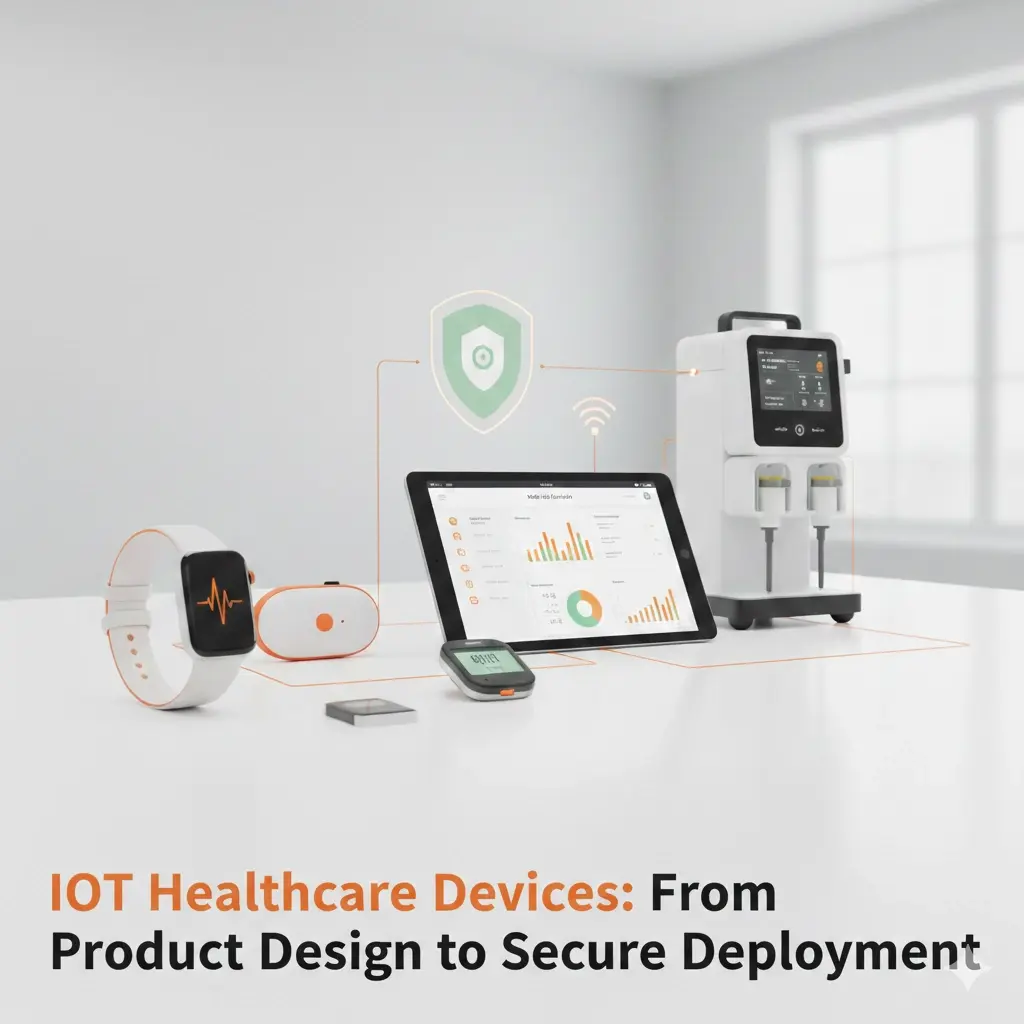
IoT healthcare devices are rapidly reshaping how care is delivered, monitored, and scaled across modern healthcare systems. From connected medical devices in hospitals to remote patient monitoring tools at home, the Internet of Things is enabling healthcare organizations to collect real-time data, improve outcomes, and operate more efficiently.
For CTOs, Product Managers, and Founders in healthcare and medtech, IoT is no longer experimental. It is a foundational technology driving smarter clinical workflows, data-driven decision-making, and next-generation digital health products. At the same time, building and deploying IoT devices in healthcare comes with unique challenges, including regulatory compliance, security, and product design complexity.
What Is IoT in Healthcare?
IoT in healthcare refers to a network of connected medical devices, sensors, software applications, and cloud systems that collect and exchange health data automatically. These devices communicate with each other and with centralized platforms to enable continuous monitoring, analysis, and action without manual intervention.
In practical terms, IoT allows healthcare organizations to move from episodic care to continuous, data-driven care. Instead of relying only on in-person visits or manual reporting, clinicians can access real-time insights from connected devices wherever the patient is located.
What Are the 4 Main Components of IoT?
Every IoT healthcare system is built on four core components:
Devices and Sensors: These include wearables, medical devices, imaging equipment, and embedded sensors that collect patient or operational data.
Connectivity: Data is transmitted through Wi-Fi, cellular, Bluetooth, or LPWAN networks to ensure secure and reliable communication.
Data Processing and Cloud Platforms: Cloud-based systems store, process, and analyze incoming data, often integrating with EHRs and clinical dashboards.
User Interfaces and Applications: Dashboards, mobile apps, and clinician portals present actionable insights to healthcare professionals and patients.
Together, these components form the backbone of IoT healthcare devices and solutions.
What Are the 4 Types of IoT?
IoT applications are commonly grouped into four categories, all of which play a role in healthcare:
Consumer IoT: Wearables and home health devices used directly by patients for monitoring vitals and wellness.
Medical IoT: Regulated IoT medical devices used for diagnosis, treatment, and clinical monitoring.
Commercial IoT: Systems that support hospital operations, asset tracking, and facility management.
Industrial IoT: Infrastructure-focused IoT used in manufacturing and large-scale medical device production.
In healthcare, these types often overlap, creating integrated ecosystems that connect patients, providers, and care environments.
What Are IoT Healthcare Devices?
IoT healthcare devices are connected medical and health-related tools that collect, transmit, and analyze data to support clinical care, patient monitoring, and healthcare operations. These devices use sensors and software to communicate with cloud platforms and healthcare systems in real time, enabling faster decisions and more proactive care delivery.
Unlike traditional medical devices that operate in isolation, IoT healthcare devices are designed to work as part of an interconnected ecosystem. They integrate with electronic health records, analytics platforms, and mobile applications to provide continuous visibility into patient health and system performance.
Examples range from wearable health monitors and smart infusion pumps to connected imaging systems and hospital asset trackers. Together, these IoT devices in healthcare help organizations improve patient outcomes while reducing operational inefficiencies
IoT Devices Used in Healthcare
IoT devices used in healthcare generally fall into three functional categories:
Patient-focused devices
Wearables, remote monitoring tools, and implantable devices that track vital signs such as heart rate, glucose levels, and oxygen saturation.
Clinical and hospital devices
Connected medical equipment, such as smart beds, infusion pumps, ventilators, and diagnostic tools used in care settings.
Operational and infrastructure devices
Asset tracking tags, environmental sensors, and facility monitoring systems that improve logistics, safety, and compliance.
These healthcare IoT devices generate continuous data streams that enable clinicians and administrators to act before issues escalate.
What Are the 7 Levels of IoT Architecture?
Understanding IoT architecture is essential when designing scalable and compliant healthcare solutions. A typical IoT healthcare system can be viewed across seven levels:
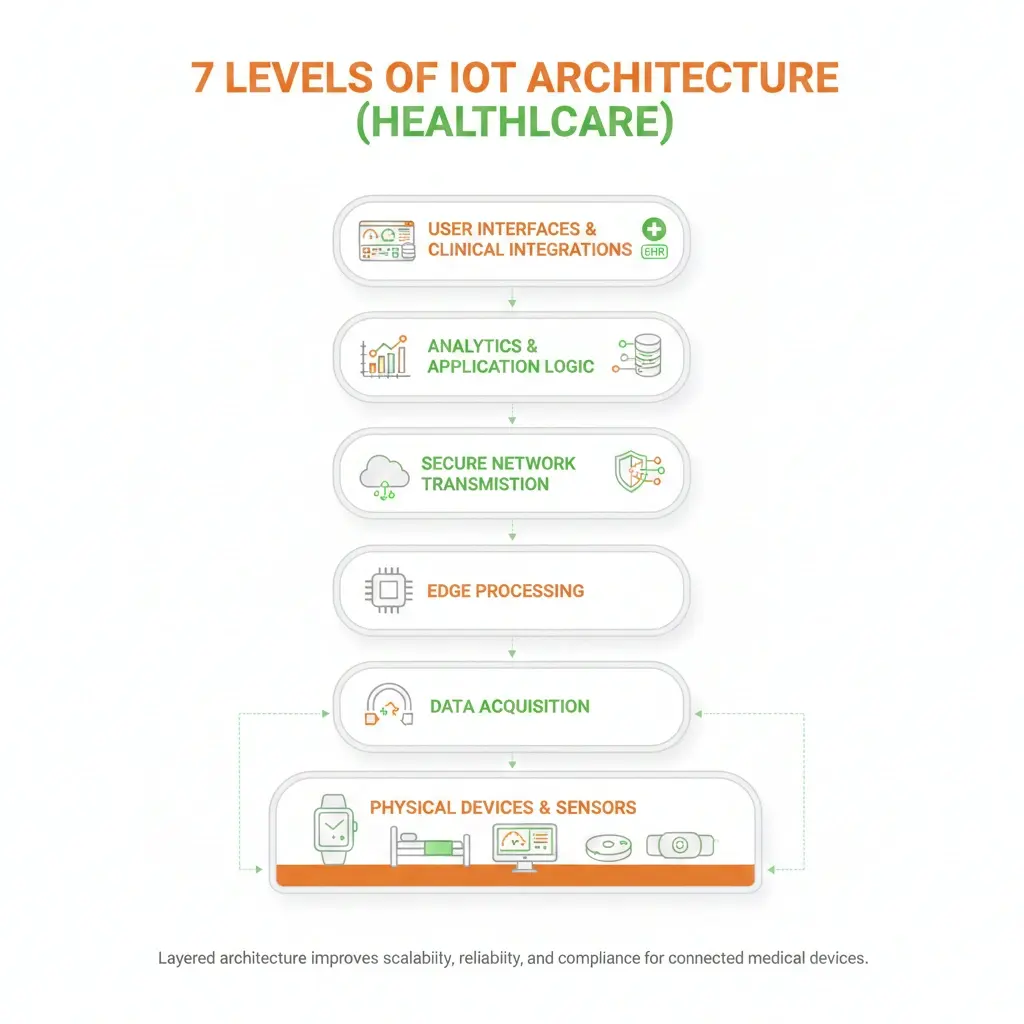
- Physical devices and sensors that collect raw data
- Data acquisition systems that aggregate sensor inputs
- Edge processing for real-time filtering and decision-making
- Data transmission via secure networks
- Cloud data ingestion and storage
- Analytics and application logic
- User interfaces and integrations with clinical systems
This layered approach helps healthcare organizations manage complexity, ensure reliability, and maintain compliance across connected medical devices.
IoT Healthcare Device Examples
IoT healthcare devices are already in active use across hospitals, clinics, and home care environments. These examples illustrate how IoT delivers tangible value in real-world healthcare settings.
IoT Devices for Remote Patient Monitoring
Remote patient monitoring is one of the most widely adopted IoT healthcare applications. Connected devices allow clinicians to track patients outside traditional care settings.
Common examples include:
- Wearable heart rate and ECG monitors
- Connected blood pressure cuffs
- Continuous glucose monitoring systems
These IoT medical devices enable early intervention, reduce hospital readmissions, and support chronic disease management at scale.
Smart Medical Devices in Hospitals and Clinics
Within clinical environments, IoT healthcare devices improve both care quality and operational efficiency.
Examples include:
- Smart infusion pumps that reduce medication errors
- Connected ventilators with real-time performance monitoring
- IoT-enabled imaging equipment that integrates directly with clinical systems
These devices help healthcare teams respond faster while maintaining accuracy and compliance.
IoT Devices for Health Monitoring at Home
Home-based IoT devices extend care beyond hospital walls and support aging-in-place and post-acute care models.
Examples include:
- Fall detection sensors
- Smart inhalers for respiratory conditions
- Connected thermometers and pulse oximeters
By enabling continuous monitoring, these IoT devices used in healthcare empower patients while giving providers reliable, real-time visibility.
Key Applications of IoT in Healthcare
IoT healthcare devices support a wide range of clinical, operational, and data-driven applications. For healthcare leaders, these healthcare applications go beyond innovation and directly impact cost control, care quality, and scalability
Clinical Care and Patient Safety Applications
IoT plays a critical role in improving patient safety and clinical outcomes through continuous monitoring and real-time alerts.
Key applications include:
- Continuous vital sign monitoring for high-risk patients
- Smart medication delivery systems that reduce dosing errors
- Connected alerts for abnormal readings and critical events
By enabling proactive intervention, IoT applications in healthcare help clinicians respond faster and reduce preventable complications.
Operational Efficiency and Asset Tracking
Beyond clinical use, IoT healthcare devices are widely adopted to improve hospital operations.
Common operational applications include:
- Real-time tracking of medical equipment and devices
- Monitoring environmental conditions in labs and operating rooms
- Optimizing bed utilization and patient flow
These healthcare IoT applications reduce equipment loss, improve utilization, and lower operational costs across care facilities.
Data-Driven and Predictive Healthcare Use Cases
When combined with analytics and machine learning, IoT unlocks predictive healthcare capabilities.
Examples include:
- Early detection of patient deterioration using real-time data
- Predictive maintenance of medical equipment
- Population health insights derived from connected devices
These applications of IoT in healthcare enable organizations to shift from reactive care to predictive, outcome-driven models
Product Development for IoT Healthcare Devices
Building successful IoT healthcare devices requires more than technical expertise. Healthcare product development must balance innovation with regulatory compliance, security, and long-term scalability.
Organizations developing IoT medical devices must consider hardware, software, connectivity, and data architecture as a single, integrated system.
IoT Healthcare Product Development Lifecycle
A structured product development approach is essential for healthcare IoT success.

Typical stages include:
- Product discovery and requirements validation
- Hardware and firmware development
- Cloud and application platform design
- Integration with healthcare systems and workflows
- Testing, validation, and regulatory readiness
This end-to-end approach ensures IoT healthcare product development aligns with both clinical needs and business goals.
IoT Medical Product Design Considerations
Designing IoT medical devices introduces unique challenges compared to consumer IoT.
Key considerations include:
- Regulatory compliance for US and Canadian healthcare markets
- Data privacy and security requirements
- Interoperability with existing healthcare systems
- Usability for clinicians and patients
- Scalability and long-term device management
Strong IoT medical product design ensures devices are not only functional, but also safe, compliant, and commercially viable.
How Healthcare Organizations Secure IoT Devices
Security is one of the most critical considerations when deploying IoT healthcare devices. These devices handle sensitive patient data and often operate in regulated environments, making them attractive targets for cyber threats if not properly secured.
For healthcare organizations in the US and Canada, securing IoT devices is not just a technical requirement. It is a regulatory, operational, and reputational necessity.
Common Security and Compliance Challenges
Healthcare IoT environments face several recurring security challenges:
- Large numbers of connected devices with varying security capabilities
- Legacy medical devices that were not designed for connectivity
- Limited visibility into device behavior and network activity
- Complex regulatory requirements such as HIPAA and PIPEDA
These challenges increase risk if security is treated as an afterthought rather than a core design principle.
Best Practices for Securing IoT Medical Devices
Leading healthcare organizations take a layered approach to IoT security.
Best practices include:
- Device authentication and identity management
- Encrypted data transmission and secure communication protocols
- Continuous monitoring of device behavior and network traffic
- Regular firmware updates and vulnerability management
- Role-based access controls and audit logging
Understanding how healthcare organizations secure IoT devices helps decision-makers evaluate vendors, platforms, and internal development strategies with greater confidence.
Benefits and Challenges of IoT in Healthcare
IoT healthcare devices deliver significant value, but they also introduce complexity. A balanced view helps leaders make informed adoption and investment decisions.
Business and Clinical Benefits of Healthcare IoT
When implemented effectively, IoT in healthcare delivers measurable benefits across clinical and business functions.
Key benefits include:
- Improved patient outcomes through continuous monitoring
- Reduced hospital readmissions and length of stay
- Greater operational efficiency and asset utilization
- Better data visibility for clinical and executive decision-making
- Scalable care models that support remote and home-based care
These advantages make healthcare IoT a strategic investment rather than a tactical upgrade.
Common Problems with IoT in Healthcare
Despite its benefits, IoT adoption is not without challenges.
Common problems include:
- Integration complexity with existing healthcare systems
- Security and data privacy concerns
- Regulatory and compliance hurdles
- Upfront development and infrastructure costs
- Ongoing device management and support requirements
Addressing these issues early in the planning and development process is essential for long-term success.
The Future of Smart Healthcare IoT
The future of IoT healthcare devices is increasingly intelligent, predictive, and integrated. As healthcare systems move toward value-based care and digital-first delivery models, IoT will play a central role in enabling continuous, data-driven decision-making.
Emerging trends include:
- Greater use of real-time analytics and automation
- Increased adoption of remote and hybrid care models
- Deeper integration between connected devices, clinical systems, and AI platforms
As IoT ecosystems mature, devices will shift from passive data collectors to active participants in care delivery.
AI and IoT in Healthcare
The convergence of AI and IoT is accelerating innovation across digital health and medtech. IoT devices generate high-quality, real-time data, while AI transforms that data into actionable insights.
Together, AI and IoT in healthcare enable:
- Predictive risk detection and early intervention
- Automated clinical alerts and decision support
- Personalized treatment pathways based on continuous data
For healthcare leaders, this convergence represents a major opportunity to improve outcomes while optimizing costs and operations
How to Get Started with IoT Healthcare Solutions
For organizations exploring IoT healthcare devices, success depends on clarity, planning, and execution. Whether building a new product or modernizing existing systems, a structured approach reduces risk and accelerates value creation.
When to Build Custom IoT Healthcare Devices
Custom IoT development is often the right choice when:
- Existing solutions do not meet regulatory or workflow requirements
- Differentiation is critical to competitive advantage
- Deep integration with proprietary systems is required
Custom-built IoT healthcare solutions provide greater control over security, scalability, and long-term product evolution
Choosing the Right IoT Development Partner
Selecting the right partner is a strategic decision for healthcare and medtech organizations.
Key evaluation criteria include:
- Experience with regulated healthcare environments
- End-to-end capabilities across hardware, software, and cloud
- Proven understanding of compliance, security, and interoperability
- Ability to scale products from pilot to production
The right partner, like CitrusBits, helps reduce risk while accelerating time to market.
FAQs
Q: What are IoT devices in healthcare?
Ans: IoT devices in healthcare are connected medical and health-related tools that collect, transmit, and analyze data to support patient care, monitoring, and operations.
Q: What are 5 IoT devices examples in healthcare?
Ans: Examples include wearable heart monitors, smart infusion pumps, connected glucose monitors, remote blood pressure cuffs, and asset tracking sensors.
Q: What are the IoT devices for health monitoring?
Ans: Common devices include wearables, continuous glucose monitors, pulse oximeters, ECG monitors, and remote vital sign tracking tools.
Q: What are the problems with IoT in healthcare?
Ans: Challenges include security risks, integration complexity, regulatory compliance, and ongoing device management.
Q: What are the 4 main components of IoT?
Ans: Devices and sensors, connectivity, data processing platforms, and user-facing applications.
References
- U.S. Food & Drug Administration (FDA)
https://www.fda.gov/medical-devices/digital-health-center-excellence
- World Health Organization (WHO)
https://www.who.int/health-topics/digital-health
- NIST–Cybersecurity for IoT
https://www.nist.gov/cybersecurity
- HealthIT.gov (U.S. HHS)
Table of Contents
1) What Is IoT in Healthcare?
2) What Are IoT Healthcare Devices?
3) What Are the 7 Levels of IoT Architecture?
4) IoT Healthcare Device Examples
5) Key Applications of IoT in Healthcare
6) Product Development for IoT Healthcare Devices
7) How Healthcare Organizations Secure IoT Devices
8) Benefits and Challenges of IoT in Healthcare
9) The Future of Smart Healthcare IoT
10) How to Get Started with IoT Healthcare Solutions
Innovate the Future of Health Tech
CitrusBits helps MedTech leaders build smarter apps, connected devices, and XR health solutions that truly make an impact.
