


Blog
The Last Mile of HealthTech Product Development
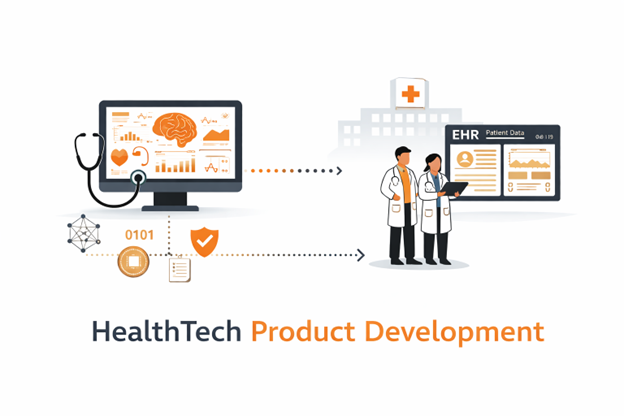
The promise of HealthTech is often articulated in terms of potential. We speak about the capacity to save lives, the ability to predict diseases before they manifest, and the power to democratize access to world class diagnostics. However, there is a substantial, often under-discussed chasm between the theoretical potential of a medical product and its practical utility in a hospital or clinic.
This gap defines one of the hardest problems in HealthTech product development which is translating technically sound solutions into tools that clinicians can trust, adopt, and rely on within real clinical environments.
My purpose in writing this is to address the specific, granular challenges that arise when product leaders attempt to move high-performing technology out of the research lab and into the hands of practicing physicians. This is not a discussion about how to write better code or train more accurate models.
It is a strategic exploration of the last mile of product development where engineering meets empathy and where many promising innovations fail simply because they do not account for the complex, high pressure reality of clinical workflows.
By sharing the specific hurdles I faced and the architectural and design changes required to overcome them, I aim to provide a blueprint for other product professionals navigating this demanding space. The goal is to shift the conversation from “Does the technology work?” to “Does the product serve?”
The Situation: The “Accuracy vs. Adoption” Paradox
Early in my journey leading product development for diagnostic support systems, my team and I encountered a situation that serves as a perfect case study for the industry’s broader challenges. We had successfully developed a sophisticated AI-driven model designed to detect early physiological anomalies in patient data.
From a purely technical perspective, the project was a resounding success. Our sensitivity and specificity metrics were best-in-class. We had validated the model against historical datasets, and the results were consistent and reliable. We believed we had built a tool that would revolutionize how clinicians approached early diagnosis.
However, the reality of deployment was humbling. When we introduced the prototype to a live clinical setting, usage was practically non-existent.
We initially assumed this was a training issue, so we increased our educational efforts. When that failed to move the needle, we assumed it was a trust issue, so we provided more white papers on our accuracy. That also failed.
The problem was not the quality of the insight. The problem was the delivery mechanism. We had built a standalone tool that existed outside the physician’s primary ecosystem. To use our product, a doctor had to log out of their Electronic Health Record (EHR) system, log into our secure portal, upload patient data, wait for analysis, and then mentally bridge the gap back to the patient’s file.
In an enterprise healthcare environment, where a physician might see thirty patients a day, every second is accounted for. We had inadvertently created a workflow burden. We ignored the cognitive load we were placing on the user. We faced the harsh reality that a clinically valid algorithm is not the same thing as a market-ready product. We had optimized for accuracy, but we had failed to optimize for utility.
The Solution: Integration, Explainability, and Workflow alignment
To turn the tide, we had to fundamentally restructure our product roadmap. We moved away from an “algorithm-first” mentality and adopted a “workflow-first” strategy. This required us to make difficult decisions about resource allocation, prioritizing user experience and integration over new feature development.
Here is the detailed strategic approach we implemented to drive adoption and bridge the gap between code and clinic:
I. Deep EHR Integration and Interoperability:
We made the decision to dismantle our standalone portal entirely. We invested heavily in interoperability standards, such as FHIR (Fast Healthcare Interoperability Resources) and Health Level Seven (HL7), to embed our solution directly into the existing clinical infrastructure.
The goal was to make our product invisible until it was needed. By integrating directly into the EHR interface, our insights appeared within the physician’s existing patient view. The analysis ran in the background, triggered automatically by new lab results or vitals.
The physician no longer had to “go to” our product. Our product came to them, appearing as a natural notification within their standard charting workflow. This removed the context switching that had previously killed adoption.
II. Explainable Outputs over “Black Box” Scores
Clinicians are trained to be skeptical. They are scientifically minded professionals who require evidence before action. Our initial prototype simply provided a risk score, asking the doctor to trust the machine. This was a fundamental error in judgment.
We redesigned the user interface to adopt a “Glass Box” approach.
We moved away from presenting a single, opaque probability score. Instead, we broke down the rationale behind the alert. We highlighted the specific biomarkers, signal patterns, and temporal trends that triggered the recommendation.
By showing the “why” behind the “what,” we shifted the dynamic from “blind trust” to “verified insight.” This allowed the physician to validate the AI’s findings against their own clinical judgment.
III. Active Feedback Loops and RLHF
We recognized that we could not build a perfect model in a vacuum. We needed the collective intelligence of our user base to refine the product. We built a low-friction mechanism for physicians to agree or disagree with the model’s suggestion with a single click.
If a physician dismissed an alert, we asked for a quick, structured reason (e.g., “known chronic condition” or “data artifact”). This accomplished two things. First, it empowered the user, making them a partner in the product’s evolution rather than a passive recipient.
Second, it created a high-value data stream for Reinforcement Learning from Human Feedback (RLHF). This allowed us to retrain our models on real-world edge cases that never appear in clean training datasets.
IV. Clinical Guardrails and Alert Fatigue Management
In healthcare, more information is not always better. An over-sensitive system that flags every minor anomaly quickly leads to alert fatigue, causing doctors to ignore even the critical warnings.
We established rigorous clinical guardrails. We worked with medical advisors to define clear thresholds where the system would not intervene. We optimized for high positive predictive value (PPV) rather than just raw sensitivity. We decided that it was better to miss a marginal case than to lose the user’s trust by flagging a false positive.
We implemented “silence” as a feature, ensuring that when our system did speak, it was saying something worth hearing.
Key Insights and Lessons Learned
This experience crystallized three fundamental truths about building enterprise-grade products in the HealthTech space. These lessons now form the core of my product philosophy.
1. Interoperability is the Primary Driver of User Experience
In the consumer world, a beautiful interface is the hallmark of good UX. In the healthcare world, interoperability is the hallmark of good UX. If your data does not flow seamlessly to where the user already lives, your product effectively does not exist. We often treat integration as a backend IT requirement, something to be handled after the “core” product is built. This is a mistake.
In HealthTech, the integration is the product. The ability to surface the right information, at the right time, within the right context, is far more valuable than the sophistication of the underlying algorithm. Reducing the “click cost” to zero is the most impactful UX improvement you can make.
2. Trust is the Currency of Adoption
You cannot “disrupt” healthcare the way you disrupt other industries. The stakes are too high. Adoption is built entirely on trust, and trust is earned through transparency. We learned that physicians are not afraid of AI or technology. They are afraid of opacity and liability. By focusing on Explainable AI (XAI) and providing the evidence behind the insight, we respected the physician’s expertise.
We positioned the product as a “digital second opinion” rather than a replacement. This psychological shift was critical. When users feel their expertise is being augmented rather than challenged, resistance evaporates.
3. The “Last Mile” is the Hardest Mile
There is a common misconception that once the technology is proven, the hard work is done. In reality, developing the core technology often takes only 20 percent of the total effort. The remaining 80 percent is spent on the “last mile.”
This includes regulatory compliance, security audits, workflow alignment, and change management. It involves navigating the complex procurement cycles of hospital systems and the rigid data governance policies of enterprise IT.
Ignoring this reality is the primary reason why many brilliant HealthTech startups fail to scale. Success depends on budgeting the majority of your time and resources for these operational and logistical challenges.
The Bottom Line
Building in the HealthTech space requires a dual mindset. You must possess the innovation of an engineer and the empathy of a caregiver. Our role as product leaders is not simply to push the boundaries of what is technically possible. It is to understand the profound constraints under which healthcare professionals operate and to design solutions that fit quietly and helpfully into their chaotic reality.
The transition from a standalone tool to an integrated, explainable, and user-centric platform was not easy. It required us to scrap work we were proud of and to listen to harsh feedback. However, the result was a product that moved from being a theoretical novelty to a daily clinical necessity.
As we continue to advance in this domain, let us remember that the ultimate metric of success is not the complexity of our neural networks or the volume of our data. It is the tangible improvement in patient outcomes and the reduction of burden on the people who care for them.
By focusing less on the novelty of our tech and more on the reality of the clinical environment, we can build products that do more than just function. We can build Health Products that truly serve. If you are currently navigating the complexities of HealthTech product development or looking for strategies to improve clinical adoption for your digital tools, I would be happy to discuss how these principles can be applied to your specific challenges. Let’s connect and explore how, at CitrusBits, we can build better healthcare solutions together.
Table of Contents
1) The Situation: The “Accuracy vs. Adoption” Paradox
2) The Solution: Integration, Explainability, and Workflow alignment
3) Key Insights and Lessons Learned
4) The Bottom Line
Innovate the Future of Health Tech
CitrusBits helps MedTech leaders build smarter apps, connected devices, and XR health solutions that truly make an impact.
