


Blog
What Is HL7 in Healthcare? Exploring V2, V3, CDA & Why They Still Matter

Reliable data exchange is the backbone of modern healthcare, yet most clinical systems speak entirely different technical languages. HL7 bridges this gap. By standardizing how patient data is formatted, shared, and interpreted, HL7 versions like V2, V3, and CDA enable hospitals, EHR vendors, labs, and digital health platforms to work together without chaos.
These standards weren’t created simply to move messages; they exist to ensure that critical information reaches the right system at the right time, in the right structure. As healthcare organizations push for better interoperability, reduce integration costs, and modernize legacy workflows, understanding HL7 becomes not just helpful but essential.
This article clarifies the purpose behind HL7, demystifies its core versions, and explains why these standards remain foundational even as the industry accelerates toward API-driven models like FHIR.
What Is HL7 in Healthcare?
HL7, short for Health Level Seven, is a globally recognized set of standards designed to streamline how healthcare data is exchanged between different software systems. Instead of allowing each EHR, LIS, RIS, PACS, or billing system to use its own proprietary format, HL7 establishes a universal language that all systems can understand.
Developed by Health Level Seven International, HL7 focuses on the “application layer” (layer 7 in the OSI model), which determines how information is structured and shared between clinical applications. These standards ensure that patient demographics, lab results, orders, diagnoses, procedures, and clinical documents move between systems in a structured, predictable way.
Purpose & Importance of HL7 in Healthcare
Healthcare environments generate enormous amounts of data, from admissions and lab results to imaging, medications, and billing. Without a common structure, that data often becomes siloed, duplicated, or inconsistent. HL7 addresses this challenge by:
- Creating a universal standard for formatting healthcare messages
- Reducing integration costs by eliminating the need for custom data formats
- Improving workflow efficiency across clinical and administrative systems
- Ensuring accurate and timely data exchange, which reduces medical errors
- Supporting regulatory and interoperability initiatives, including nationwide information sharing
The importance of HL7 is not just technical; it’s operational. When systems can reliably share data, clinicians gain faster access to complete patient information, administrators minimize manual entry, and organizations maintain better data quality across all departments.
Primary Role of HL7 in Healthcare Data Exchange
The primary role of HL7 is to provide a standardized framework for exchanging clinical data in a way that every connected system can interpret correctly. HL7 accomplishes this by:
- Defining message structures for essential workflows like ADT, ORU, ORM, VXU, and DFT
- Ensuring semantic consistency, a lab result or diagnosis means the same thing across systems
- Connecting disparate systems, from EHRs to lab instruments to billing software
- Supporting secure, reliable message delivery through transport protocols such as MLLP
- Providing the foundation for modern interoperability models, including HL7 FHIR
By establishing consistent rules for data formatting, messaging, and communication, HL7 enables healthcare organizations to build integrations that are scalable, predictable, and future-friendly. Even as newer standards emerge, HL7 remains the backbone of global healthcare interoperability.
What Is an HL7 Interface?
An HL7 interface is the connection layer that allows two healthcare systems to exchange HL7-formatted data in real time. It acts as the “bridge” that transforms, routes, and validates messages so systems like EHRs, LIS, RIS, PACS, billing platforms, and registries can communicate seamlessly.
An HL7 interface typically includes:
- A sending system (e.g., LIS sending lab results)
- A receiving system (e.g., EHR receiving those results)
- An interface engine (middleware that handles routing, parsing, and transformations)
- Communication protocols (MLLP, TCP/IP, APIs)
In simple terms, an HL7 interface ensures that data moves from System A to System B accurately, securely, and in the format each system understands.
How to Build an HL7 Interface
Building an HL7 interface requires a combination of technical knowledge, workflow understanding, and careful mapping. Here’s a practical, step-by-step guide:
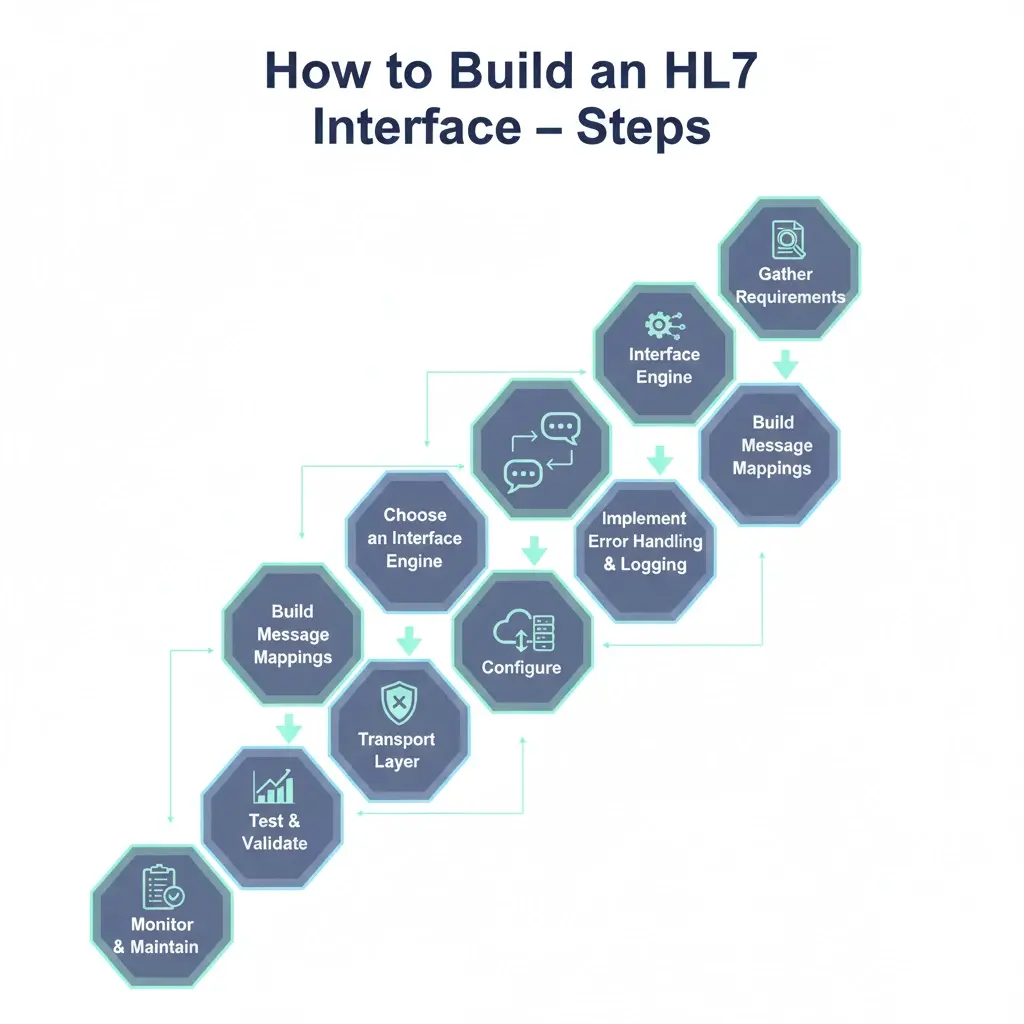
Step 1: Gather Requirements
Identify what data needs to be exchanged, including:
- Message types (ADT, ORU, ORM, VXU, DFT)
- Trigger events
- Required fields
- Custom segments (Z-segments)
- Frequency & delivery expectations
Step 2: Choose an Interface Engine
Popular interface engines include:
- Mirth Connect
- Rhapsody
- Corepoint
- Cloverleaf
- InterSystems Ensemble
These tools manage message routing, transformations, logging, and monitoring.
Step 3: Build Message Mappings
Create transformation rules to align sending system fields with receiving system requirements. This often includes:
- Parsing components
- Normalizing codes (LOINC, SNOMED, RxNorm)
- Adjusting date/time formats
- Splitting or merging fields
- Handling multi-valued segments
Step 4: Configure Transport Layer
Decide how messages will be transmitted:
- MLLP/TCP
- Web services
- APIs
- File drops (SFTP/FTPS)
Set up ports, endpoints, encryption, and firewall rules.
Step 5: Implement Error Handling & Logging
A reliable interface must:
- Retry failed deliveries
- Log errors with context
- Send alerts for critical failures
- Support acknowledgment messages
Step 6: Test and Validate
Test with real-world scenarios, including:
- Missing data
- Invalid codes
- High-volume message bursts
- Edge cases & system downtime
Step 7: Monitor and Maintain
Once live, interfaces must be:
- Continuously monitored
- Updated when systems change
- Reviewed for regulatory compliance
- Tuned for performance
Building HL7 interfaces is both technical and strategic; successful implementations reduce errors, improve workflow efficiency, and dramatically lower integration costs.
HL7 Versions: V2, V3, CDA
HL7 V2: The Most Widely Used Standard
HL7 Version 2 (V2) is by far the most widely adopted HL7 standard in the world. Since its introduction, V2 has become the backbone of real-time healthcare communication across hospitals, labs, imaging centers, and EHR systems.
Why HL7 V2 Remains So Popular
- Flexibility: It allows optional fields, customizable segments, and Z-segments.
- Simplicity: Plain-text format that is easy to parse and generate.
- Speed: Lightweight and ideal for high-volume environments like ADT feeds and lab results.
- Compatibility: Works with nearly every healthcare system and interface engine.
Strengths of HL7 V2
- Fast implementation
- Low overhead
- Proven reliability
- Huge vendor ecosystem
Limitations
- Overly flexible, which can lead to inconsistent implementations
- No native encryption
- Not designed for modern API-based needs
Despite its age, HL7 V2 remains the foundation of healthcare interoperability and will continue to be used for many years.
HL7 V3: Why It Failed to Replace V2
HL7 Version 3 was designed as a more structured and formal standard built on a strong underlying information model (RIM). However, adoption of HL7 V3 has been limited.
What HL7 V3 Introduced
- A rigid, model-driven architecture
- XML-based message format
- A focus on consistent semantics and data modeling
Why HL7 V3 Struggled
- Too complex for most real-world workflows
- High implementation costs
- Difficult for vendors and developers to adapt
- Workflow-specific variations made interoperability challenging
Where HL7 V3 Is Used Today
- Some public health systems
- Select government-driven projects
- CDA (a V3-based standard)
Although V3 never replaced V2 as intended, it laid the conceptual groundwork that later helped shape FHIR.
CDA (Clinical Document Architecture)
CDA is a document-based HL7 standard derived from HL7 V3. It focuses on structured clinical documents rather than real-time messaging.
What CDA Is Used For?
CDA is commonly used to exchange:
- Discharge summaries
- Continuity of care documents (CCD)
- Radiology reports
- Consultation notes
- Immunization summaries
Why CDA Became Important
- Combines human-readable narrative with machine-readable XML
- Supports rich clinical content
- Well-suited for long-term patient document archiving
Strengths of CDA
- Highly structured and standardized
- Good for permanent, shareable clinical documents
- Widely recognized by government and public health systems
Limitations
- Heavy and complex XML format
- Not ideal for real-time workflows
- Difficult to integrate with modern APIs
Examples of HL7 in Healthcare
HL7 powers many core clinical and administrative workflows across hospitals, labs, imaging centers, pharmacies, and public health systems. Its structured, real-time messaging keeps every system in sync.
1. HL7 in ADT Workflows (Patient Admissions & Movement)
HL7 ADT messages update all connected systems with real-time patient status.
Common ADT Uses
- Patient registration
- Demographic updates
- Room/bed changes
- Transfers and discharges
Why it matters: Every system, EHRs, labs, radiology, and pharmacy, relies on accurate patient data.
2. HL7 in Lab Orders & Results
Labs depend on HL7 ORM (orders) and ORU (results) messages.
Use Cases
- Sending lab orders from EHR to LIS
- Returning test results to the EHR
- Routing critical results
- Syncing orders with lab instruments
Benefit: Faster results, fewer errors, automated workflows.
- HL7 in Radiology & Imaging
HL7 integrates radiology systems like RIS and PACS with the EHR.
Examples
- Sending imaging orders
- Scheduling updates
- Delivering structured radiology reports
Outcome: Radiologists, clinicians, and billing teams stay aligned.
4. HL7 in Immunization & Public Health Reporting
Public health agencies use HL7 for automated data exchange.
Examples
- VXU vaccination submissions
- Reporting lab results for disease surveillance
- Hospital capacity reporting
Result: Accurate, compliant, and timely public health data.
5. HL7 in Billing & Financial Workflows
HL7 DFT messages link clinical events to financial systems.
Examples
- Mapping procedures to billing codes
- Sending charges to revenue systems
- Reducing claim denials
Impact: Stronger revenue cycle accuracy and efficiency.
6. HL7 in Medication & Pharmacy Systems
Pharmacy systems rely on HL7 for safe medication management.
Examples
- Medication orders
- MAR updates
- Allergy/interaction checks
- Refill and dispensing workflows
Benefit: Reduced medication errors and smoother pharmacy operations.
7. HL7 for Device & Monitor Integration
Bedside devices use HL7 to push real-time data into EHRs.
Use Cases
- Vital signs
- Ventilator settings
- Monitor dashboards
- Automated device documentation
Outcome: Accurate data capture and reduced clinician documentation burden.
HL7 Protocol (Is HL7 a Protocol?)
One of the most common misconceptions in healthcare IT is the belief that HL7 is a communication protocol. In reality, HL7 is a standard, not a transport protocol.
HL7 defines how healthcare data should be structured, what fields should exist, and how systems should interpret them. It does not define how that data travels across networks.
For message transmission, HL7 typically relies on external protocols such as:
- MLLP (Minimal Lower Layer Protocol)
- TCP/IP
- HTTP/HTTPS
- REST APIs (commonly used with FHIR)
So while HL7 specifies the language, the communication layer that moves this language between systems is provided by a separate protocol.
Is HL7 Protocol Unencrypted?
Yes, by default, HL7 V2 messages transmitted using MLLP are unencrypted. MLLP runs on plain TCP/IP, which means data is vulnerable during transmission unless additional security layers are applied.
Why does this matter?
HL7 messages often carry protected health information (PHI), including:
- Patient identifiers
- Diagnoses
- Vaccination history
- Lab results
- Billing details
How do organizations secure HL7 communication?
To meet HIPAA compliance and modern security needs, organizations typically implement:
- TLS/SSL encryption
- VPN tunnels
- IPSec
- Secure MLLP over TLS
- Encrypted file transfers (SFTP/FTPS)
- HTTPS-based APIs (when using FHIR)
While HL7 V2 itself doesn’t provide encryption, secure network-level protocols ensure PHI remains protected in transit.
HL7 Message Structure & Format Overview
An HL7 message is a structured string of text divided into segments, each containing fields, components, and subcomponents. This format enables healthcare systems to exchange data in a predictable and machine-readable way.
Here’s a simplified example of an HL7 V2 message:
MSH|^~\&|LAB|HOSPITAL|EHR|HOSPITAL|202403011200||ORU^R01|123456|P|2.5
PID|1||789456^^^HOSPITAL^MR||Doe^John||19800101|M
OBR|1||987654|^Complete Blood Count
OBX|1|NM|WBC^White Blood Cell Count||6.8|10^3/uL|4.0-10.5|N
- MSH: Message Header
- PID: Patient Identification
- OBR: Observation Request
- OBX: Observation Result
Every symbol in an HL7 message hasa purpose:
- | = field separator
- ^ = component separator
- ~ = repetition separator
- \ = escape character
- & = subcomponent separator
This structure creates a universal format that all systems can parse consistently.
HL7 Segments Explained
Segments are the building blocks of HL7 messages. Each serves a specific purpose, and the order often matters depending on the message type.
Common HL7 Segments:
- MSH: Defines message metadata, sending/receiving systems, timestamps
- PID: Patient demographic details
- PV1: Visit information
- ORC: Order control
- OBR: Observation request
- OBX: Observation result
- AL1: Allergies
- NK1: Next of kin
- GT1: Guarantor
- IN1/IN2: Insurance information
These segments are assembled differently for ADT, ORM, ORU, DFT, VXU, and other HL7 message types.
HL7 Message Mapping
Message mapping is the process of translating HL7 segments and fields to match the requirements of another system. This ensures data is exchanged accurately and consistently.
Step 1: Identify the Message Type
Determine whether it’s ADT^A01, ORU^R01, ORM^O01, DFT^P03, etc. Each type has a predefined structure and required segments.
Step 2: Understand Sending & Receiving Requirements
Document the workflow, use case, and system constraints:
- What data must be mandatory?
- Which fields are optional?
- Are custom Z-segments required?
Step 3: Map HL7 Fields to Target System Fields
| HL7 Field | Description | Target Field | Notes |
| PID-5 | Patient Name | FullName | Parse components |
| OBR-4 | Test Code | TestType | Must match LOINC |
| OBX-5 | Result Value | Result | Convert units |
Step 4: Validate and Test
Use tools like Mirth, HL7 Inspector, or custom scripts to validate the mapping.
Step 5: Handle ACKs & Errors
Acknowledge messages properly and build error-handling workflows for:
- Missing fields
- Invalid codes
- Format errors
- Schema mismatches
Why Message Mapping Matters
- Ensures data integrity
- Supports interoperability
- Reduces manual corrections
- Aligns clinical workflows across systems
This mapping process forms the foundation of every successful HL7 interface.
Common Challenges with HL7 & How to Solve Them
Even though HL7 standards are widely adopted, healthcare organizations often face significant implementation and integration challenges. Many issues stem from inconsistencies between systems, customizations, and the age of legacy infrastructures.
Version Fragmentation Across Systems
Different healthcare systems often run different HL7 versions (e.g., 2.3, 2.4, 2.5.1). This lack of version alignment creates mapping issues and breaks consistency.
Challenges
- Fields missing or located differently
- Inconsistent segment structures
- Varying requirements for mandatory fields
Solutions
- Build version-specific mapping rules
- Use interface engines to normalize structures
- Create profile-based message definitions
- Maintain clear documentation for each connection
Custom Z-Segments Complicating Interoperability
Many vendors use Z-segments (custom segments) to add proprietary fields that their systems require. While useful, they undermine standardization.
Challenges
- Increased mapping complexity
- Non-portable integrations
- High maintenance costs
Solutions
- Only allow Z-segments when absolutely necessary
- Document custom fields thoroughly
- Use interface engines to transform Z-segment data into standard fields when possible
Inconsistent or Poorly Structured Data
HL7 messages often contain data that is incomplete, incorrectly formatted, or semantically inconsistent.
Challenges
- Invalid codes
- Incorrect units of measure
- Free-text values instead of standardized terminology
- Missing demographic fields
Solutions
- Implement validation rules at the interface level
- Normalize terminology using LOINC, SNOMED, and RxNorm
- Enforce mandatory field checks before accepting messages
Limited Support in Legacy Systems
Older systems were not built for flexible, modern interoperability requirements.
Challenges
- Hard-coded HL7 message formats
- No support for APIs or FHIR
- Limited acknowledgment handling
- Difficulty adapting to new workflows
Solutions
- Use middleware to modernize communication
- Gradually migrate to updated vendor systems
- Wrap legacy HL7 messages in secure transport layers
- Implement temporary bridges that convert HL7 V2 to FHIR where appropriate
Complex Testing and Validation
Because HL7 implementations vary widely, testing each connection can be time-consuming.
Challenges
- Many edge cases
- Varying interpretations of the HL7 spec
- High dependency on workflow-specific rules
Solutions
- Automate testing with HL7 validation tools
- Use test harnesses with real clinical scenarios
- Perform end-to-end testing with live data (de-identified)
Integrating HL7 with FHIR-Based Systems
As organizations adopt FHIR APIs, bridging HL7 V2/V3/CDA with FHIR creates new complexity.
Challenges
- Different message formats
- Granular FHIR resources vs. delimited HL7 messages
- Conflicting vocabulary standards
Solutions
- Use interface engines or integration platforms to convert HL7 → FHIR
- Implement FHIR facade layers for legacy systems
- Normalize terminology across standards
Why HL7 Still Matters Today and in the Future?
Despite the rise of modern standards like FHIR, HL7 continues to play an irreplaceable role in healthcare interoperability. The vast majority of hospitals, labs, imaging centers, and EHR vendors still rely on HL7 V2 and CDA for daily operations because these standards are deeply embedded in critical workflows, from admissions and orders to results and billing.
Replacing them overnight is neither practical nor cost-effective. Instead, organizations are building hybrid environments where HL7 provides the backbone for high-volume, real-time transactions, while FHIR introduces agility, mobile access, and API-driven innovation.
In this evolving ecosystem, HL7 remains essential not because it’s old, but because it’s dependable, flexible, and universally supported. As healthcare systems modernize, HL7 continues to provide the stable foundation upon which next-generation interoperability is being built.
Summary
HL7 remains one of the most critical foundations of healthcare interoperability. From rapid patient admissions to lab results, imaging, billing, and public health reporting, HL7 V2, V3, and CDA continue to power the daily exchange of clinical data across healthcare systems worldwide. Even as modern frameworks like FHIR introduce new possibilities through APIs and cloud-based integrations, HL7’s reliability, flexibility, and widespread adoption ensure its ongoing relevance.
Understanding how these standards work and how to implement, map, and secure them is essential for any organization looking to streamline operations, reduce errors, and build a connected care ecosystem.
Ready to streamline your healthcare integrations, eliminate data silos, and build powerful HL7 or FHIR interfaces?
Whether you need expert guidance, healthcare application development, or end-to-end interoperability support, our team can help you create reliable, scalable, and future-ready solutions.
Get in touch today and accelerate your journey toward seamless healthcare data exchange.
Table of Contents
1) What Is HL7 in Healthcare?
2) What Is an HL7 Interface?
3) HL7 Versions: V2, V3, CDA
4) Examples of HL7 in Healthcare
5) HL7 Protocol (Is HL7 a Protocol?)
6) HL7 Message Structure & Format Overview
7) HL7 Message Mapping
8) Common Challenges with HL7 & How to Solve Them
9) Why HL7 Still Matters Today and in the Future?
10) Summary
Innovate the Future of Health Tech
CitrusBits helps MedTech leaders build smarter apps, connected devices, and XR health solutions that truly make an impact.
