


Blog
Cloud-Based Medical Devices: Build Secure, Scalable Healthcare Solutions
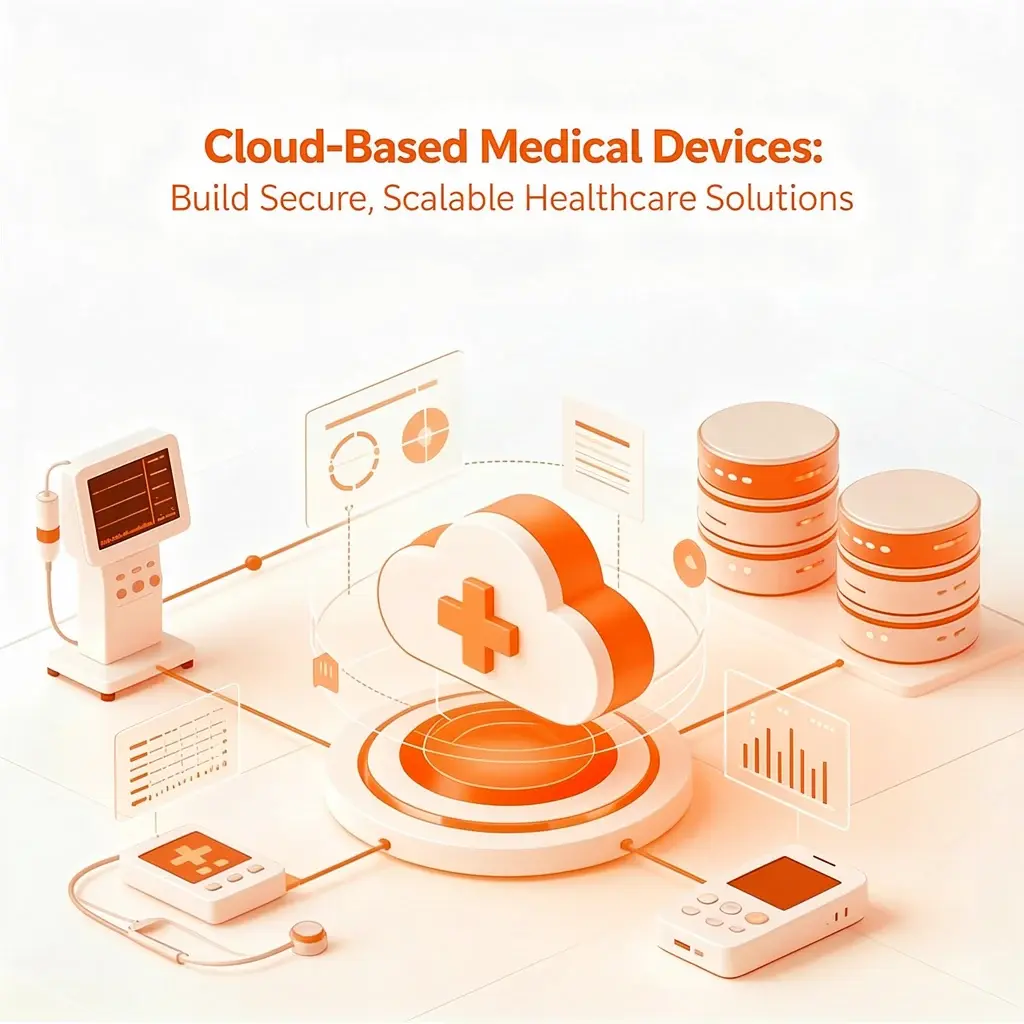
Cloud based medical devices are changing how care is delivered because they don’t stop at capturing data. They connect the device, patient apps, clinician dashboards, and cloud services into one reliable system that can support remote monitoring, faster updates, and smarter clinical decisions.
But building it the right way takes more than “moving to the cloud.” You need a platform that’s secure by design, integration-ready for healthcare workflows, and scalable enough to support real-world device fleets and real patients. Let’s explore what cloud medical devices are, where they deliver the most value, the cloud services behind them, and practical examples you can model.
If you’re building SaMD, IoMT/connected devices, or a digital health product that needs a cloud backbone, you’ll also see what “good” looks like so you can ship faster, reduce risk, and turn your product into a platform that drives adoption.
What Are Cloud Medical Devices?
Cloud based medical devices are medical devices that don’t just collect data; they connect that data to a secure cloud environment where it can be stored, analyzed, monitored, and shared with authorized care teams. In practice, this usually includes a cloud device (the hardware), a companion patient app, a clinician portal, and the cloud services that keep everything synced and reliable.
This “connected system” is why cloud medical devices are becoming foundational for remote patient monitoring, at-home diagnostics, and digital therapeutics.
The key advantage is not simply “using the cloud.” It’s that cloud based medical devices can support real healthcare workflows: continuous data streams, alerts and thresholds, audit trails, secure access, and interoperability with other systems.
And because these products touch patient safety and sensitive data, the cloud layer needs to be designed with security, traceability, and compliance in mind from day one, not bolted on later.
Cloud device vs connected device vs SaMD
These terms get used interchangeably, but they describe different “centers of gravity” in a product hardware-first, connectivity-first, or software-first. The table below clarifies what each one usually means in real healthcare settings.
Term | What it typically means | How data flows | Common examples | Key considerations |
Cloud device | A physical medical device designed to send data to a cloud platform for storage, monitoring, and analytics. | Device → cloud (directly or via app/gateway) → clinician dashboard | RPM sensors, connected therapeutic devices, home monitoring devices | Security, identity, reliable ingestion, audit trails, uptime/monitoring |
Connected device | A broader umbrella term for devices that connect to something (often a phone) but may not always connect to the cloud. | Device → phone/app (sometimes cloud) | Bluetooth-only devices, consumer-style wearables used in care programs | Data reliability, offline sync, workflow fit, integration readiness |
SaMD (Software as a Medical Device) | Software that performs a medical function (e.g., analysis, diagnosis support, decision support), with or without a physical device. | App/cloud software → clinical output (may ingest device/EHR data) | ECG interpretation software, clinical risk scoring, decision support tools | Lifecycle controls, validation, post-market maintenance, cybersecurity monitoring |
Why Cloud-Based Medical Devices in Healthcare Are Growing
Cloud based medical devices in healthcare are growing because care is increasingly distributed. Monitoring and therapeutics are moving outside hospitals into clinics, homes, and ambulatory settings, while clinicians still need timely, trustworthy data.
Cloud connectivity enables this shift by turning raw device readings into accessible insights, delivered through dashboards, alerts, and integrated workflows.
For MedTech teams, the cloud also makes product iteration more practical. Instead of waiting for long device refresh cycles, manufacturers can improve analytics, reliability, and user experience through controlled software updates, while maintaining robust logging, monitoring, and cybersecurity processes over the product lifecycle.
The FDA has emphasized that cybersecurity risk management is ongoing and needs continued maintenance across the lifecycle of marketed devices, which aligns directly with how cloud-based platforms are operated.
Core benefits for patients, providers, and manufacturers
Remote monitoring at scale: Reliable capture of longitudinal data for earlier intervention and better follow-up.
Faster access to insights: Cloud processing supports trend detection, thresholds, and analytics that are harder to do on-device alone.
Operational resilience: Centralized monitoring and auditability make it easier to detect issues and maintain uptime.
Security and governance: Mature access controls and audit controls help manage ePHI responsibly (especially when multiple care teams or organizations are involved).
Better integration paths: Cloud APIs make it easier to connect to other clinical systems over time.
Common use cases (what’s actually being built)
Cloud-based medical devices show up across nearly every MedTech segment, but the highest-impact use cases tend to cluster around:
- Remote patient monitoring (RPM): Vitals and symptom tracking, adherence monitoring, escalation logic.
- Diagnostics support: Device capture + cloud analysis + reporting and clinician review.
- Imaging workflows: Upload, storage, and secure access for viewing and collaboration.
- Rehabilitation and therapeutics: Program delivery, adherence, progress tracking, and personalization.
- Connected assistive technology: Continuous usage and outcome measurement tied to care plans.
Cloud Services for Healthcare: The Building Blocks Behind a Cloud-Based Device Platform
When teams talk about “cloud services for healthcare,” they’re usually describing a stack of capabilities that make cloud based medical devices reliable and safe in real-world environments. This includes identity and access management, encrypted transport, device authentication, data ingestion pipelines, storage designed for sensitive health data, and robust observability (logging, monitoring, alerting).
These are not “nice-to-haves”, they’re what turns a prototype into a production-grade healthcare platform.
The most common mistake is focusing only on features (dashboards, alerts, patient flows) without building the foundations that support security, audits, and post-market maintenance. HIPAA’s Security Rule, for example, explicitly calls out technical safeguards such as access controls, audit controls, integrity protections, authentication, and transmission security, exactly the areas that need to be designed into healthcare cloud services from the start.
A practical reference architecture (from device to clinician workflow)
A scalable cloud-based device platform typically looks like this:
- Device/edge layer: Device firmware, sensors, local buffering (when connectivity drops).
- Connectivity + device identity: Secure provisioning, certificates/keys, authenticated sessions.
- Data ingestion: APIs and streaming pipelines that handle bursts and continuous flows.
- Storage layer: Structured storage and retention policies aligned to data sensitivity and access needs.
- Processing + analytics: Rules engines, trend analysis, and (when appropriate) AI pipelines.
- Applications: Patient app + clinician portal + admin tools for operations and support.
- Observability: Monitoring, audit logs, alerts, incident response workflows.
- Integration layer: Interfaces for EHR systems and third-party tools as the product matures.
This approach supports both straightforward monitoring solutions and more advanced “cloud medical devices” that deliver decision support or personalized therapeutics, without painting yourself into an architectural corner.
Security & compliance essentials
Instead of chasing buzzwords, focus on controls that map to real requirements and real risk:
- Access control: Role-based access aligned to least privilege (who can see what, when).
- Audit controls: Traceable logs for system activity and sensitive data access.
- Integrity protections: Guardrails to prevent improper alteration or loss of data.
- Authentication: Strong identity verification for users and services.
- Transmission security: Secure transport for ePHI between device, app, and cloud.
- Lifecycle cybersecurity: A process to monitor, identify, and address vulnerabilities after launch, because the device ecosystem evolves continuously.
For regulated software components, lifecycle discipline matters too. Standards such as IEC 62304 are widely referenced in medical device software development to structure development and maintenance processes, which becomes especially relevant when the “device” includes a cloud platform and frequent software iteration.
Healthcare Cloud Providers: How to Choose the Right One for Medical Devices
There’s no single “best” answer when evaluating healthcare cloud providers because cloud-based medical devices don’t all have the same risk profile, data volume, or workflow needs. The right choice depends on what you’re building (monitoring vs diagnostics vs imaging), where your users are located, how you plan to integrate into care delivery, and what your security and compliance obligations look like.
A better way to choose is to work backward from your product and operating model. What must be encrypted? What must be audited? What must be monitored in real time? How do you plan to respond to vulnerabilities and ship updates safely?
Since FDA guidance emphasizes ongoing cybersecurity maintenance across the lifecycle, your provider choice should support strong logging, monitoring, patching workflows, and operational maturity, because you’re not only building software, you’re operating it.
A shortlist checklist
Use this shortlist to narrow options quickly:
- Compliance readiness: Supports the safeguards you need (access control, auditability, encryption, retention policies).
- Integration ecosystem: Can support device connectivity patterns and healthcare interoperability plans.
- Observability and incident response: Monitoring and alerting that your team will actually use daily.
- Data residency and disaster recovery: Matches where you operate and your uptime requirements.
- Cost predictability at scale: Especially important when you grow device fleets.
Cloud Based EHR System vs Cloud-Based Medical Devices (Where They Connect)
It’s easy to mix up a cloud based EHR system with cloud based medical devices, especially because both live “in the cloud” and both deal with clinical data. But they solve different problems. An EHR is the system of record for care delivery, documentation, orders, billing, care plans, and clinical workflows.
Cloud based medical devices, on the other hand, are built to capture device data, turn it into usable insights, and deliver that data to the right place (often the EHR) in a safe, structured way.
This distinction matters because the highest-value implementations don’t create “another dashboard.” They connect device intelligence into clinical workflows, so care teams can act without extra steps. That’s why interoperability planning (HL7/FHIR, data mapping, event triggers, and audit trails) should be part of your cloud platform design early, not a last-minute integration sprint.
When a cloud EHR is the goal
A cloud EHR initiative is usually led by a provider organization and focuses on clinical documentation, operational efficiency, patient communication, and revenue cycle management. It’s a large-scale enterprise project with deep workflow change management.
When a cloud device platform is the goal
A device cloud platform is typically led by MedTech teams (or digital health product teams) to support:
- Remote monitoring programs
- Diagnostics and reporting
- Longitudinal trends and analytics
- Fleet operations (device provisioning, uptime, support workflows)
- Integration of device-derived observations into care delivery
Integration points that matter
When cloud based medical devices integrate into provider environments, the most useful touchpoints tend to be:
- Observations/vitals (device readings, trends, thresholds)
- Reports (summaries clinicians can trust and review)
- Alerts (actionable notifications, not noise)
- Orders and encounters (context that improves interpretation)
HL7 standards still play a major role in exchanging clinical data, and they continue to underpin interoperability even as APIs become more common.
Best Cloud Based Medical Devices: What “Best” Means (Without the Hype)
Searchers often look for “best cloud-based medical devices,” expecting a product list. But in healthcare, “best” is rarely about brand names; it’s about whether the device ecosystem reliably produces clinical value while staying secure, auditable, and integration-ready.
For buyers and product teams, the real question is: does the device + cloud platform fit a healthcare workflow and risk profile? If not, adoption stalls, clinicians ignore it, and the platform becomes expensive overhead.
A more useful approach is an evaluation framework. It helps manufacturers position their product, and it helps provider stakeholders assess whether a device platform can be trusted at scale. This also keeps your content evergreen and credible (and avoids claims that age quickly).
Evaluation checklist
- Workflow fit: Does it reduce burden or add steps?
- Data quality + traceability: Can you explain where every data point came from?
- Security posture: Strong identity, encryption, and least-privilege access aligned to HIPAA safeguards.
- Auditability: Clear audit logs for sensitive actions and access.
- Update strategy: Safe deployments, rollback plans, and monitoring after releases.
- Interoperability readiness: HL7/FHIR mapping and API strategy for EHR workflows.
- Reliability + supportability: Observability, alerting, and issue triage.
- Scaling model: Predictable costs as device fleets grow.
Red flags to watch for
- “We’ll add audit logs later.”
- Weak user/device authentication.
- No clear data retention and access policy.
- Integration is treated as a future phase with no plan.
- Limited operational monitoring (no one knows when data stops flowing).
If your organization is regulated (or building SaMD adjacent software), quality and traceability expectations also rise. QMS tooling and disciplined lifecycle practices become part of “best,” not an optional add-on.
Cloud-Based Medical Devices Examples
When teams ask for cloud based medical devices examples, what they often really want is: “What does a successful cloud device ecosystem look like in the real world?” The best examples share a pattern: they connect device data to outcomes through reliable workflows, patient engagement, clinician review, alerts, and integration.
Instead of naming “best” devices (which can become outdated fast), the most useful examples are architectural and workflow patterns you can adapt to your product.
Example patterns
RPM pattern: device data → cloud ingestion → trend detection → clinician dashboard → patient messaging
Diagnostics support pattern: device capture → cloud analysis → reviewable report → clinician sign-off → EHR attachment
Imaging workflow pattern: capture → secure upload → storage → viewer access controls → collaboration and reporting
Rehab/therapeutics pattern: sessions tracked → adherence scoring → progress analytics → personalized adjustments
One simple “example stack” (end-to-end flow)
Cloud device → secure ingestion → processing → storage → clinician portal → EHR-ready exchange
This is where Internet of Medical Things (IoMT) thinking becomes practical: connected devices are only valuable when the ecosystem reliably communicates, protects data, and supports action, at scale.
Implementation Roadmap: From Prototype to Production Cloud Medical Devices
Building cloud based medical devices isn’t just software delivery; it’s building and operating a healthcare-grade platform. A roadmap keeps teams from overbuilding early while still putting the right foundations in place. The goal is to move quickly without creating security debt or integration barriers that slow you down later.

A good roadmap also helps stakeholders align: product, engineering, clinical, QA/regulatory, and security all know what “done” means at each step.
Phase 1: Discovery + risk planning
- Define intended use and where clinical decisions happen
- Map data flow (device → app → cloud → clinician)
- Identify sensitive data (PHI/ePHI) and access roles
- Establish interoperability needs (future EHR targets, HL7/FHIR approach)
- Create a cybersecurity and operational risk baseline (what could go wrong?)
Phase 2: MVP with compliant foundations
- Build patient + clinician workflows that prove value
- Implement identity/access control, encryption, and audit logging
- Set up monitoring, alerts, and incident response playbooks
- Establish CI/CD discipline and documentation habits that scale
HIPAA’s technical safeguard concepts (access control, audit controls, integrity, authentication, transmission security) are a practical checklist for what this phase must include, even before you scale.
Phase 3: Scale + interoperability
- Add fleet management and operational tooling
- Mature observability and support processes
- Implement HL7/FHIR integration and data mapping
- Build post-market monitoring practices and vulnerability response workflows
This is also where “cloud services for healthcare” become a competitive advantage: operational maturity, reliability, and integration readiness are what help a product move from pilot to enterprise adoption.
How CitrusBits Helps
If you’re building cloud-based medical devices or modernizing an existing connected product, CitrusBits helps you design and deliver the platform behind it: secure architecture, scalable data systems, and integration-ready workflows that fit real healthcare environments. Our teams support MedTech, SaMD, and IoMT products from concept through production, with a focus on outcomes and adoption.
Engagements built for high-intent teams
- Cloud architecture + security review (clear gaps, prioritized fixes, roadmap)
- MVP build (device connectivity + patient app + clinician dashboard)
- Interoperability plan + execution (HL7/FHIR strategy, mapping, integration)
- Lifecycle readiness support (traceability, operational monitoring foundations)
FAQs
Q: Are cloud medical devices HIPAA compliant by default?
Ans: No. HIPAA compliance depends on how the system is designed and operated, especially access controls, audit logs, encryption, and secure transmission.
Q: How do healthcare cloud providers support device workloads?
Ans: They provide infrastructure and managed services for identity, security, data processing, storage, monitoring, and scalability, but you still need correct architecture and governance.
Q: What’s the difference between a cloud-based EHR system and a device platform?
Ans: A cloud EHR is the system of record for care delivery; a device platform captures device data and delivers insights and structured exchanges into workflows, often through HL7/FHIR integration.
Q: What are cloud-based medical devices examples in healthcare?
Ans: Common examples include RPM platforms, cloud-connected diagnostics, imaging upload/viewing workflows, and rehab/therapeutics adherence systems.
Table of Contents
1) What Are Cloud Medical Devices?
2) Why Cloud-Based Medical Devices in Healthcare Are Growing
3) Cloud Services for Healthcare: The Building Blocks Behind a Cloud-Based Device Platform
4) Healthcare Cloud Providers: How to Choose the Right One for Medical Devices
5) Cloud Based EHR System vs Cloud-Based Medical Devices (Where They Connect)
6) Best Cloud Based Medical Devices: What “Best” Means (Without the Hype)
7) Cloud-Based Medical Devices Examples
8) Implementation Roadmap: From Prototype to Production Cloud Medical Devices
9) How CitrusBits Helps.
Innovate the Future of Health Tech
CitrusBits helps MedTech leaders build smarter apps, connected devices, and XR health solutions that truly make an impact.
