


Blog
Custom Ophthalmology Software Development That Scales Clinics, Boosts Revenue, and Future-Proofs Eye Care
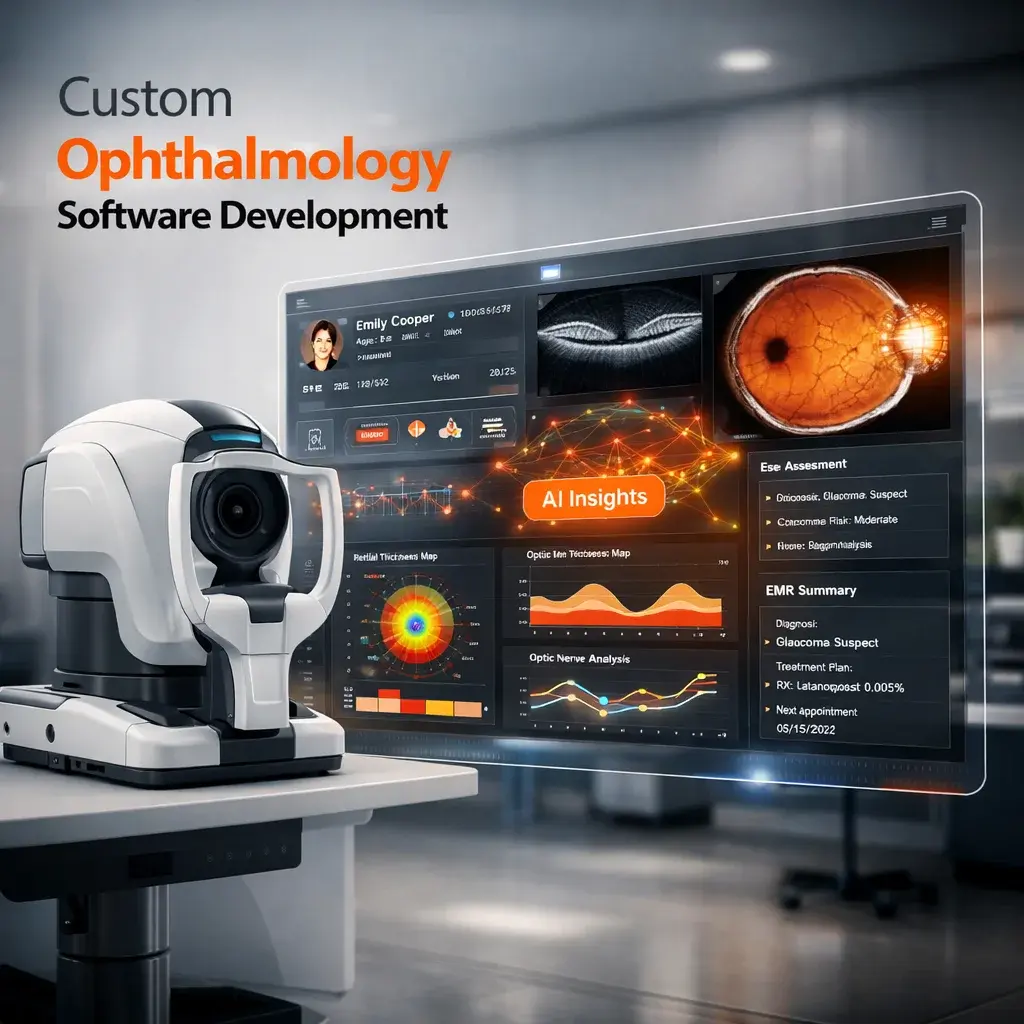
Ophthalmology software is no longer just a digital record system. It is the operational backbone of modern eye care practices. From managing high-resolution diagnostic imaging to streamlining patient workflows and ensuring regulatory compliance, the right ophthalmology software directly impacts clinical efficiency and revenue growth. Yet, most off-the-shelf solutions fail to address the complex, device-heavy, and data-intensive nature of ophthalmology practices.
This is where custom ophthalmology software development becomes a strategic advantage. Instead of forcing your workflows into rigid systems, custom-built EMR, EHR, and practice management platforms are engineered around your clinical processes, integrations, and scalability needs.
Whether you are a growing multi-location clinic or a healthtech startup building a specialized solution, investing in tailored software enables seamless interoperability, AI-driven insights, and long-term cost efficiency.
Clinical Workflows Powered by Ophthalmology Software
Ophthalmology software is a specialized category of healthcare IT systems designed to manage the clinical, operational, and diagnostic workflows of eye care practices. Unlike generic EMR or EHR platforms, ophthalmology software must handle high-resolution imaging, device integrations, and condition-specific workflows such as glaucoma tracking, retinal imaging, and vision testing.
At a system level, ophthalmology software is not a single application. It is a modular ecosystem consisting of multiple interconnected components:
- Clinical Layer (EMR/EHR): Manages patient records, diagnoses, treatment plans, and longitudinal health data
- Operational Layer (Practice Management): Handles scheduling, billing, and revenue cycle management
- Diagnostic Layer: Integrates with devices like OCT scanners, fundus cameras, and visual field analyzers
- Data Interoperability Layer: Enables communication using standards like HL7 and FHIR
This architecture ensures that patient data flows seamlessly between systems, reducing manual input and minimizing errors. According to HealthIT.gov, interoperability standards like FHIR are essential for modern healthcare systems to exchange data efficiently across platforms.
For growing clinics and digital health companies, scalability becomes a critical requirement. Building systems that can handle increasing patient volumes, device integrations, and regulatory demands requires a strong foundation in scalable and compliant medical product engineering.
Key Problems Facing Ophthalmologists Today (Why Software Matters)
Before investing in any software solution, it is important to understand the real-world bottlenecks ophthalmologists face daily. These challenges are exactly why generic systems fail and why custom solutions outperform them.
1. Fragmented Diagnostic Data
Ophthalmology relies heavily on imaging devices, but most clinics operate with disconnected systems. OCT scans, fundus images, and visual field data often live in separate silos, making it difficult to access a complete patient profile.
2. Lack of Interoperability
Many legacy systems do not support modern APIs or standards like FHIR, preventing seamless integration between:
- EMRs
- Diagnostic devices
- Billing systems
This leads to duplicated data entry and increased risk of errors.
3. Inefficient Clinical Workflows
Manual documentation, disconnected scheduling systems, and poor UI/UX design slow down clinicians. This directly impacts:
- Patient throughput
- Consultation time
- Staff productivity
4. Revenue Leakage & Billing Complexity
Ophthalmology billing involves complex coding (ICD-10, CPT). Without automation:
- Claims are delayed or rejected
- Revenue cycles become inefficient
- Administrative overhead increases
5. Compliance & Data Security Pressure
Healthcare providers must comply with strict regulations such as:
- HIPAA (USA)
- GDPR (UK/EU)
Improper data handling can lead to legal risks and financial penalties. Effective medical device document control systems are essential to maintain compliance and audit readiness.
Types of Ophthalmology Software Systems (System Architecture View)
To build or choose the right solution, it is critical to understand the different types of ophthalmology software systems and how they interact within a unified ecosystem.
1. Ophthalmology EMR Software
Ophthalmology EMR (Electronic Medical Record) systems focus on clinical documentation within a single practice. These systems are optimized for:
- Eye-specific templates (glaucoma, cataracts, macular degeneration)
- Structured exam data
- Imaging integration (OCT, slit lamp, fundus photography)
Unlike generic EMRs, ophthalmology EMRs must support visual data overlays and longitudinal eye condition tracking, making them significantly more complex.
2. Ophthalmology EHR Systems
EHR (Electronic Health Record) systems extend beyond a single clinic, enabling data sharing across healthcare providers.
Key capabilities include:
- Interoperability using FHIR APIs
- Long-term patient history across multiple facilities
- Integration with labs, pharmacies, and external providers
Organizations like HL7.org define the standards that enable this level of interoperability, making EHR systems critical for connected healthcare ecosystems.
3. Practice Management Software
This layer handles the business and operational side of ophthalmology practices. It includes:
- Appointment scheduling systems
- Billing and claims management
- Insurance verification
- Revenue cycle management
When tightly integrated with EMR/EHR systems, practice management software can automate end-to-end workflows, reducing administrative burden and improving cash flow.
4. Optical Management Systems
Optical management systems are designed for clinics that also operate retail optical services. These systems manage:
- Inventory (frames, lenses, accessories)
- Sales and POS systems
- Order tracking and fulfillment
This layer is especially important for clinics looking to diversify revenue streams and improve patient experience through integrated services.
Bringing all these systems together requires deep expertise in clinical software architecture and healthcare integrations. For a deeper understanding of how these systems are engineered, refer to:
Must-Have Features in Ophthalmology Software
Not all ophthalmology software is built equally. High-performing systems are defined by their ability to handle complex clinical workflows, device integrations, and real-time data processing without slowing down practitioners.
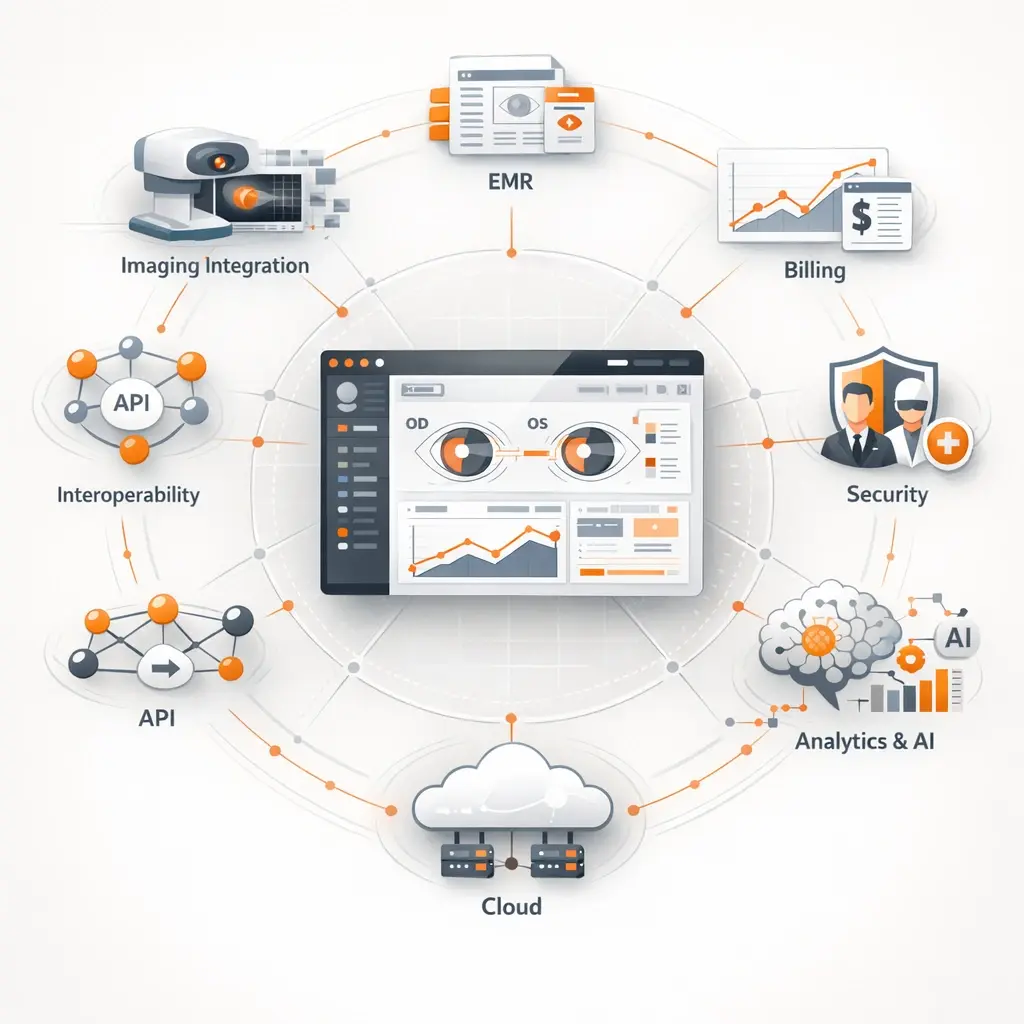
Below are the non-negotiable features every modern ophthalmology software solution must include:
1. Advanced Imaging & Device Integration (DICOM Support)
Ophthalmology is inherently image-driven. Your software must integrate seamlessly with:
- OCT (Optical Coherence Tomography) devices
- Fundus cameras
- Visual field analyzers
This requires support for DICOM standards, enabling structured storage and retrieval of imaging data.
Without this, clinics face:
- Data silos
- Manual uploads
- Diagnostic delays
For organizations building such integrations, expertise in diagnostic medical device software engineering becomes critical:
2. Intelligent Clinical Documentation (EMR/EHR)
Generic templates do not work in ophthalmology. Systems must support:
- Eye-specific charting (OD/OS tracking)
- Condition-specific workflows (glaucoma, cataracts, AMD)
- Longitudinal disease tracking
This ensures clinicians can capture detailed, structured data without friction.
3. Automated Billing & Revenue Cycle Management
Revenue leakage is a major issue in eye care practices. A robust system should include:
- ICD-10 and CPT coding automation
- Claim submission workflows
- Insurance eligibility verification
- Denial management systems
This directly impacts cash flow and profitability, making it a core buying factor.
4. Role-Based Access Control (RBAC) & Security
Healthcare systems must enforce strict data governance policies:
- Role-based access (doctor, technician, admin)
- End-to-end encryption
- Audit logs for compliance
This is essential for meeting HIPAA and GDPR requirements while maintaining operational security.
5. Interoperability & API-First Architecture
Modern ophthalmology software must connect with:
- External EHR systems
- Labs and pharmacies
- Insurance providers
Using standards like FHIR and HL7, API-first systems allow seamless data exchange and scalability.
6. Cloud-Native Infrastructure & Scalability
Cloud-based systems offer:
- Real-time access across locations
- Automatic updates
- Elastic scalability
For multi-location clinics and growing organizations, this is not optional, it is foundational.
7. Analytics & Clinical Decision Support
Advanced systems go beyond storage and provide:
- Patient outcome analytics
- Operational dashboards
- Predictive insights
This transforms software from a tool into a strategic decision-making engine.
New Technology in Ophthalmology Software (Innovation Layer)
Ophthalmology is one of the fastest-evolving specialties in healthcare, driven by AI, imaging advancements, and data-driven care models. Software is at the center of this transformation.
AI-Powered Diagnostics
Artificial intelligence is revolutionizing how eye diseases are detected and managed.
Use cases include:
- Diabetic retinopathy detection
- Glaucoma progression analysis
- Macular degeneration identification
According to the National Institutes of Health (NIH), AI models can achieve diagnostic accuracy comparable to specialists in certain ophthalmic conditions.
2. Computer Vision in Ophthalmology
Computer vision algorithms analyze retinal images and identify abnormalities with high precision. When integrated into ophthalmology software, this enables:
- Real-time diagnostic assistance
- Reduced clinician workload
- Faster decision-making
3. Cloud & Distributed Healthcare Systems
Cloud-native architectures enable:
- Multi-location synchronization
- Secure data sharing
- Remote consultations (tele-ophthalmology)
This is especially critical for expanding practices and global healthcare delivery.
4. Edge Computing for Diagnostic Devices
Instead of sending all data to the cloud, edge computing allows processing directly on devices, reducing latency and improving performance.
This is particularly useful for:
- High-resolution imaging
- Real-time diagnostics
5. Extended Reality (XR) in Ophthalmology
XR technologies are transforming:
- Surgical training
- Patient education
- Simulation-based diagnostics
Healthcare providers exploring immersive solutions can leverage medical XR technologies to enhance both training and clinical outcomes.
Clinics that adopt these technologies early gain a competitive edge in diagnosis, efficiency, and patient experience.
Custom vs Off-the-Shelf Ophthalmology Software
Choosing between custom and off-the-shelf ophthalmology software is not just a technical decision; it is a strategic business choice. While ready-made solutions offer faster deployment, they often fail to support the complex workflows, device integrations, and scalability needs of modern eye care practices.
Custom software, on the other hand, is engineered around your exact requirements, giving you full control over performance, integrations, and long-term growth.
Criteria | Custom Ophthalmology Software | Off-the-Shelf Software |
Workflow Fit | Fully tailored to clinical workflows | Generic, requires adaptation |
Device Integration | Seamless integration with OCT, fundus, etc. | Limited or restricted integrations |
Scalability | Built to scale with multi-location growth | Often constrained by vendor limitations |
Interoperability | API-first, supports FHIR/HL7 integrations | Limited interoperability options |
Compliance Control | Designed for HIPAA/GDPR from the ground up | Depends on vendor implementation |
Customization | Unlimited flexibility | Minimal customization |
AI Integration | Can embed custom AI models | Rare or restricted |
Cost (Short-Term) | Higher upfront investment | Lower initial cost |
Cost (Long-Term) | Better ROI, no licensing lock-in | Recurring subscription costs |
Ownership | Full ownership of code and data | Vendor-controlled |
If you are planning for long-term scalability, innovation, and competitive differentiation, custom software is not an expense; it is an investment.
For organizations looking to build tailored healthcare solutions, working with an experienced partner like CitrusBits ensures your system is designed for both clinical excellence and business growth.
Pillars of Ophthalmology Software Development
Building high-performance ophthalmology software requires more than just coding features. It demands a robust engineering foundation that ensures scalability, compliance, and long-term maintainability.
1. Modular & Scalable Architecture
Modern systems are built using:
- Microservices architecture for flexibility
- Containerization (Docker, Kubernetes)
- Cloud-native infrastructure
This allows systems to scale independently as patient volume and feature complexity grow.
For deeper insights into building scalable healthcare systems, refer to: https://citrusbits.com/building-scalable-compliant-medical-products/
2. Security & Compliance by Design
Healthcare software must be built with compliance at its core:
- HIPAA (USA) for patient data protection
- GDPR (UK/EU) for data privacy
- End-to-end encryption (AES-256)
- Secure authentication (OAuth 2.0, MFA)
Compliance is not a feature; it is an architectural requirement.
3. API-First & Interoperability
An API-first approach ensures seamless integration with:
- EHR/EMR systems
- Diagnostic devices
- Third-party healthcare services
Standards like FHIR and HL7 make systems future-proof and interoperable.
4. Data Management & Imaging Infrastructure
Ophthalmology software must handle:
- Large imaging datasets (OCT, fundus)
- Structured + unstructured clinical data
- High-speed retrieval systems
This requires optimized storage solutions and efficient data pipelines.
5. UX Designed for Clinicians
Poor UX slows down clinicians. Effective systems focus on:
- Minimal clicks for documentation
- Clear visualization of imaging data
- Intuitive dashboards
Better UX directly translates into higher productivity and better patient care.
6. DevOps & Continuous Delivery
Modern healthcare platforms rely on:
- CI/CD pipelines
- Automated testing
- Continuous monitoring
This ensures faster updates, reduced downtime, and consistent performance.
How Much Does Custom Ophthalmology Software Development Cost?
Cost is one of the most important factors when deciding to build custom ophthalmology software. However, pricing is not fixed; it depends on complexity, integrations, and compliance requirements.
Estimated Cost Breakdown
Project Scope | Estimated Cost | Description |
Basic System | $30,000 – $70,000 | Core EMR features, basic scheduling, minimal integrations |
Mid-Level System | $70,000 – $150,000 | Advanced workflows, billing, device integrations |
Advanced Platform | $150,000 – $300,000+ | AI features, full interoperability, multi-location scalability |
Key Cost Drivers
- Feature Complexity: More advanced features like AI diagnostics and analytics increase development effort.
- Device Integrations: Connecting OCT, fundus cameras, and other devices requires specialized engineering.
- Compliance Requirements: HIPAA, GDPR, and FDA considerations add development overhead.
- Technology Stack: Cloud-native and scalable architectures require more upfront planning.
- Team & Location: Development costs vary depending on the expertise and location of your team.
How to Choose the Right Ophthalmology Software Development Partner
Selecting the right development partner is just as critical as choosing the technology itself. The wrong partner will deliver a system that looks functional but fails under real-world clinical pressure. The right partner builds a platform that is scalable, compliant, and aligned with your business goals.
- Proven Healthcare & Ophthalmology Expertise
- Strong Understanding of Compliance & Regulations
- Integration Capabilities
- Scalable Engineering Approach
- Post-Launch Support & Continuous Improvement
- Portfolio, Case Studies & Technical Depth
A partner like CitrusBits demonstrates the ability to build scalable, compliant, and high-performance healthcare software solutions tailored to complex clinical environments.
Summary
Ophthalmology is evolving rapidly, driven by AI, advanced imaging, and data-driven care models. Clinics and healthcare organizations that rely on outdated or rigid systems will struggle to keep up with increasing patient demands, regulatory requirements, and competitive pressure.
Custom ophthalmology software is no longer a luxury; it is a strategic necessity. It enables you to:
- Streamline clinical workflows
- Integrate seamlessly with diagnostic devices
- Ensure compliance across regions
- Scale operations without technical limitations
More importantly, it positions your organization to adopt emerging technologies like AI-powered diagnostics, predictive analytics, and immersive training solutions without being constrained by legacy systems.
Table of Contents
1) Clinical Workflows Powered by Ophthalmology Software
2) Key Problems Facing Ophthalmologists Today (Why Software Matters)
3) Types of Ophthalmology Software Systems (System Architecture View)
4) Must-Have Features in Ophthalmology Software
5) New Technology in Ophthalmology Software (Innovation Layer)
6) Custom vs Off-the-Shelf Ophthalmology Software
7) Pillars of Ophthalmology Software Development
8) How Much Does Custom Ophthalmology Software Development Cost?
9) How to Choose the Right Ophthalmology Software Development Partner
10) Summary
Innovate the Future of Health Tech
CitrusBits helps MedTech leaders build smarter apps, connected devices, and XR health solutions that truly make an impact.
