


Blog
Wearable Health Devices for Healthcare Organizations Ready to Build and Scale
Wearable health devices are no longer experimental add-ons to healthcare systems. They are becoming core digital health products used for continuous monitoring, remote patient care, and data-driven clinical decision-making. For healthcare organizations, startups, and digital health teams, the real question is no longer what wearables, but whether investing in wearable health devices makes technical, regulatory, and commercial sense.
From wearable health monitoring devices and wearable patient monitoring solutions to AI-powered smart health devices, the market is crowded with opportunities and risks.
Many organizations underestimate the complexity behind building reliable health monitoring wearable devices, from sensor accuracy and data pipelines to cloud scalability and compliance requirements.
Why Wearable Health Devices Are a Strategic Investment in Healthcare?
Wearable health devices have moved beyond consumer wellness trends and are now a strategic investment area for healthcare organizations, digital health startups, and enterprise innovation teams. Across the US, UK, and other developed markets, providers and healthcare companies are under pressure to deliver better outcomes with fewer resources. This is where wearable tech in healthcare is creating measurable value.
From a business perspective, wearable health devices enable continuous access to patient-generated data that traditional care models cannot provide. Instead of relying on episodic visits, organizations can deploy health monitoring devices that track vital signs, activity, sleep, and condition-specific metrics in real time. This shift supports preventive care, early intervention, and scalable wearable patient monitoring programs.
For decision-makers, the strategic value lies in three areas:
Operational efficiency: Smart devices in healthcare reduce unnecessary in-person visits and support remote care models, particularly for chronic disease management and post-acute care.
New revenue and care models: Wearable health monitoring devices power remote patient monitoring programs, subscription-based digital health services, and value-based care initiatives.
Competitive differentiation: Healthcare organizations that successfully deploy smart health devices gain access to longitudinal data assets that competitors without wearables simply cannot replicate.
However, this opportunity comes with risk. Many teams invest in wearable devices without fully evaluating technical feasibility, data scalability, or regulatory exposure. As a result, wearable initiatives stall after pilot phases or fail to deliver ROI.
This is why wearable health devices should be approached not as gadgets, but as long-term digital health products requiring the right architecture, technology stack, and execution partner.
What Are Wearables and What Counts as a Wearable Health Device Today
Before evaluating feasibility or investment, it is critical to clarify what wearables are in a healthcare context. Not every wearable device qualifies as a viable healthcare product, and confusing consumer gadgets with medical-grade solutions is one of the most common strategic mistakes.
At a high level, wearable devices are electronic health devices worn on the body that collect, process, and transmit health-related data. In healthcare, wearable health devices typically fall into three categories:
Consumer health wearables:
These include fitness trackers and smartwatches designed for general wellness. While useful for engagement, they often lack the accuracy, validation, and compliance required for clinical use.
Wearable health monitoring devices:
These devices focus on tracking specific physiological signals such as heart rate, activity levels, sleep patterns, or oxygen saturation. They are commonly used in preventive care and early risk detection.
Medical wearables:
Also referred to as wearable medical devices, these solutions are designed for diagnosis, treatment support, or clinical decision-making. They often require regulatory approval and integration with healthcare systems.
For healthcare organizations and digital health teams, the distinction matters because it directly affects cost, development timelines, regulatory requirements, and data reliability. A wearable built for lifestyle insights is fundamentally different from a device intended for remote patient monitoring or clinical workflows.
How Do Wearable Health Devices Work?
At a functional level, wearable health devices operate as connected systems rather than standalone products. Understanding this end-to-end flow is essential for evaluating feasibility, cost, and scalability.
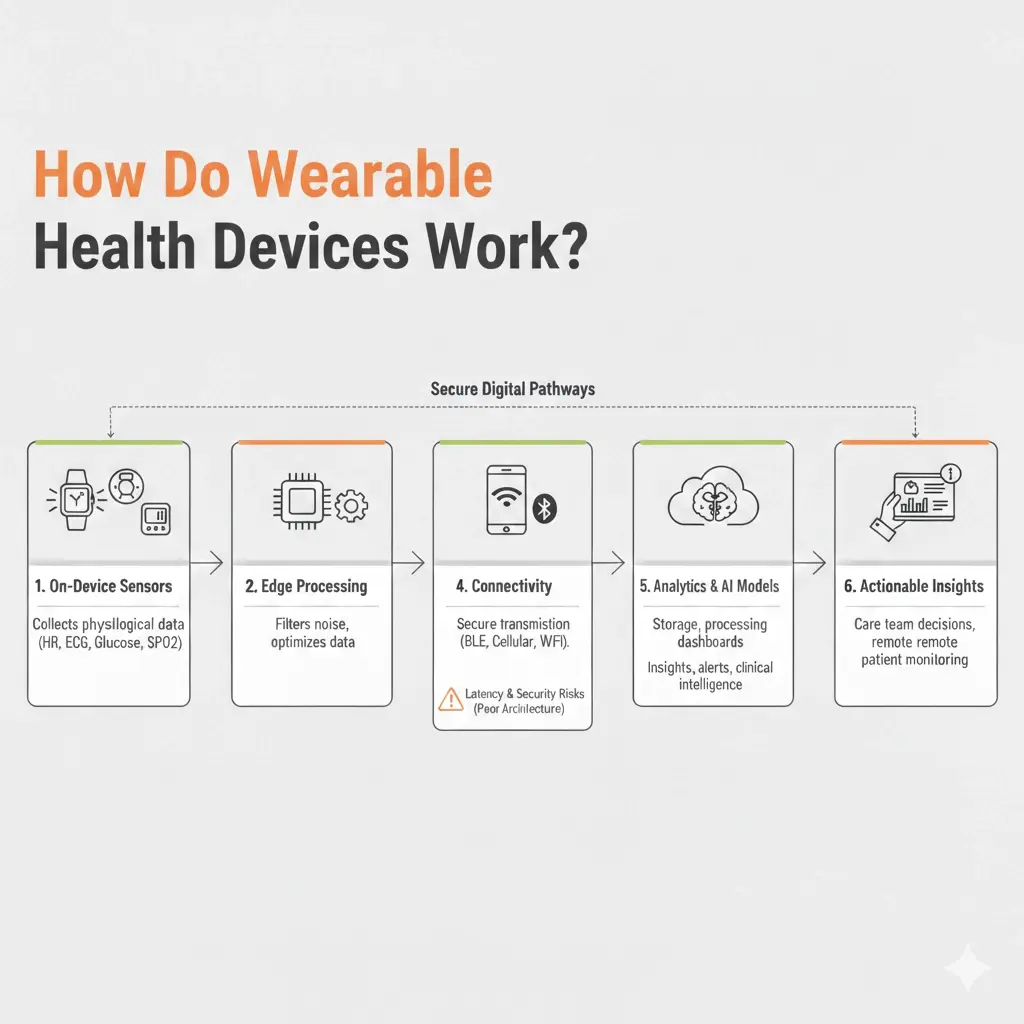
Most health monitoring devices follow this architecture:
- On-device sensors collect physiological data such as heart rate, ECG, glucose levels, movement, temperature, or oxygen saturation.
- Firmware and edge logic preprocess data to reduce noise and battery consumption.
- Connectivity layers transmit data via Bluetooth, cellular, or Wi-Fi to mobile apps or gateways.
- Cloud-based platforms store, process, and analyze data at scale, enabling dashboards, alerts, and integrations with healthcare systems.
- Analytics and AI models transform raw signals into actionable insights for clinicians, patients, or care teams.
This is where many wearable initiatives fail. Without a scalable cloud and data architecture, wearable health devices struggle with latency, data loss, security gaps, and limited clinical usefulness. Successful implementations treat wearables as part of a broader digital health ecosystem, not as isolated hardware.
Wearable Health Monitoring Devices and Patient Monitoring Use Cases
Wearable health monitoring devices play a central role in modern wearable tech in healthcare, particularly for continuous and remote care delivery. These devices enable wearable patient monitoring across multiple use cases:
- Chronic disease management for conditions like diabetes, cardiovascular disease, and respiratory disorders
- Post-discharge monitoring to reduce readmissions and detect complications early
- Preventive care and risk detection using continuous vital-sign tracking
- Hospital-at-home and RPM programs that rely on real-time patient data
From a transactional perspective, these use cases directly support new care models, reimbursement pathways, and digital health revenue streams. However, they also increase demands around data reliability, device accuracy, and integration with existing clinical workflows. This makes device selection and system design critical for long-term success.
Types of Wearable Medical Devices Healthcare Organizations Are Building
There are several types of wearable medical devices currently driving adoption across healthcare systems. Each comes with different technical and regulatory considerations.
Major categories include:
Smartwatches and wrist-worn medical wearables
Used for heart rate monitoring, ECG detection, activity tracking, and early arrhythmia alerts.
Continuous glucose monitors (CGMs)
Widely adopted for diabetes management, providing real-time glucose data without finger pricks.
ECG and cardiac monitoring wearables
Patch-based or wearable sensors designed for long-term heart rhythm monitoring.
Blood pressure monitoring wearables
Cuffless or semi-continuous solutions used in hypertension management.
Respiratory and sleep monitoring devices
Track breathing patterns, oxygen saturation, and sleep quality for conditions like sleep apnea.
Wearable biosensors and patches
Lightweight medical wearables are used for temperature, hydration, and biochemical monitoring.
These medical wearables differ significantly from consumer gadgets. They demand higher accuracy, stronger security controls, and clear regulatory pathways. For healthcare organizations, selecting the right device category is less about trends and more about aligning product goals with clinical value, technical feasibility, and time to market.
Examples of Wearable Medical Devices in Healthcare Products
Many healthcare organizations already rely on wearable medical devices as part of real-world care delivery, not just pilot programs. These examples show how wearable health devices are being used in practical, scalable ways.
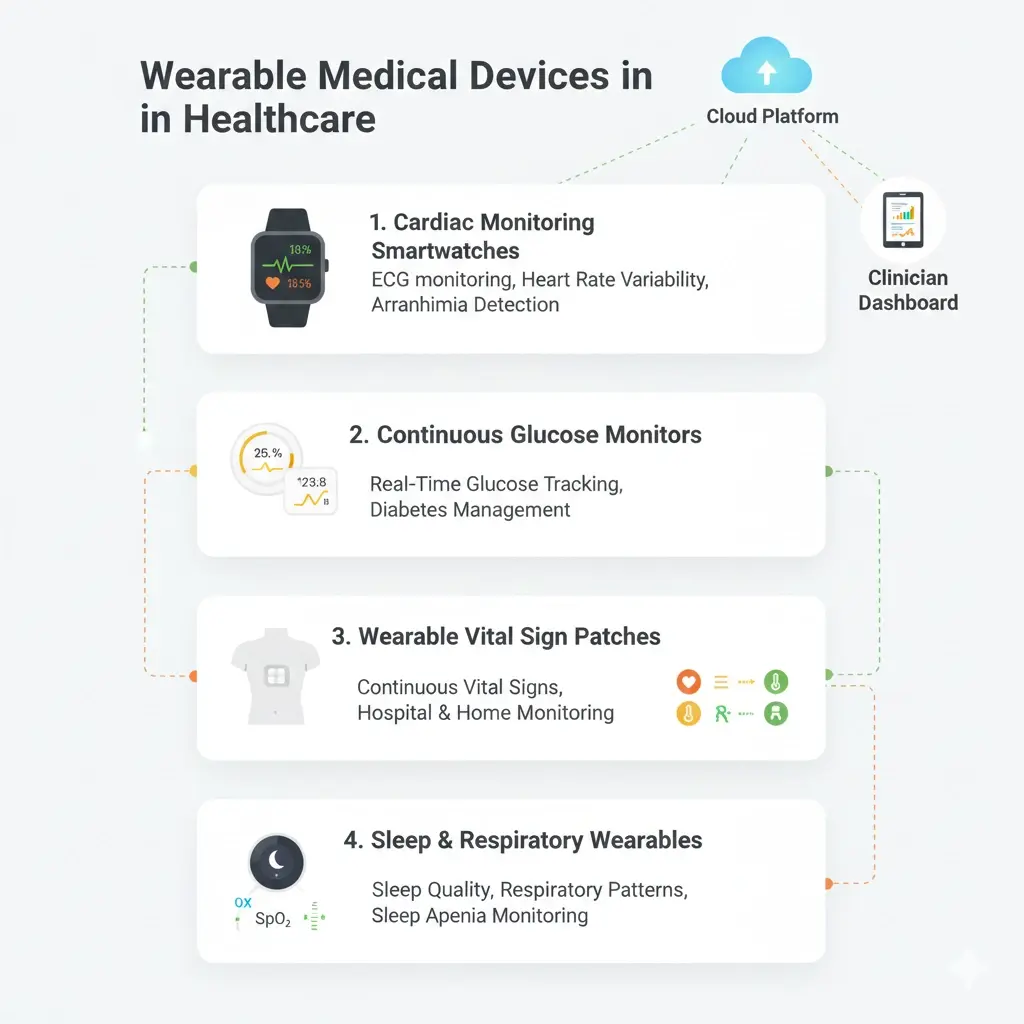
Common examples include:
- Smartwatches used for cardiac monitoring: Devices capable of ECG and heart rate variability tracking are widely used for early detection of irregular heart rhythms and long-term heart health monitoring.
- Continuous glucose monitoring devices: These wearables provide ongoing glucose data for people with diabetes and are increasingly integrated into digital health platforms for remote care.
- Wearable patches for vital sign monitoring: Lightweight, adhesive devices track metrics such as heart rate, temperature, and respiration in both hospital and home settings.
- Sleep and respiratory monitoring wearables: Used to assess sleep quality, oxygen saturation, and breathing patterns for conditions like sleep apnea.
These examples highlight an important point for decision-makers: successful health monitoring wearable devices are built as part of a connected system that includes mobile apps, cloud platforms, and clinician dashboards.
Benefits of Wearable Technology in Healthcare
When implemented correctly, the benefits of wearable technology in healthcare extend beyond convenience and patient engagement.
Key benefits include:
- Continuous health monitoring
Wearable health devices provide real-time data that supports early intervention rather than reactive care. - Improved patient engagement
Smart health devices encourage patients to take a more active role in managing their health. - Support for remote patient monitoring
Wearable patient monitoring enables care teams to track patients outside clinical settings, reducing unnecessary visits. - Operational efficiency
Smart devices in healthcare help reduce clinician workload by automating data collection and basic alerts.
For healthcare organizations, these benefits translate into better outcomes, lower costs, and more scalable care models.
Disadvantages of Wearable Technology in Healthcare
Despite their potential, there are real disadvantages of wearable technology in healthcare that must be addressed during planning and execution.
Common challenges include:
- Data accuracy and reliability
Not all wearable devices provide clinically reliable data, especially in uncontrolled environments. - Privacy and security concerns
Wearable health devices generate sensitive data that must be protected across devices, apps, and cloud systems. - User adherence issues
If devices are uncomfortable or difficult to use, patient adoption and long-term engagement suffer. - Integration complexity
Connecting wearable data to existing healthcare systems can be technically challenging and costly.
Understanding these limitations early helps organizations design wearable solutions that are realistic, compliant, and sustainable.
Wearable AI and Smart Health Devices
Wearable AI is becoming a key differentiator in modern smart health devices, but it is often misunderstood. AI does not replace clinicians. Instead, it helps wearable health devices make sense of large volumes of continuous data.
In practical healthcare applications, AI is used to:
- Detect patterns and anomalies in health monitoring data
- Reduce false alerts from wearable patient monitoring systems
- Personalize thresholds based on individual patient behavior
- Support early risk identification for chronic conditions
For healthcare organizations, the value of AI depends heavily on data quality and system design. Poorly implemented AI can increase risk rather than reduce it. Successful wearable tech in healthcare uses AI selectively, focusing on decision support rather than automated diagnosis.
Healthcare Wearable Technology Trends Shaping Investment Decisions
Several healthcare wearable technology trends are influencing how organizations plan and invest in wearable health devices.
Key trends include:
- Growth of remote patient monitoring programs driven by value-based care models
- Increased use of cloud-based platforms to manage wearable data at scale
- Greater focus on interoperability with EHRs and existing healthcare systems
- Rising adoption of medical-grade wearables over consumer-only devices
Looking ahead, the future of wearable technology in healthcare will be shaped less by new device form factors and more by how well Cloud-Based Medical Devices integrate into care workflows, data infrastructure, and regulatory frameworks.
Is Investing in Wearable Health Devices the Right Move for Your Organization?
Not every organization is ready to invest in wearable health devices, even if the market opportunity is strong. For product leaders and CTOs, the decision should be based on readiness, not hype.
You may be ready to invest if:
- You have a clear clinical or operational problem to solve
- You can support secure data handling and compliance requirements
- You plan to integrate wearable data into broader digital health systems
You may need to pause if:
- The use case relies solely on consumer-grade wearable devices
- Data accuracy or clinical validation is unclear
- Long-term scalability has not been evaluated
A structured feasibility assessment often saves more time and cost than rushing into development.
Building and Scaling Wearable Health Devices with the Right Technology Partner
Building reliable wearable health devices requires more than hardware selection. It involves product design, cloud architecture, IoT connectivity, data security, and regulatory awareness working together.
Healthcare organizations that succeed typically partner with teams experienced in:
- Designing scalable wearable platforms
- Integrating health monitoring devices with cloud and mobile systems
- Supporting compliance in the US and UK healthcare markets
- Evolving products from pilot to production
For organizations evaluating wearable tech feasibility, the next step is not choosing a device, but choosing the right execution partner like CitrusBits to build, scale, and support the solution long term.
FAQs
Q: What is the best wearable device for health?
Ans: The best wearable device depends on the use case. Consumer wearables are suitable for general wellness, while medical wearables are better for clinical monitoring and healthcare use.
Q: What are the four wearable devices commonly used in healthcare?
Ans: Common wearable devices include smartwatches, continuous glucose monitors, ECG or cardiac monitors, and wearable biosensor patches.
Q: Do cardiologists recommend smartwatches?
Ans: Cardiologists may recommend smartwatches for basic heart rhythm monitoring, but they do not replace medical-grade diagnostic devices.
Q: Are wearable health trackers worth it?
Ans: Wearable health trackers are worth it when used within structured healthcare or wearable patient monitoring programs rather than as standalone tools.
Q: What is the biggest problem with wearable technology?
Ans: The biggest problem is ensuring data accuracy, security, and proper integration with healthcare systems.
Q: What are three examples of wearable technology?
Ans: Examples include smartwatches, continuous glucose monitors, and wearable ECG or vital-sign monitoring devices.
Table of Contents
1) Why Wearable Health Devices Are a Strategic Investment in Healthcare?
2) What Are Wearables and What Counts as a Wearable Health Device Today
3) How Do Wearable Health Devices Work?
4) Wearable Health Monitoring Devices and Patient Monitoring Use Cases
5) Types of Wearable Medical Devices Healthcare Organizations Are Building
6) Examples of Wearable Medical Devices in Healthcare Products
7) Benefits of Wearable Technology in Healthcare
8) Disadvantages of Wearable Technology in Healthcare
9) Wearable AI and Smart Health Devices
10) Healthcare Wearable Technology Trends Shaping Investment Decisions
11) Is Investing in Wearable Health Devices the Right Move for Your Organization?
12) Building and Scaling Wearable Health Devices with the Right Technology Partner
Innovate the Future of Health Tech
CitrusBits helps MedTech leaders build smarter apps, connected devices, and XR health solutions that truly make an impact.
