

Blog
Healthcare App Development: Best Programming Languages for 2025-2026
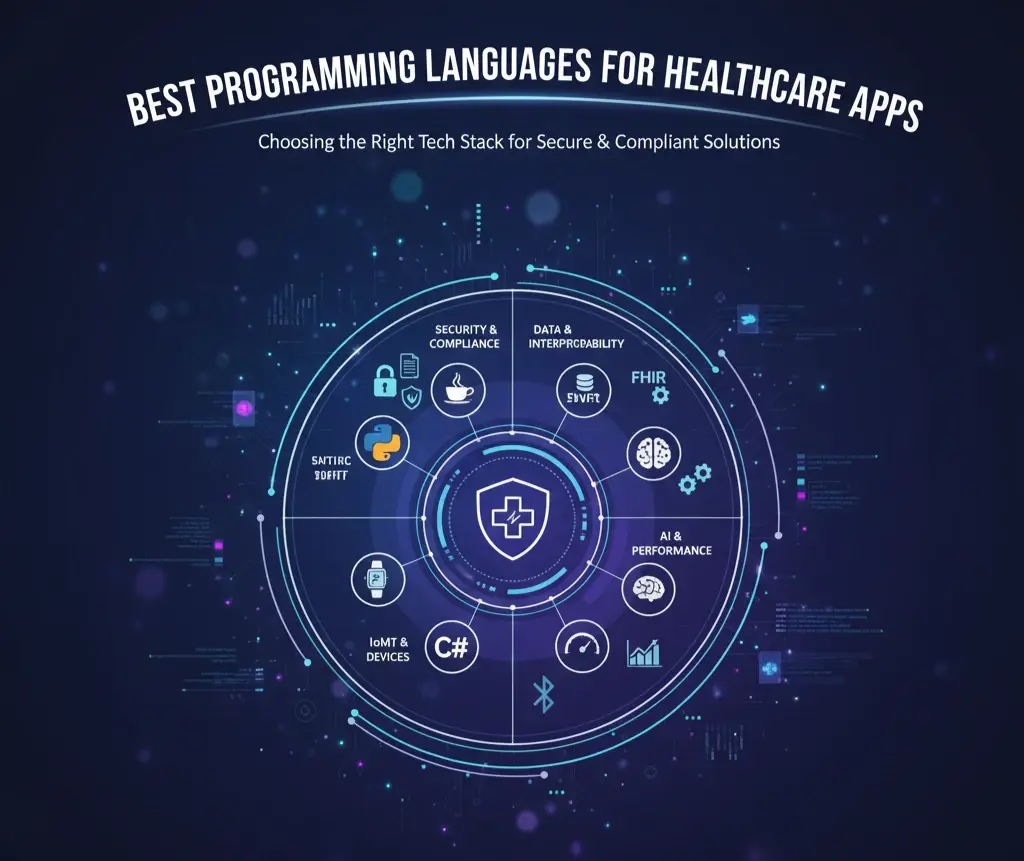
Choosing the programming languages for healthcare app development has become more crucial than ever as hospitals, MedTech startups, and digital health companies continue adopting AI-powered, HIPAA-compliant, and IoMT-connected solutions. The wrong programming language can slow development, create security vulnerabilities, or make HIPAA/HITECH compliance nearly impossible.
Whether you’re building a telemedicine platform, a remote patient monitoring (RPM) app, an IoMT device companion app, or an AI healthcare solution, choosing the right tech stack directly affects performance, reliability, long-term scalability, and regulatory success.
We are going to break down the best programming languages for healthcare apps, why they matter in today’s HealthTech ecosystem, and how to select the right one based on your use case, compliance needs, and clinical workflow requirements.
If you’re planning to build a healthcare application and want expert guidance on choosing the optimal language, frameworks, and architecture, explore our healthcare application development services for full-cycle MedTech and AI healthcare development.
Why Choosing the Right Programming Language Matters in Healthcare Software Development
Developing healthcare applications requires far more than selecting a language based on popularity or developer preference. Healthcare software must comply with strict industry regulations, support secure PHI storage, integrate with EHR/EMR systems, communicate with IoMT devices, and deliver reliable performance for clinicians and patients.
Because of this, the best programming languages for healthcare app development are those that provide strong security, interoperability, speed, and long-term maintainability.
1. Security Requirements (HIPAA, HITECH, SOC 2)
Healthcare applications handle Protected Health Information (PHI), making security a non-negotiable requirement. The programming language you choose must support:
- End-to-end encryption
- Secure authentication & authorization
- Audit logging
- Access controls (RBAC)
- Tokenization
- TLS 1.2+
- Vulnerability protection
Framework and language ecosystems with strong security libraries (such as Java, Swift, .NET, Python’s FastAPI + Django) are naturally better suited for healthcare.
HIPAA Security Rule https://www.hhs.gov/hipaa/index.html
2. Compliance & Regulatory Standards (SaMD, FDA, MDR, IEC 62304)
Healthcare app development goes beyond coding; compliance matters just as much. The best languages for medical app development support frameworks and workflows aligned with:
- FDA SaMD (Software as a Medical Device)
- ISO 13485
- IEC 62304 medical software lifecycle
- EU MDR compliance
- HIPAA/HITECH regulations
SaMD-related software often requires deterministic behavior, auditability, code clarity, and robust validation, making C#, Java, and C/C++ ideal choices for medical-grade software.
FDA Medical Device Software Guidance: https://www.fda.gov/medical-devices
3. Interoperability (FHIR, HL7, SMART on FHIR, EMR/EHR Integrations)
Modern healthcare apps need seamless connectivity with hospital systems and health data. Programming languages must support:
- FHIR APIs
- HL7 messaging
- SMART on FHIR apps
- EMR/EHR integration (Epic, Cerner, Allscripts)
- CCDs, C-CDA documents
- Health information exchanges (HIEs)
Languages with mature libraries for FHIR/HL7 integrations, like Python, Java, C#, Node.js, offer a huge advantage.
4. IoMT, Wearables & Medical Device Integration Requirements
As IoMT adoption grows, healthcare apps must integrate with:
- Wearables (Apple Watch, Fitbit, Garmin)
- Bluetooth Low Energy (BLE) medical devices
- Remote patient monitoring kits
- Hospital bedside devices
- Embedded sensors
Swift, Kotlin, C, C++, and Go are strong choices for IoMT because they support native hardware communication, low-latency data transfer, and secure device pairing.
5. Scalability & Performance for Clinical Workflows
Healthcare applications must handle:
- Thousands of concurrent users
- Live telemedicine sessions
- High-frequency sensor data
- Large image files (radiology, pathology)
- Real-time AI inference
Languages built for performance, Go, Rust, Java, and C# allow high throughput and stability, especially in enterprise-grade systems.
6. Long-Term Maintenance & Future-Proofing
Healthcare apps require long-term support due to:
- Regulatory updates
- EMR/EHR changes
- New AI capabilities
- Medical device integrations
- Staffing and maintenance cycles
Choosing the right language ensures easier maintenance, faster updates, and more secure patches.
Top Programming Languages for Healthcare App Development
Choosing the right tech stack for a healthcare app depends on your use case, security needs, compliance requirements, IoMT integration, and AI capabilities. Below is a detailed breakdown of the best programming languages for healthcare app development in 2025–2026, ranked by performance, security, and suitability for clinical environments.
1. Python: Best for AI, Predictive Analytics & Data-Driven Healthcare Apps
Python remains the #1 programming language for building AI healthcare apps, predictive analytics tools, and medical imaging solutions. Hospitals and MedTech companies rely on Python due to its powerful machine learning ecosystem.
Why Python Is Ideal for Healthcare App Development
- Advanced AI/ML frameworks: TensorFlow, PyTorch, Scikit-learn
- Perfect for clinical decision support systems (CDSS)
- Works excellently for medical imaging and radiology models
- Fast prototyping for MedTech startups
- Large community and rich libraries for healthcare data processing
- Works well with FHIR APIs and Cloud Healthcare datasets
Best Use Cases
- AI diagnostic tools
- Radiology imaging solutions
- Predictive analytics
- NLP for clinical notes
- Population health
2. Java/Kotlin: Best for Secure, Native Android Healthcare Apps
Java and Kotlin are the strongest choices for Android healthcare apps, especially those requiring high security, offline support, or hardware-level integrations.
Why Java/Kotlin Are Strong for Healthcare
- Excellent for telemedicine applications
- Best for hospital tablets and clinician Android devices
- Strong encryption and security libraries
- Ideal for RPM apps using Bluetooth, BLE, NFC
- Great for companion apps for IoMT medical devices
Best Use Cases
- Telehealth apps
- Android RPM dashboards
- IoMT device companion apps
- Hospital workflow apps
3. Swift: Best for iOS Healthcare, mHealth & Medical Device Applications
Swift is the top choice for developing healthcare apps on iOS, especially clinician apps, patient-facing mHealth apps, and apps requiring Apple HealthKit and CareKit integration.
Why Swift Is Perfect for iOS Medical Apps
- Strong type safety, reducing security errors
- Seamless integration with HealthKit, CareKit, ResearchKit
- Excellent performance for real-time data
- Great for Apple Watch apps for continuous monitoring
- Supports secure offline mode for clinics
Best Use Cases
- Patient portals
- Remote monitoring apps
- Clinician-facing apps
- Apple Watch medical integrations
4. Flutter: Best for Fast, Multi-Platform Healthcare MVPs & Startups
Flutter offers a single codebase for iOS, Android, and web, a huge advantage for healthcare startups trying to release quickly.
Why Flutter Works Well in Healthcare
- Smooth UI for telehealth & patient apps
- Ideal for MVPs and mid-sized MedTech solutions
- Easy to maintain compared to native apps
- Good performance with IoMT dashboards
- Can integrate AI features via Python APIs
Best Use Cases
- Telemedicine apps
- Wellness apps
- Cross-platform patient engagement apps
- RPM interfaces
5. React Native: Best for Telehealth & Real-Time Healthcare Apps
React Native is widely used for building cross-platform telehealth apps, doctor-patient communication tools, and RPM dashboards because of its high performance and rapid development cycles.
Why React Native Is a Strong Healthcare Choice
- Great for video consultations
- Works well with WebRTC telehealth integrations
- Lower development costs
- Easy to integrate Node.js backend
- Supports IoMT visual dashboards
Best Use Cases
- Telemedicine solutions
- Medical chat apps
- RPM dashboards
- Hybrid wellness apps
6. C# / .NET: Best for Enterprise Healthcare, EHR/EMR Systems & Hospital Platforms
C# and .NET dominate enterprise healthcare due to their scalability, security, and integration capabilities.
Why .NET Is Excellent for Healthcare Systems
- Strong support for ICD-10, HL7, FHIR integration
- Excellent for cloud-hosted hospital systems
- Reliable for multi-hospital deployments
- FDA-friendly for SaMD
- Great for enterprise-grade reporting & analytics
Best Use Cases
- EHR/EMR systems
- Hospital management systems
- Enterprise telehealth portals
- SaMD platforms
7. Go (Golang): Best for IoMT Data Pipelines & High-Performance Backends
Go is rapidly gaining popularity in healthcare because of its ability to handle massive real-time data streams, such as those from IoMT devices, sensors, and RPM systems.
Why Go Is Useful in Healthcare
- Highly scalable for real-time workloads
- Efficient for IoMT data pipelines
- Excellent for microservices
- Strong concurrency
Best Use Cases
- IoMT hubs
- Data ingestion pipelines
- Backend services
- High-throughput hospital dashboards
8. Rust: Best for High-Security Medical Device Software (SaMD)
Rust is becoming the go-to language for high-security, safety-critical medical device software, especially where memory safety is essential.
Why Rust Is Becoming Popular in Healthcare
- Memory-safe (prevents common vulnerabilities)
- Suitable for embedded medical devices
- Great for secure clinical platforms
- Future-proof for next-gen SaMD solutions
Best Use Cases
- Medical device firmware
- Real-time monitoring systems
- Safety-critical software
- Low-latency clinical systems
Recommended Tech Stack
Modern healthcare apps use a combination of frontend, backend, AI/ML, and cloud services. Below is the optimal tech stack for fast, safe, and scalable development.
Frontend (Mobile + Web)
- Swift: iOS healthcare apps
- Kotlin: Android healthcare apps
- Flutter: Cross-platform mobile
- React Native: Real-time communication & telehealth
- React.js: Web dashboards for clinicians
Backend Technologies
- Node.js: Fast APIs for telehealth
- Python (Django / FastAPI: AI workflows
- .NET Core: Enterprise hospital systems
- Go: High-performance IoMT pipelines
AI & Machine Learning Stack
- TensorFlow
- PyTorch
- Scikit-learn
- FastAPI (serving models)
- GPUs (NVIDIA / AWS Inferentia)
Databases
- PostgreSQL
- MongoDB
- DynamoDB
- Elasticsearch
- Time-series DBs for IoMT data
Healthcare Cloud Platforms (Highly Important)
- AWS HealthLake: https://aws.amazon.com/healthlake/
- Google Cloud Healthcare API: https://cloud.google.com/healthcare
- Azure Health Data Services
These platforms provide built-in support for:
- FHIR data stores
- EMR/EHR integrations
- Medical NLP
- HIPAA-compliant environments
Considerations Before Choosing a Programming Language
Selecting a programming language for healthcare app development requires a deep understanding of clinical workflows, security risks, compliance demands, and long-term scalability. Because healthcare apps handle sensitive PHI, integrate with EHR/EMR systems, and increasingly rely on AI, IoMT, and real-time analytics, choosing the right tech stack directly impacts performance, privacy, and regulatory success.
Security, Privacy & Compliance Requirements
Healthcare apps must meet strict regulations, including HIPAA, HITECH, FDA SaMD, and SOC 2. The programming language should support:
- Strong encryption (AES-256, TLS 1.2+)
- Secure authentication & role-based access control
- Support for audit trails & PHI handling
- Active security libraries & patches
- Secure APIs for PHI transmission
Languages like C#, Java, Swift, and Python (with Django/FastAPI) excel in regulated environments.
Integration with EMR/EHR Systems (FHIR, HL7, SMART on FHIR)
Healthcare apps rarely operate alone; they require seamless interoperability with systems like Epic, Cerner, Allscripts, and national HIEs. Choose languages that offer:
- Robust FHIR client libraries
- HL7 v2/v3 support
- SMART on FHIR compatibility
- Secure OAuth 2.0 authentication
- JSON & XML data processing reliability
Languages with strong interoperability support include Python, C#, Java, and Node.js.
IoMT, Wearable & Device Connectivity Needs
IoMT apps need reliable communication with:
- Bluetooth & BLE medical devices
- NFC readers
- Wearables (Apple Watch, Garmin, Fitbit)
- Embedded health sensors
- Clinical monitoring devices
Languages like Swift, Kotlin, C/C++, and Go provide the performance and hardware access required for continuous monitoring and low-latency data transfer. Learn more about IoMT here: https://citrusbits.com/internet-of-medical-things-iomt/
Scalability for High User Loads
Telemedicine apps, AI-powered diagnostics, and remote patient monitoring systems must handle:
- Thousands of concurrent video sessions
- Real-time IoMT sensor ingestion
- Instant synchronization with the hospital system
- Parallel AI inference workloads
Choose languages/frameworks optimized for concurrency and distributed systems: Go, Java, .NET, Python + FastAPI.
Development Speed vs. Long-Term Maintainability
Some projects prioritize fast MVP development, while others require long-term enterprise support.
- Flutter, React Native = best for fast, cost-effective MVPs
- Swift, Kotlin = ideal for stable native apps
- C#, Java, Python = better for enterprise healthcare systems
Pick based on roadmap, team capabilities, and maintenance cycles.
AI, Machine Learning & Predictive Analytics Requirements
If your roadmap includes:
- Clinical decision support (CDSS)
- Predictive risk scoring
- Radiology or pathology AI
- NLP for clinical notes
- Medical imaging AI
Then Python is the clear winner due to its unmatched ML ecosystem (PyTorch, TensorFlow, Scikit-learn).
Team Expertise, Talent Availability & Ecosystem Support
A language is only as good as the developers who maintain it.
Choose languages with:
- Large communities
- Rich healthcare libraries
- Long-term vendor support
- Skilled talent availability
- Extensive documentation
This ensures long-term stability and rapid feature expansion.
Final Recommendations

Ready to Build a Secure, Compliant Healthcare App?
Developing healthcare apps requires mastery over security, compliance, architecture, AI, IoMT, and clinical workflow design. If you’re planning to build a telehealth app, IoMT platform, remote patient monitoring system, or AI healthcare solution, our team can help.
👉 Visit https://citrusbits.com/ to get expert guidance, architecture planning, and full-cycle MedTech development support.
FAQs
Q: What is the most secure programming language for healthcare apps?
Ans: C#, Java, and Rust offer strong security and are ideal for HIPAA-compliant apps.
Q: Which programming language is best for HIPAA-compliant apps?
Ans: Java, C#, Python (with Django/FastAPI), and Swift are frequently used in HIPAA-compliant systems.
Q: Is Flutter good for healthcare app development?
Ans: Yes, Flutter is fast, efficient, and ideal for telemedicine, patient engagement, and RPM app MVPs.
Q: Which language is best for AI healthcare applications?
Ans: Python remains the top choice due to its ML ecosystem.
Q: What tech stack is best for IoMT applications?
Ans: Swift/Kotlin for front ends, Go/C/C++ for device communication and backend processing.
Table of Contents
1) Why Choosing the Right Programming Language Matters in Healthcare Software Development
2) Top Programming Languages for Healthcare App Development
3) Recommended Tech Stack
4) Considerations Before Choosing a Programming Language
5) Final Recommendations
6) Ready to Build a Secure, Compliant Healthcare App?
Innovate the Future of Health Tech
CitrusBits helps MedTech leaders build smarter apps, connected devices, and XR health solutions that truly make an impact.
