


Blog
The 5 Phases of Medical Device Development: Requirements and FDA Process
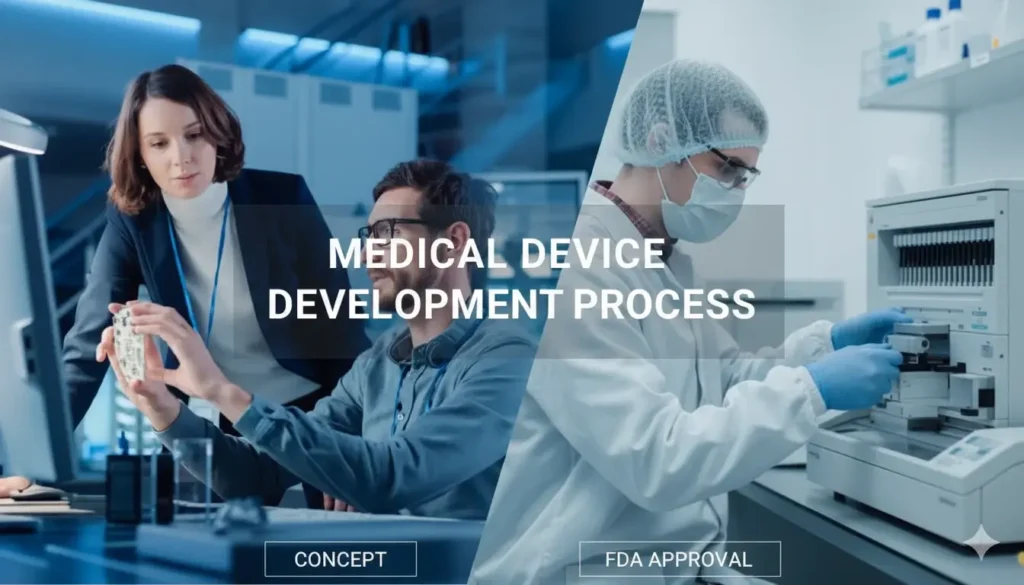
Bringing a new medical device to market demands far more than engineering skill; it requires a structured, regulatory-driven pathway that ensures safety, performance, and patient impact. The Medical Device Development Process is a multi-phase journey that blends clinical insight, risk management, design controls, and rigorous testing to transform an initial idea into a market-ready product.
Whether you’re building a diagnostic tool, a digital health platform, or a Class III life-sustaining device, understanding the stages of medical device development is essential for avoiding costly delays and achieving FDA clearance.
What Is the Medical Device Development Process?
The Medical Device Development Process is a structured, regulatory-driven framework used to design, engineer, validate, manufacture, and launch safe and effective medical devices. Unlike traditional product design, medical device development must follow strict FDA and international standards, such as ISO 13485, ISO 14971, IEC 62304, and human factors engineering to ensure clinical safety and technical reliability.
This structured product development process for medical devices includes:
- Understanding user needs and clinical requirements
- Translating those needs into risk-controlled engineering specifications
- Building prototypes that meet performance and safety standards
- Testing and validating the device in labs and clinical environments
- Preparing documentation for FDA submission
- Establishing controlled manufacturing and post-market monitoring
A well-executed process not only speeds time-to-market but also reduces compliance issues, development costs, and regulatory risks.
Complete 5 Phases of Medical Device Development
Although many frameworks break the lifecycle into 5 phases of medical device development, they all include the same core stages:
- Concept Development
- Feasibility & Technology Development
- Design & Engineering
- Verification, Validation & Clinical Evaluation
- Regulatory Approval & Market Launch
- (Often included as a sixth phase) Post-Market Surveillance
Together, these stages form a structured, risk-controlled medical device new product development process that ensures safety, performance, and regulatory compliance.
Completing each stage with strong documentation and engineering discipline is the key to faster approvals and lower development risk.
1. Medical Device Concept Development (Phase 1)
The journey begins with medical device concept development, where innovators identify a clinical problem and define how a new device can solve it. This stage sets the foundation for all downstream engineering and regulatory activities.
Key activities in this phase include:
- Identifying clinical needs: Conducting interviews with clinicians, observing procedures, and analyzing gaps in current solutions.
- Market and competitive analysis: Determining demand, reimbursement potential, and existing technologies.
- Initial feasibility assessment: Reviewing whether the concept is technically achievable and clinically relevant.
- User personas and workflow mapping: Ensuring the device fits into real medical environments.
- Diagnostic medical device development considerations: For diagnostic products, early definition of biomarkers, accuracy requirements, and testing methodologies is essential.
By the end of this phase, companies typically establish early design requirements, use-case diagrams, and a preliminary technological approach for the device.
2. Feasibility & Medical Device Technology Development (Phase 2)
Once the concept is validated, the next step is transforming the idea into an engineering strategy. This is where medical device technology development begins, focusing on proving that the concept can work reliably in practical conditions.
This phase includes:
- Proof-of-concept prototyping: Early bench models or breadboards to demonstrate functional viability.
- Engineering feasibility studies: Understanding performance thresholds, materials, sensors, electronics, and software architecture.
- Initial risk assessment: Following ISO 14971 to identify hazards and safety mechanisms.
- Preliminary usability engineering: Assessing potential use errors and early human factors considerations.
- Technical documentation: Starting a foundation for the Design History File (DHF).
This stage greatly influences cost, development time, and regulatory classification. Decisions made here determine whether the device’s architecture is sound enough to proceed to detailed design and prototyping.
3. Design & Engineering: The Core of Medical Device Development (Phase 3)
This is the most intensive part of the medical device and design process. During this phase, engineering teams convert feasibility outputs into a complete, manufacturable design. The device begins to take shape, mechanically, electronically, and through its software systems.
Key elements of this phase include:
- Design Inputs: User needs, regulatory requirements, risk controls, and performance specifications.
- Design Outputs: CAD models, schematics, firmware, software code, materials, and manufacturing drawings.
- Iterative prototyping: Alpha and beta prototypes refined through multiple engineering cycles.
- Design Reviews: Formal milestone evaluations to ensure compliance and traceability.
- Design for Manufacturability (DFM): Ensuring the device can be produced at scale with consistent quality.
- Human Factors & Usability: Designing intuitive interfaces and reducing use-related risks.
This phase aligns with what competitors call “preclinical research–prototype,” but extends deeper into full engineering maturity required to enter testing and validation.
Modern devices increasingly rely on software, mobile interfaces, and connected platforms. Ensuring the software is secure, compliant, and user-centric is a critical part of the engineering phase.
If your solution requires a companion app or digital interface, exploring best practices in medical app development can help you streamline usability, data integration, and regulatory readiness from the start.
4. Verification, Validation & Clinical Evaluation (Phase 4)
Before any medical device can be submitted for regulatory approval or mass production, it must undergo rigorous testing to confirm that it works as intended.
Design Verification (Does it meet engineering specifications?)
- Bench, mechanical, electrical, and environmental testing
- Software verification following IEC 62304
- Biocompatibility testing using ISO 10993
- Reliability and stress testing
- Electrical safety (IEC 60601)
Design Validation (Does it meet user needs?)
- Human factors validation studies
- Usability testing in simulated or relevant clinical environments
- System-level validation
Preclinical & Clinical Evaluation
- Animal studies (if required) to confirm biological safety and performance
- Clinical trials based on device class and FDA pathway
- Evidence generation to support marketing claims
This stage completes one of the most crucial parts of the 5 phases of medical device development, ensuring that the device is safe, effective, and ready for regulatory submission.
5. Regulatory Strategy & FDA Approval Pathways (Phase 5)
Navigating regulatory requirements is one of the most challenging and essential parts of the medical device development process.
How to Get Products FDA Approved?
The first regulatory step is determining the device category:
- Class I: Low-risk devices, often exempt from premarket submission
- Class II: Moderate risk, typically requiring a 510(k) submission
- Class III: High risk, requiring Premarket Approval (PMA)
Companies determine the correct pathway 510(k), De Novo, or PMA based on the device’s risk level, novelty, and existing predicate devices.
FDA Medical Device Approval Process Timeline
The timeline varies by pathway:
- 510(k): ~90 days review time (often 6–12 months total with preparation)
- De Novo: 8–12 months
- PMA: 1–3 years, including clinical data
FDA Approval Process for Medical Devices: Core Requirements
- Complete Design History File (DHF)
- Clinical and performance evidence
- Risk management file
- Software documentation (if applicable)
- Labeling and instructions for use
- Quality system compliance (21 CFR Part 820)
6. Manufacturing Transfer & Production Readiness (Phase 6)
Once the device has passed verification and validation, it moves into manufacturing transfer, where engineering and production teams collaborate to prepare for large-scale, compliant manufacturing. This phase ensures the medical device can be produced consistently, safely, and efficiently.
Key steps in this phase include:
Process Validation (IQ, OQ, PQ):
- Installation Qualification (IQ): Ensures equipment is installed correctly.
- Operational Qualification (OQ): Verifies that equipment operates within required limits.
- Performance Qualification (PQ): Confirms stable production at intended volumes.
Pilot Builds: Small-run manufacturing to test assembly workflows, tooling, and supply chain logistics.
Supply Chain Establishment: Selecting and validating vendors for components, packaging, sterilization, and distribution.
Quality Control Systems: Implementing inspection, testing, and documentation processes that align with ISO 13485 and FDA QSR.
Packaging & Sterilization Validation: Ensuring sterility maintenance, shelf-life stability, and compliance with IEC/ISO packaging standards.
This stage determines whether the device is ready for market introduction and long-term commercial success.
7. Post-Market Surveillance & Continuous Improvement (Final Phase)
After regulatory approval and product launch, the work is far from over. The FDA and global regulatory bodies require ongoing monitoring to ensure devices remain safe and effective in real-world usage.
Post-market activities include:
- Complaint Handling: Capturing and analyzing user-reported issues.
- CAPA (Corrective and Preventive Actions): Implementing solutions to address systemic problems.
- Field Safety Corrective Actions & Recalls (if required): Taking immediate steps to mitigate risks.
- Monitoring Product Performance: Using real-world data, clinician feedback, and usage analytics for iterative improvements.
- Software Updates & Cybersecurity Maintenance: Ensuring digital and connected devices remain stable and secure.
This aligns with competitors’ “FDA Post-Market Safety Monitoring,” but extends into modern considerations like cybersecurity and digital updates, key for today’s connected devices.
Summary
Successfully navigating the entire medical device development process requires deep expertise in engineering, human factors, regulatory strategy, FDA submissions, and manufacturing readiness. By following a structured, compliant methodology, companies can reduce delays, avoid design pitfalls, and bring innovative healthcare solutions to market with confidence.
If you’re ready to accelerate your development process, consider working with a specialized team:
Partner with a medical device software development company like CitrusBits to build compliant, reliable digital and embedded systems.
References
- Medical Device Overview
https://www.fda.gov/medical-devices
- Premarket Notification 510(k)
https://www.fda.gov/medical-devices/premarket-submissions/premarket-notification-510k
- ISO 13485 – Medical Devices Quality Management Systems
https://www.iso.org/standard/59752.html
- IMDRF (International Medical Device Regulators Forum)
Table of Contents
1) What Is the Medical Device Development Process?
2) Complete 5 Phases of Medical Device Development
3) Summary
4) References
Innovate the Future of Health Tech
CitrusBits helps MedTech leaders build smarter apps, connected devices, and XR health solutions that truly make an impact.
