


Blog
Medical Mobile App Development: A Guide to Building Secure, Scalable Healthcare Apps
Healthcare is transforming faster than ever, and at the center of this evolution lies medical mobile app development, a powerful bridge connecting patients, providers, and modern digital care. From remote patient monitoring and AI-assisted diagnostics to telemedicine and medical device integrations, healthcare apps are no longer optional; they’re becoming essential components of high-quality care delivery.
Whether you’re a healthcare organization, startup, or MedTech innovator, understanding how to develop a medical app securely, compliantly, and strategically can determine your success in today’s competitive digital health landscape.
This article explores everything from “what an app in healthcare is” to the processes, technologies, costs, and compliance standards behind healthcare mobile app development.
What Is a Medical App? Exploring Mobile Apps in Healthcare
Healthcare today is more digital, connected, and patient-driven than ever before. A medical app is any mobile application designed to support patient care, clinical workflows, diagnostics, monitoring, or overall health management. These apps enable secure communication between patients and providers, automate administrative tasks, improve diagnosis accuracy, and empower users to manage their health from anywhere.
In simple terms, an app in healthcare is a digital tool that brings medical services, data, and decision-making directly to smartphones and connected devices.
Key Characteristics of Modern Medical Mobile Apps
- Built with healthcare regulations in mind (HIPAA, GDPR, HL7/FHIR)
- Designed for accessibility and multi-device usage (iOS, Android, tablets)
- Integrated with EMR/EHR systems and medical devices
- High-level encryption and data protection
- Smart features powered by AI, IoT, and cloud computing
Types of Medical Mobile Apps Shaping Digital Healthcare
The medical app ecosystem is expanding rapidly, driven by AI advancements, cloud adoption, and the integration of medical devices. Below are the major categories within medical app development and healthcare app development, each offering unique value for patients, clinicians, and healthcare enterprises.
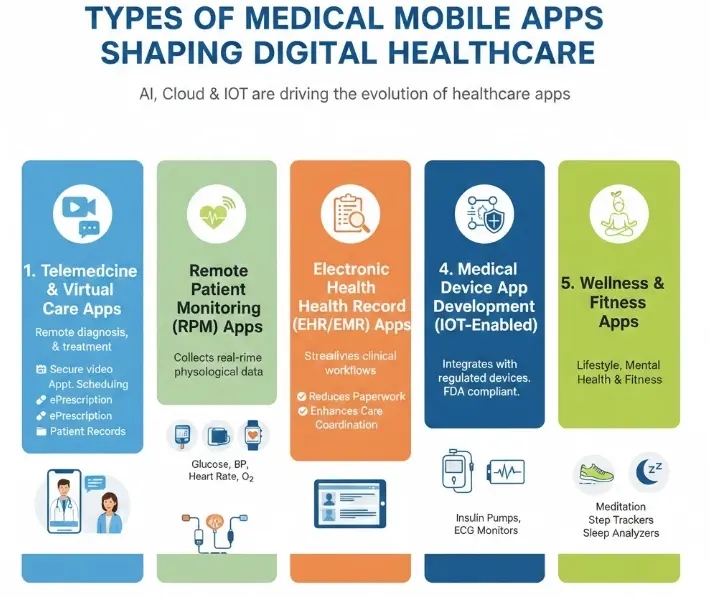
1. Telemedicine & Virtual Care Apps
Telemedicine apps allow healthcare providers to diagnose, monitor, and treat patients remotely through video consultations, messaging, and digital prescriptions. They have become essential for care accessibility and operational efficiency.
Common features:
- Secure video sessions
- Appointment scheduling
- ePrescription
- Patient records
2. Remote Patient Monitoring (RPM) Apps
RPM apps pair with IoT-based medical devices to collect real-time physiological data. This enables proactive and preventive healthcare.
Examples: Glucose meters, blood pressure devices, wearables tracking heart rate & oxygen levels.
3. Electronic Health Record (EHR/EMR) Apps
These apps streamline clinical workflows by giving clinicians quick access to patient records, lab results, history, and treatment plans.
Benefits:
- Improves decision-making
- Reduces paperwork
- Enhances care coordination
4. Medical Device App Development (IoT-Enabled)
This category includes apps that integrate with regulated devices. These apps require precision, FDA guidelines, and tight security protocols.
Use Cases:
- Insulin pump controllers
- ECG & heart monitoring apps
- Wearable medical sensors
5. Wellness & Fitness Apps
These apps focus on lifestyle, mental health, and general fitness.
Examples: Meditation apps, step trackers, sleep analyzers.
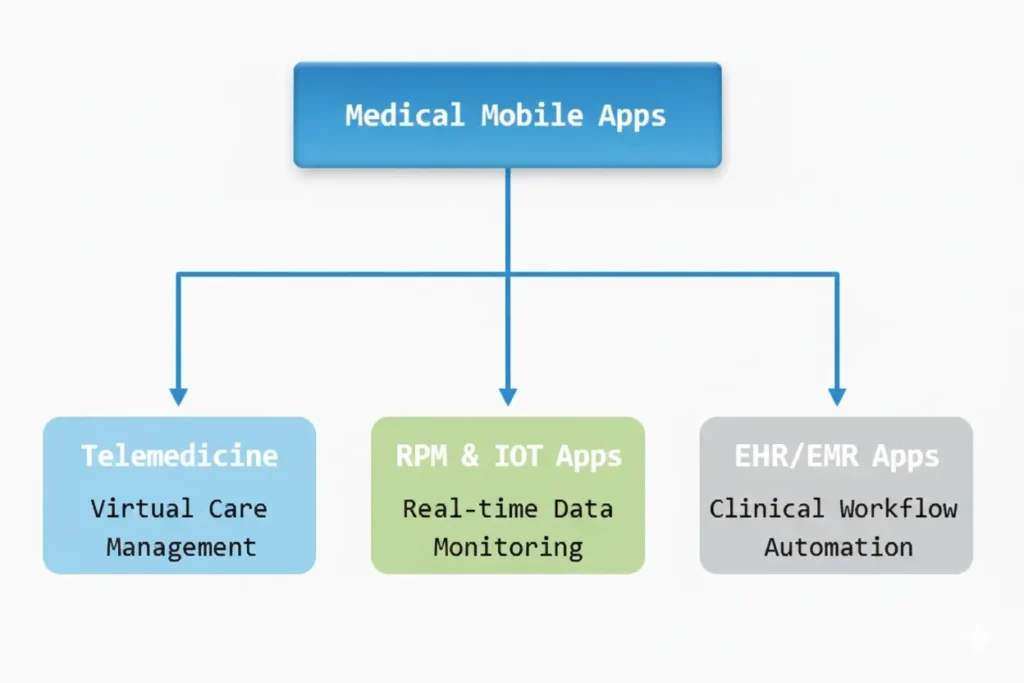
Medical Mobile App Ecosystem
Healthcare Mobile App Development Market Overview
The global healthcare mobile app development market continues to scale rapidly as digital health technologies become deeply embedded in patient care, diagnostics, and medical operations. With patients expecting on-demand healthcare access and providers adopting data-driven clinical tools, the demand for medical app development and mobile health app development is stronger than ever.
Today’s winning healthcare apps combine AI-driven intelligence, IoT-powered medical device integrations, and secure cloud infrastructures, making them more advanced and more essential than ever before.
Market Insights & Growth Factors
Here’s a concise look into the driving forces behind the industry’s explosive growth:
- Increased adoption of telemedicine and virtual care
- Aging populations requiring continuous monitoring
- IoT-driven medical devices and remote patient monitoring
- AI and machine learning for diagnostics and automation
- Cloud migration is making apps scalable, secure, and efficient
- Regulatory frameworks pushing interoperability and data transparency
- High smartphone penetration across global markets
Factor | Impact | Description |
Telehealth Expansion | High | Surge in virtual consultations and remote care tools |
RPM Device Adoption | High | IoT medical devices fueling data-driven patient monitoring |
AI Integration | Medium–High | Enhances diagnostics, triage, patient support, automation |
Wearables & Sensors | High | Increases need for connected healthcare mobile apps |
Interoperability (FHIR/HL7) | High | Enables seamless EMR/EHR integration |
Hospital Digital Transformation | High | Health systems investing heavily in secure applications |
How to Develop a Medical App? Step-by-Step Guidelines
Building a secure, scalable, and compliant healthcare application requires far more than traditional app development. Medical mobile app development must align with clinical workflows, regulatory standards, medical device integrations, and patient safety requirements.
Below is the complete roadmap used by top healthcare development companies when delivering healthcare mobile app development services.
Step 1: Validate Your Medical App Idea
Successful healthcare apps start with a validated concept, market fit, and real clinical value. Validation ensures your solution solves measurable problems for patients, providers, or healthcare systems.
Key Actions
- Conduct in-depth market research
- Evaluate competitor apps
- Consult clinicians, healthcare administrators, and patients
- Assess regulatory classification (FDA Class I, II, III if applicable)
- Determine the feasibility of IoT or AI integrations
Step 2: Define Your App’s Core Features & User Roles
Healthcare apps must define all user roles clearly:
- Patients
- Doctors
- Nurses
- Medical technicians
- Admins
Once roles are clear, features can be mapped precisely to user workflows.
Common Features for Healthcare Apps
User | Common Features |
Patients | Telehealth, appointment booking, medication reminders, EMR access, AI chat support |
Doctors | EHR integration, e-Prescriptions, task management, clinical dashboards |
Admins | Billing, insurance, workflow automation, analytics |
RPM Users | IoT device pairing, real-time vitals tracking, alerts |
Include advanced features like:
- Wearable integrations
- Multi-language support
- Biometric authentication
- HIPAA-compliant messaging
Step 3: Choose the Right Tech Stack
Choosing the correct technologies determines performance, security, and long-term scalability.
iOS Healthcare App Development Stack
- Swift, SwiftUI
- HealthKit, CareKit
- HIPAA-compliant APIs
- CloudKit or secure backend systems
Android Healthcare Application Development Stack
- Kotlin, Jetpack Compose
- Google Fit APIs
- Secure Room database
- Encrypted SharedPreferences
Cross-Platform Options
- React Native
- Flutter
- Ionic (less common for medical apps)
Backend Technologies
- Node.js
- Python (Django/FastAPI)
- Java/Spring Boot
- .NET
Compliance & Security Tools
- OAuth 2.0 / OpenID Connect
- SSL/TLS encryption
- FHIR server modules
- Role-based access control
Step 4: UI/UX Design for Medical Apps
Healthcare UX demands accuracy, simplicity, and accessibility. A poor interface can impact clinical outcomes or patient adherence.
Key UX Principles
- High contrast & readable fonts
- Large touch targets
- Minimal steps per task
- Consistent iconography
- Clear error messages
- Accessibility (WCAG guidelines)
Step 5: Develop Core Features & Integrations
Development begins by building secure and modular components.
Important Development Areas
- Authentication (biometric/2FA)
- HIPAA-compliant chat and data storage
- EHR/EMR integration via FHIR/HL7
- Medical device connectivity (Bluetooth, WiFi, BLE)
- Payment/billing integrations
- Push notifications
AI-Driven Enhancements
- Automated triage
- Chatbots
- Predictive risk scoring
- Image analysis (radiology, dermatology)
Step 6: Ensure Compliance & Security
This is one of the most critical steps in medical app development.
Required Standards
Standard | Applies To | Purpose |
HIPAA | US apps | Protect patient data |
GDPR | EU users | Regulate personal data |
HL7/FHIR | Interoperability | Data exchange |
FDA Guidelines | Medical devices | Safety & accuracy |
ISO 13485 | Devices | Quality management |
Security Measures
- End-to-end encryption
- Secure API gateways
- RBAC (Role-Based Access Control)
- PHI anonymization
- Logging & audit trails
Step 7: Test Your Healthcare App Thoroughly
Medical apps must undergo extensive testing to ensure reliability and safety.
Testing Types
- Functional testing
- Clinical workflow testing
- Performance testing
- Penetration testing
- Compliance checks
- Usability testing for patients & clinicians
Testing Workflow
Design → Develop → Test → Validate → Fix → Approve → Deploy
Step 8: Deploy, Monitor & Maintain the App
Once approved, the app can be deployed to the Apple App Store, Google Play Store, or private enterprise distribution systems.
Ongoing Maintenance Includes
- Version updates
- Compliance upgrades
- Server optimizations
- Bug fixes
- Adding new features
- Continuous monitoring of device integrations
Why Medical Mobile App Development Matters Today
The demand for medical mobile app development is skyrocketing, driven by patient expectations, hospital digital transformation, and the rapid expansion of AI and IoT in healthcare.
Here’s why healthcare organizations, enterprises, and MedTech startups are investing heavily in healthcare mobile app development services:
Patients Demand Digital-First Experiences: Patients expect convenience, transparency, and 24/7 access to care. Mobile apps make this possible.
Providers Need Efficient Clinical Workflows: Apps reduce administrative overhead, streamline documentation, and optimize medical decision-making.
Medical Devices Require Smart Connectivity: IoT-driven medical device apps enable continuous monitoring, personalized care, and early diagnosis.
AI, Cloud, and Data Analytics Are Transforming Care: Healthcare apps now leverage:
- AI triage
- Predictive analytics
- Chatbots
- Digital twins
- Personalized medicine algorithms
Regulatory Push for Interoperability: Standards like FHIR and HL7 allow secure, fast, and standardized data exchange between systems. Learn about HL7 in Healthcare in detail here: https://citrusbits.com/what-is-hl7-in-healthcare-v2-v3-cda/
Financial Efficiency: Hospitals using digital systems save up to 20–30% in operational costs through automation, virtual care, and optimized workflows.
Key Trends Driving Mobile Health App Development
Below are the most influential trends shaping android healthcare application development, iOS healthcare apps, and cross-platform solutions today.
- AI & Machine Learning in Healthcare Apps
AI is revolutionizing diagnostics, triage, patient engagement, and clinical decision-making.
AI use cases include:
- Predictive analytics for patient risk assessments
- AI-based symptom checkers
- NLP-powered chatbots
- Automated transcription for medical notes
- Personalized care recommendations
- Internet of Medical Things (IoMT) & Wearable Integrations
Medical apps now frequently connect with:
- Smartwatches
- ECG sensors
- Glucose monitors
- Pulse oximeters
- Blood pressure cuffs
- Implantable medical devices
These integrations are central to medical device app development, enabling real-time monitoring and early intervention.
- Telehealth & Hybrid Care Models
Telemedicine remains a dominant trend, providing on-demand care, lower operational costs, and better patient access.
Benefits:
- Reduces unnecessary clinic visits
- Expands reach to rural populations
- Offers seamless follow-ups and chronic care management
- Cloud-Powered Healthcare App Development
Cloud infrastructures support scalable, secure, and interoperable healthcare systems.
Popular stacks include:
- AWS HealthLake
- Google Cloud Healthcare API
- Microsoft Azure Health Data Services
These platforms are also essential for integrating HIPAA-compliant backends.
- Increased Demand for Secure & Compliant Apps
Security is the backbone of healthcare app development.
Modern healthcare apps must comply with:
- HIPAA
- GDPR
- HITECH
- FDA guidelines (for medical devices)
- HL7 & FHIR standards
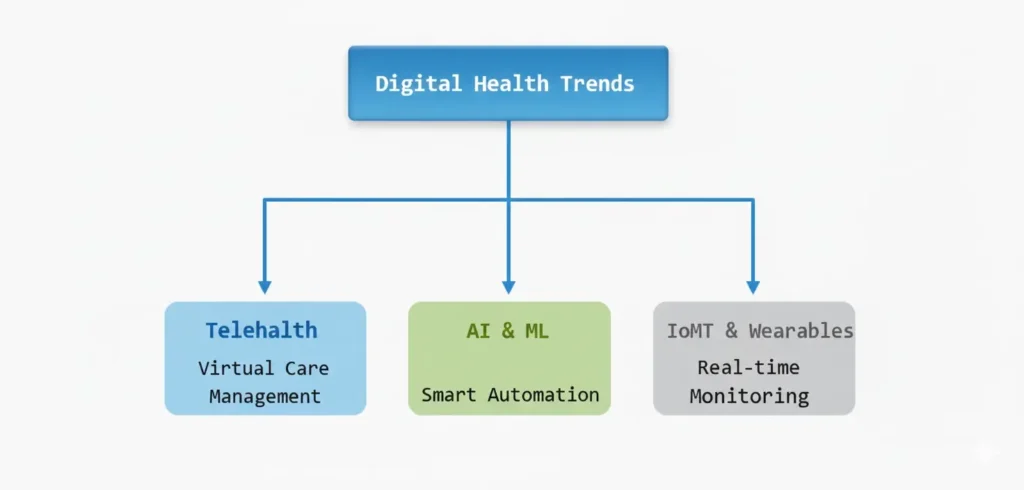
Digital Health Trends Impacting App Development
Essential Features of a Modern Medical Mobile App
A successful healthcare mobile app must balance clinical precision, regulatory compliance, seamless user experience, and advanced technology. Whether you’re building a telehealth solution, a medical device companion app, or a full-scale hospital management platform, the following features are essential for delivering safe, reliable, and value-driven digital healthcare.
These features not only enhance usability but also significantly impact patient engagement, provider efficiency, and long-term scalability. Incorporating them is a key factor in modern medical mobile app development and healthcare app development strategies.
I. Core Patient-Facing Features
Patients are the primary users of many healthcare apps, and their needs must be addressed with clarity, simplicity, and security.
Key Features for Patients
Feature | Description | Benefit |
User Authentication (Biometric/2FA) | Secure login via Face ID, fingerprint, or OTP | Protects PHI & improves trust |
Telemedicine Consultations | Video calls, voice calls, chat-based care | Convenient access to care |
Appointment Scheduling | Real-time bookings, reminders | Reduces no-shows |
Medical Records Access | View lab results, prescriptions, history | Patient empowerment |
Medication Tracking | Reminders, logs, dosage instructions | Increased adherence |
Symptom Checker (AI-based) | Self-assessment using smart algorithms | Helps triage early |
Wearable Integration | Sync with heart rate, SpO₂, BP devices | Real-time health insights |
II. Clinician-Facing Features
Doctors and healthcare providers need powerful, streamlined tools that fit naturally into their clinical workflows.
Key Features for Providers
Feature | Description | Benefit |
EHR/EMR Integration (FHIR/HL7) | Sync patient data with hospital systems | Faster decision-making |
e-Prescriptions | Digital prescriptions sent to pharmacies | Reduces errors |
Clinical Dashboard | Patient vitals, history, alerts | Improved monitoring |
Task & Workflow Management | Scheduling, notes, to-do lists | Enhances productivity |
Telehealth & Chat | Connect patients & providers securely | Continuity of care |
Secure File Sharing | X-rays, test results, reports | Faster diagnostics |
III. Admin & Operations Features
Hospitals, clinics, and administrative teams benefit from automation and centralized control.
Key Admin Capabilities
- Staff management
- Insurance claim processing
- Billing & payment modules
- Workflow automation
- Analytics dashboards
- Audit logs
- Role-based permissions
Medical Device App Development: How It Differs from Standard Healthcare Apps
Medical device app development is one of the most technical and regulated segments of digital healthcare. Unlike general wellness or telehealth applications, these apps connect directly with IoT-enabled, Bluetooth, or FDA-regulated medical devices, meaning the margin for error is extremely small.
These apps must ensure data accuracy, safety, regulatory compliance, and real-time performance. They often serve as the control interface, data receiver, or visualization platform for medical hardware.
What Makes Medical Device Apps Unique?
Factor | Standard Healthcare Apps | Medical Device Apps |
Regulation | Not always required | FDA, MDR, CE required |
Data Accuracy | Good accuracy | High precision required |
Connectivity | Optional | Mandatory (BLE/WiFi/IoT) |
Testing | App-level testing | Hardware + software validation |
Security Requirements | High | Extremely high |
Development Complexity | Moderate | Advanced & specialized |
Key Elements of Medical Device App Development
Hardware Integration
These apps communicate with devices using:
- Bluetooth Low Energy (BLE)
- WiFi
- NFC
- USB
- Cloud sync
Real-Time Data Processing
Vital signs such as heart rate, glucose levels, ECG readings, and oxygen saturation must be:
- Accurate
- Instant
- Securely transmitted
- Properly visualized
FDA/CE Regulatory Compliance
If the mobile app works as part of a medical device ecosystem, it may be classified as a medical device itself.
Regulatory considerations include:
- FDA Class I, II, III
- ISO 13485
- IEC 62304 (software lifecycle)
- Biocompatibility standards
Data Security & Encryption
Medical device apps must:
- Securely transmit PHI
- Enforce user authentication
- Maintain audit trails
- Provide offline fail-safes
Choosing the Right Partner for Healthcare Mobile App Development Services
Selecting the right development partner is essential for successful implementation, especially when compliance, medical integrations, and long-term scalability matter.
A qualified healthcare development company like CitrusBits brings medical expertise, engineering talent, and understanding of clinical environments.
What to Look for in a Medical App Development Partner
Choosing the right partner for medical mobile app development is crucial to building a secure, compliant, and scalable healthcare solution. Start by selecting a team with proven experience in healthcare, including successful projects in telemedicine, remote patient monitoring (RPM), EHR/EMR systems, medical device app development, and AI-powered diagnostics.
Your development partner must also demonstrate a deep understanding of compliance, with expertise in HIPAA, GDPR, HL7/FHIR standards, FDA classifications, and proper access control frameworks. Equally important is strong technical expertise, supported by skilled Android/iOS developers, backend engineers, UI/UX designers, data security specialists, and QA compliance testers.
Finally, ensure the partner offers long-term support and maintenance, providing ongoing compliance updates, device compatibility enhancements, new feature releases, and performance optimization to keep your healthcare app safe, reliable, and future-ready.
Challenges in Healthcare App Development & How to Overcome Them
Developing secure, reliable healthcare apps is complex, involving patient safety, sensitive data, and regulatory constraints. Below are the most common challenges and how to address them effectively.
Challenge | Why It Matters | Solution |
Data Security | Protects PHI | Encryption, RBAC, secure cloud |
Interoperability | Connects systems | FHIR, HL7, APIs |
Compliance | Prevents legal issues | HIPAA, FDA, MDR frameworks |
UX Complexity | Impacts adoption | Med-focused UI/UX processes |
Device Accuracy | Ensures safety | Algorithm validation, testing |
Future of Mobile Health App Development
The future of healthcare is more predictive, connected, personalized, and intelligent. As technology accelerates, so does the capability of medical mobile apps.
Here are the trends shaping next-generation healthcare applications.
AI-Powered Personalized Healthcare: AI enables personalized recommendations, precision medicine, predictive analytics, and automated clinical workflows.
Expansion of IoT & Connected Medical Devices: Wearables, implantables, and IoT sensors will continue to drive innovation in medical device app development.
Virtual-First Care Models: Telehealth is evolving into hybrid digital + in-clinic care models, enabling continuous care.
Digital Therapeutics (DTx) Growth: FDA-cleared app-based therapies will become more common for managing chronic diseases.
Blockchain for Medical Records: Blockchain may soon secure medical data exchange, identity management, and audit trails.
Voice-Based Healthcare Interfaces: Voice assistants will power clinical documentation, patient engagement, and real-time support.
Conclusion
Medical mobile app development is reshaping the future of patient care, diagnostics, remote monitoring, and clinical operations. With advancements in AI, IoT-driven medical devices, cloud infrastructures, and interoperability standards, healthcare apps are now able to deliver safer, smarter, and more personalized care experiences than ever before.
Whether you’re a hospital aiming to streamline workflows, a MedTech company building IoT-enabled medical devices, or a startup entering the digital health space, investing in secure and scalable healthcare mobile app development services is no longer optional; it is a strategic advantage.
References
- FDA Medical Device Regulations
https://www.fda.gov/medical-devices - HIPAA Security Rule
https://www.hhs.gov/hipaa/for-professionals/security/index.html - HL7 FHIR Standards
https://www.hl7.org/fhir/ - World Health Organization – Digital Health
https://www.who.int/health-topics/digital-health - ONC Interoperability Standards
https://www.healthit.gov
Table of Contents
1) What Is a Medical App? Exploring Mobile Apps in Healthcare
2) Types of Medical Mobile Apps Shaping Digital Healthcare
3) Healthcare Mobile App Development Market Overview
4) How to Develop a Medical App? Step-by-Step Guidelines
5) Why Medical Mobile App Development Matters Today
6) Essential Features of a Modern Medical Mobile App
7) Medical Device App Development: How It Differs from Standard Healthcare Apps
8) Choosing the Right Partner for Healthcare Mobile App Development Services
9) What to Look for in a Medical App Development Partner
10) Challenges in Healthcare App Development & How to Overcome Them
11) Future of Mobile Health App Development
12) Conclusion
Innovate the Future of Health Tech
CitrusBits helps MedTech leaders build smarter apps, connected devices, and XR health solutions that truly make an impact.
