


Blog
FHIR-First Software Development for Modern Healthcare Platforms
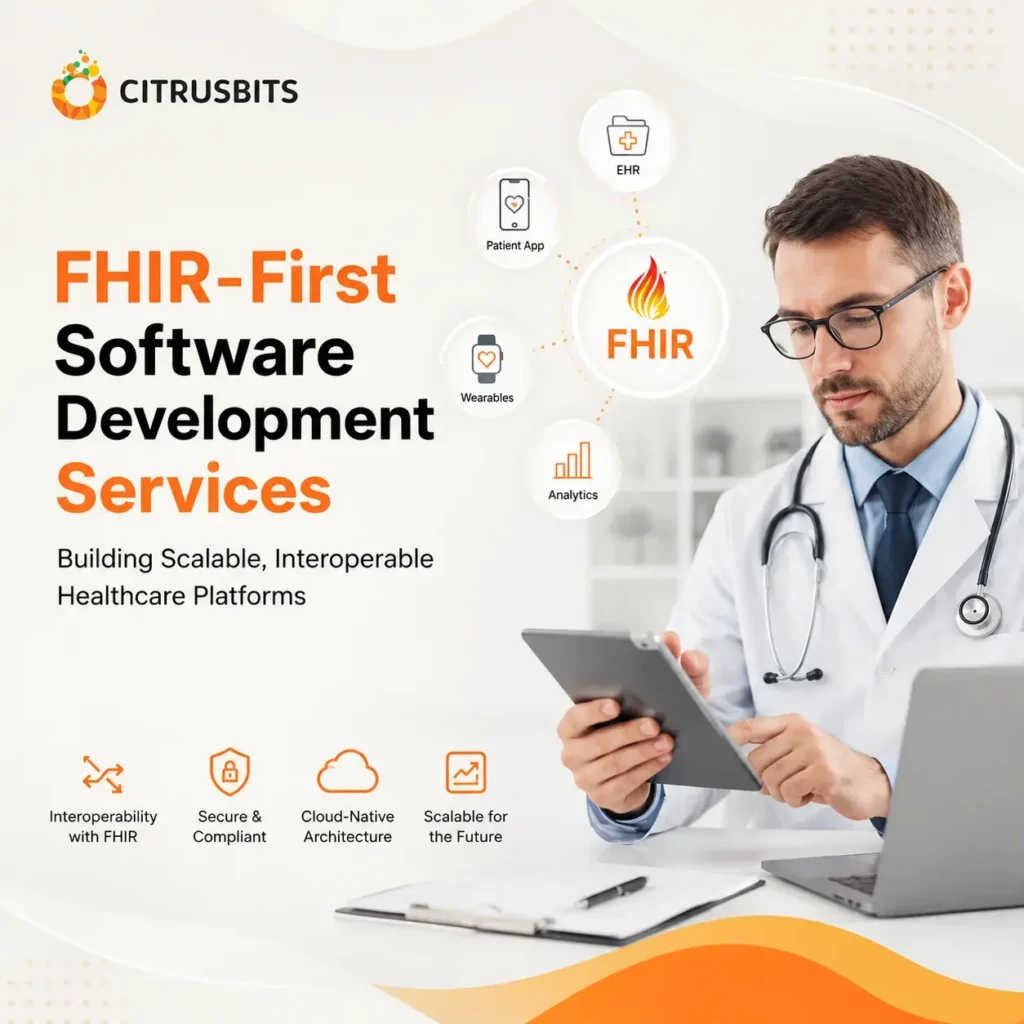
Healthcare organizations are under increasing pressure to modernize disconnected systems, accelerate interoperability, and deliver seamless digital patient experiences. Traditional integration methods built on legacy HL7 architectures often create scalability challenges, slow development cycles, and costly maintenance overhead. This is why healthcare providers, digital health startups, payers, and enterprise HealthTech companies are rapidly adopting FHIR-first software development services to build interoperable, future-ready healthcare platforms.
A FHIR-first approach enables healthcare organizations to develop secure, API-driven ecosystems that support real-time data exchange, SMART on FHIR applications, cloud-based FHIR solutions, and scalable healthcare interoperability solutions across EHRs, patient apps, medical devices, and care coordination systems.
Building scalable healthcare platforms requires more than basic integrations. Learn how modern healthcare organizations approach FHIR interoperability, HIPAA-compliant architecture, cloud-native infrastructure, and enterprise healthcare integrations.
A Closer Look at FHIR-First Software Development
Traditional healthcare platforms were built around disconnected systems, custom integrations, and rigid middleware. A FHIR-first software development services approach changes that by making interoperability the foundation of the platform instead of an afterthought.
Using the HL7 FHIR standard, healthcare organizations can build secure, API-driven ecosystems that support real-time data exchange between EHRs, patient applications, medical devices, payer systems, and cloud platforms. This approach enables faster integrations, improved scalability, and more efficient healthcare workflows.
Modern FHIR app development also allows organizations to create modular applications using RESTful APIs, standardized healthcare resources, and SMART authorization protocols. Instead of building one-off integrations for every provider or vendor, organizations can create reusable interoperability layers that accelerate innovation and reduce technical debt.
For healthcare leaders, this means:
- Faster go-to-market timelines
- Lower integration costs
- Improved scalability
- Easier compliance readiness
- Better patient and clinician experiences
Organizations adopting SMART on FHIR development are also better positioned to integrate with platforms like Epic, Cerner, and Athenahealth while supporting secure third-party healthcare applications.
For technical healthcare leaders evaluating platform architecture, the official HL7 FHIR documentation provides a strong overview of modern interoperability standards.
Why Modern Healthcare Platforms Need a FHIR-First Architecture?
Healthcare organizations are generating massive amounts of incomplete clinical data across EHRs, IoMT devices, patient portals, diagnostic systems, and remote care platforms. Without a standardized interoperability layer, these systems create operational silos that slow innovation and increase infrastructure complexity.
A FHIR-first architecture solves this problem by creating a unified interoperability framework that supports secure, real-time healthcare data exchange across systems.
Key Benefits of a FHIR-First Approach
Traditional Integrations | FHIR-First Architecture |
Hard-coded integrations | API-driven interoperability |
Vendor lock-in | Flexible healthcare ecosystems |
Slow onboarding | Faster integrations |
Limited scalability | Cloud-native scalability |
Complex maintenance | Reusable interoperability layers |
This is especially important for organizations investing in:
- Digital health platforms
- Remote patient monitoring
- AI-driven healthcare systems
- Enterprise EHR integrations
- Connected healthcare ecosystems
Modern healthcare interoperability solutions also improve long-term operational efficiency by reducing duplicate development efforts and simplifying compliance initiatives.
According to the Office of the National Coordinator for Health Information Technology (ONC), interoperability remains one of the most critical priorities in healthcare modernization.
Organizations looking to modernize infrastructure should also evaluate scalable healthcare engineering approaches.
Core Components of a FHIR-First Healthcare Platform
A successful FHIR server implementation services strategy requires more than APIs alone. Modern healthcare ecosystems depend on multiple interoperable infrastructure layers working together securely and efficiently.

1. FHIR Server Layer
The FHIR server acts as the foundation of the interoperability ecosystem by managing healthcare resources, authentication, and data exchange.
Common technologies include:
- HAPI FHIR
- AWS HealthLake
- Azure API for FHIR
- Google Cloud Healthcare API
These platforms support scalable, cloud-native interoperability while simplifying healthcare data management.
2. SMART on FHIR Authorization
Secure authentication is essential for healthcare interoperability. SMART on FHIR enables secure third-party healthcare applications using OAuth 2.0 and OpenID Connect protocols.
This allows organizations to build:
- Provider applications
- Patient engagement platforms
- Clinical dashboards
- Healthcare mobile apps
Learn more about SMART standards here: https://smarthealthit.org/
3. Cloud-Native Infrastructure
Modern cloud-based FHIR solutions require scalable infrastructure capable of handling high-volume clinical data, connected devices, and real-time healthcare workflows.
Leading healthcare platforms now adopt:
- Microservices architecture
- Kubernetes orchestration
- Event-driven systems
- Multi-region deployment
- Real-time analytics pipelines
This architecture improves:
- Reliability
- Scalability
- Disaster recovery
- Performance optimization
For CTOs and healthcare founders, adopting a cloud-native interoperability strategy early reduces future infrastructure rebuilds and accelerates enterprise scalability.
SMART on FHIR Development for Modern Clinical Applications
Modern healthcare platforms require more than interoperability. They need secure, scalable applications that integrate directly into clinical workflows. This is where SMART on FHIR development becomes essential.
By combining SMART authorization protocols with FHIR APIs, healthcare organizations can build secure applications that work seamlessly across EHR ecosystems like Epic and Cerner.
Common SMART on FHIR Applications
- Clinical decision support tools
- Patient engagement apps
- Telehealth platforms
- Provider dashboards
- Medication management systems
For healthcare leaders, this approach reduces integration complexity while accelerating product deployment and improving user adoption.
Common Challenges in FHIR Implementation Services
While demand for FHIR implementation services continues to grow, many healthcare organizations struggle with legacy infrastructure, disconnected data systems, and compliance complexity.
The Most Common FHIR Challenges
Legacy HL7 Integrations: Older healthcare systems often rely on outdated HL7 v2 architectures that require extensive transformation and mapping.
EHR Vendor Variability: Each EHR platform handles interoperability differently, increasing integration complexity across providers.
Security & Compliance: Healthcare APIs must support:
- HIPAA compliance
- Role-based access control
- Audit logging
- Secure authentication workflows
Scalability Issues: Many organizations adopt interoperability without designing a scalable infrastructure for future growth.
Healthcare organizations modernizing legacy systems should prioritize interoperability-first engineering and scalable healthcare infrastructure from the beginning.
Why Healthcare Startups Are Investing in FHIR-First Development
For digital health startups, speed and scalability are critical. A FHIR-first approach helps founders launch interoperable healthcare products faster while reducing long-term integration costs.
Instead of building custom integrations for every healthcare system, startups can use standardized APIs to accelerate development and improve scalability.
Startup Goal | FHIR-First Advantage |
Faster MVP launch | Standardized integrations |
Enterprise readiness | EHR compatibility |
Investor confidence | Scalable infrastructure |
Compliance preparation | Secure healthcare APIs |
Product scalability | Cloud-native architecture |
This is why many organizations now hire FHIR experts for healthcare startups and partner with a custom FHIR API development company early in the product lifecycle.
The Future of FHIR in Digital Health
The future of healthcare interoperability is moving beyond simple integrations. Modern healthcare platforms are evolving into intelligent ecosystems powered by AI, real-time analytics, connected devices, and interoperable clinical data.
This is why the Future of FHIR in Digital Health is closely tied to:
- AI-driven healthcare systems
- Remote patient monitoring
- Predictive analytics
- Personalized medicine
- Connected care platforms
As healthcare organizations adopt cloud-native infrastructure, FHIR servers are becoming the foundation for scalable healthcare data exchange and AI-ready architectures.
Emerging Trends Shaping FHIR Adoption
AI + FHIR Integration: FHIR-standardized data improves the quality and usability of clinical datasets for AI and machine learning systems.
Real-Time Healthcare Data Exchange: Healthcare organizations are moving toward event-driven architectures that support instant interoperability across systems and devices.
Cloud-Based Healthcare Ecosystems: Modern cloud-based FHIR solutions allow organizations to scale infrastructure faster while reducing operational overhead.
How to Choose the Right FHIR Software Development Services Partner
Choosing the right technology partner is critical for long-term interoperability success. Many healthcare organizations struggle because they select vendors focused only on development rather than scalable healthcare architecture.
A strong FHIR consulting services partner should understand:
- Healthcare interoperability standards
- EHR integration complexity
- HIPAA and compliance requirements
- Cloud-native healthcare infrastructure
- SMART on FHIR development
- Enterprise scalability
What Healthcare Leaders Should Evaluate
Evaluation Area | Why It Matters |
Healthcare domain expertise | Reduces implementation risk |
Interoperability experience | Improves integration scalability |
Compliance knowledge | Accelerates regulatory readiness |
Cloud infrastructure expertise | Supports long-term growth |
API-first architecture | Enables flexible ecosystems |
Organizations investing in FHIR software development services should prioritize partners that can support both technical execution and strategic healthcare transformation.
Why CitrusBits for FHIR-First Healthcare Development
At CitrusBits, healthcare platforms are engineered as scalable, interoperable ecosystems built for real-world healthcare complexity.
Our teams help healthcare organizations:
- Build secure FHIR app development ecosystems
- Implement scalable FHIR server implementation services
- Modernize healthcare infrastructure
- Accelerate interoperability initiatives
- Develop cloud-native healthcare platforms
Building interoperable healthcare systems requires more than API integration. Healthcare platforms must support clinical workflows, regulatory compliance, device interoperability, and scalable infrastructure from day one.
For example, CitrusBits partnered with RadiusXR to build a HIPAA-compliant diagnostic and clinical workflow platform that integrates immersive XR experiences with healthcare systems and real-time patient data workflows. The platform was designed to support scalability, interoperability, and clinical efficiency across healthcare environments.
This reflects the same interoperability-first thinking required for modern FHIR app development, FHIR server implementation services, and scalable healthcare interoperability solutions.
Explore the RadiusXR case study: https://citrusbits.com/portfolio/radius-xr/
Summary
Healthcare interoperability is no longer optional. As healthcare ecosystems become more connected, organizations need scalable infrastructure capable of supporting secure, real-time data exchange across providers, payers, devices, and patient applications.
A FHIR-first approach enables healthcare organizations to move beyond Incomplete integrations and build modern platforms designed for long-term scalability, compliance, and innovation. From SMART on FHIR development to enterprise-grade FHIR implementation services, interoperability is becoming the foundation of digital health transformation.
For healthcare CTOs, founders, and enterprise leaders, the biggest advantage of adopting FHIR software development services early is not just integration efficiency. It is the ability to create flexible, AI-ready healthcare ecosystems that can evolve with changing regulatory, operational, and patient expectations.
Build a Scalable FHIR-First Healthcare Platform with CitrusBits
Whether you’re modernizing legacy healthcare systems, launching a digital health platform, or scaling enterprise interoperability initiatives, CitrusBits helps healthcare organizations engineer secure, scalable, and future-ready healthcare ecosystems.
Talk to Our Healthcare Experts About:
- FHIR consulting services
- SMART on FHIR development
- FHIR server implementation services
- Cloud-native healthcare infrastructure
- Healthcare API integrations
- AI-ready healthcare platforms
Talk to us about building secure, scalable healthcare platforms.
Table of Contents
1) A Closer Look at FHIR-First Software Development
2) Why Modern Healthcare Platforms Need a FHIR-First Architecture?
3) Core Components of a FHIR-First Healthcare Platform
4) SMART on FHIR Development for Modern Clinical Applications
5) Common Challenges in FHIR Implementation Services
6) Why Healthcare Startups Are Investing in FHIR-First Development
7) The Future of FHIR in Digital Health
8) How to Choose the Right FHIR Software Development Services Partner
9) Why CitrusBits for FHIR-First Healthcare Development
10) Summary
Innovate the Future of Health Tech
CitrusBits helps MedTech leaders build smarter apps, connected devices, and XR health solutions that truly make an impact.
