


Blog
Cerner vs Epic: EHR Comparison, Costs & Key Differences
Choosing between Cerner vs Epic isn’t just a software decision; it’s a long-term strategic commitment that affects clinical workflows, patient experience, regulatory compliance, and your organization’s ability to scale and innovate. Whether you’re a hospital executive, CIO, CMIO, or digital health leader, the Epic versus Cerner debate often comes down to more than feature checklists or market share statistics.
Both platforms dominate the EHR landscape, power millions of medical records, and meet strict healthcare compliance standards. Yet, they differ significantly in implementation complexity, customization philosophy, interoperability strategy, cost structure, and ideal use cases.
This guide cuts through vendor marketing and surface-level comparisons to deliver a practical, experience-informed analysis of Cerner versus Epic, helping you determine not just which system is bigger or more popular, but which one truly aligns with your clinical, operational, and digital transformation goals.
What’s the Difference Between Epic and Cerner?
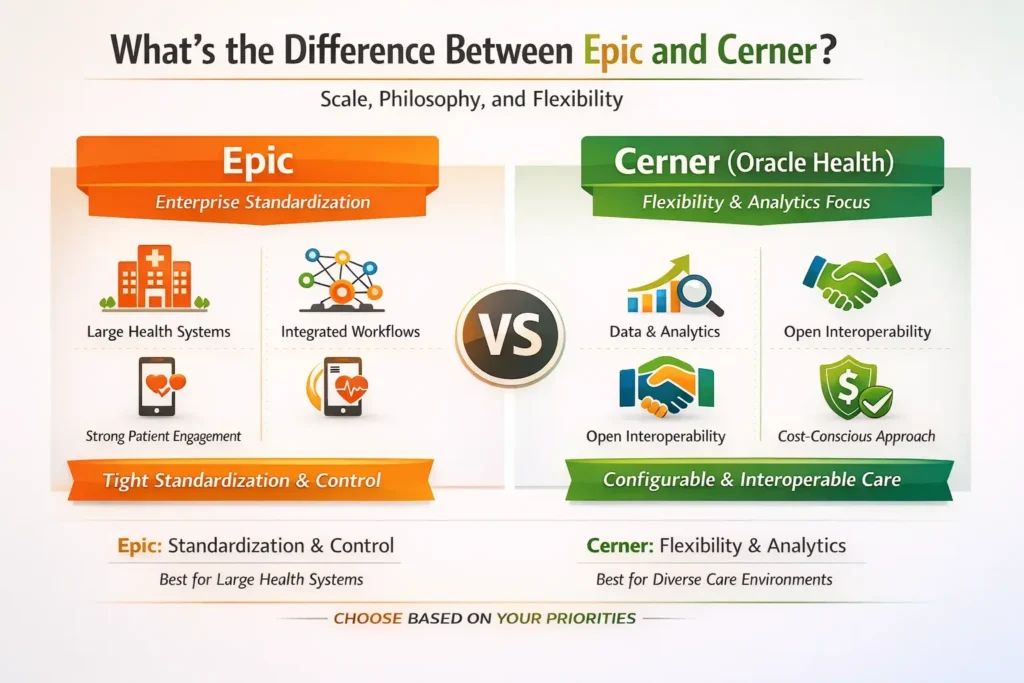
At a high level, the difference between Epic and Cerner comes down to scale, philosophy, and flexibility.
Epic is the dominant choice for large, integrated health systems that want a highly standardized, deeply integrated EHR with strong patient engagement and enterprise-wide workflows.
Cerner (now Oracle Health) is often favored by organizations that prioritize flexibility, data analytics, interoperability, and a more cost-conscious approach across diverse care settings.
- If you want tight standardization and enterprise control, Epic often leads.
- If you want configurability, interoperability, and analytics-driven care, Cerner may be the better fit.
This distinction becomes clearer when we examine Cerner vs Epic EMR capabilities in detail
Cerner vs Epic EMR
Area | Epic | Cerner (Oracle Health) |
Ideal Organization Size | Large hospitals, IDNs, academic centers | Small to large hospitals, ambulatory, specialty clinics |
Workflow Approach | Opinionated, standardized | Flexible, build-driven |
Patient Engagement | MyChart ecosystem | HealtheLife / Cerner Health |
Interoperability | Care Everywhere, Carequality, TEFCA Nexus | CommonWell, Oracle Ignite APIs |
Analytics & Population Health | Strong operational reporting | Strong population health & data analytics |
Cost Profile | Higher total cost of ownership | Generally more cost-effective |
Implementation Complexity | High, resource-intensive | Moderate to high, more adaptable |
Core EHR Capabilities Compared (Clinical & Operational)
Clinical Documentation and Charting
Epic is widely recognized for its SmartTools ecosystem (SmartPhrases, SmartTexts, SmartLinks), which helps clinicians document faster once templates are properly built and governed. Epic’s approach favors consistency and efficiency across large provider groups, but requires disciplined build standards.
Cerner’s charting, particularly through PowerChart and Dynamic Documentation, emphasizes flexibility. Cerner medical records can pull live data directly into documentation views, reducing context switching. However, the experience depends heavily on how well the system is configured.
Orders, Results, and Clinical Decision Support
Both Epic and Cerner support:
- Computerized Provider Order Entry (CPOE)
- Medication management
- Lab and imaging results
- Clinical decision support rules
Epic’s decision support tends to feel more tightly embedded across workflows, while Cerner’s approach allows greater configurability, especially useful for organizations with unique clinical protocols.
Specialty and Care Setting Support
When comparing Epic or Cerner, both platforms support a wide range of specialties, including:
- Inpatient and outpatient care
- Behavioral and mental health
- Emergency and urgent care
- Specialty clinics
Epic is often chosen by academic medical centers with complex, multi-specialty needs. Cerner is frequently selected by organizations that operate across mixed care environments (acute + ambulatory + post-acute).
Revenue Cycle and Financial Operations
Epic offers an integrated revenue cycle management (RCM) system designed to align tightly with clinical workflows. This works well for organizations seeking a single-vendor ecosystem.
Cerner integrates RCM capabilities but often pairs with third-party financial systems, offering flexibility at the cost of tighter vendor coordination.
User Experience: Which EHR Is Easier for Clinicians?
User experience is one of the most debated aspects of cerner versus epic, and opinions often vary by role and training quality.
1. Epic User Experience
Strengths
- Consistent interface across modules
- Strong personalization with SmartTools
- Familiarity due to widespread adoption
Challenges
- Steep learning curve for new users
- Limited flexibility outside Epic’s preferred workflows
- Requires strong governance to avoid template sprawl
Epic often feels easier after optimization, but harder during early adoption.
2. Cerner User Experience
Strengths
- Modular, customizable dashboards
- Flexible workflows for different specialties
- Strong visualization through mPages
Challenges
- Inconsistent experiences across modules if not governed
- Requires intentional UX design during implementation
Cerner can feel more intuitive for certain roles, but poorly built environments can frustrate users.
Adoption Reality Check
Regardless of platform, training, change management, and governance matter more than vendor choice. Many frustrations attributed to Epic or Cerner stem from implementation decisions, not core software limitations.
Interoperability & Data Sharing: Epic Versus Cerner
Interoperability is no longer optional; it’s a regulatory and operational requirement. When evaluating cerner vs epic, organizations must look beyond marketing claims to understand real-world data exchange.
Standards That Matter
Both platforms support:
- HL7 v2
- FHIR (including SMART on FHIR)
- CCD/CCDA exchange
The difference lies in network strategy and execution. Learn more about HL7 in detail here: https://citrusbits.com/what-is-hl7-in-healthcare-v2-v3-cda/
Epic Interoperability Approach
Epic enables data exchange through:
- Care Everywhere
- Carequality
- EpicCare Link
- TEFCA participation via Epic Nexus
Epic excels in large-scale, national exchange, especially among Epic-to-Epic organizations.
Cerner Interoperability Approach
Cerner emphasizes open interoperability through:
- CommonWell Health Alliance
- Oracle Health Ignite APIs
- Strong FHIR-based integration pathways
Cerner medical records systems are often favored in multi-vendor ecosystems where cross-platform exchange is critical.
Can Cerner Communicate With Epic?
Yes. Cerner and Epic can share medical records, but it is not plug-and-play. Successful interoperability typically requires:
- Standards-based interfaces (FHIR, HL7)
- Governance and consent management
- Custom integration work and testing
This is where many organizations invest in custom healthcare application development to bridge workflow gaps and create seamless clinician or patient experiences.
👉 https://citrusbits.com/services/application-development/
Security, Privacy, and Compliance Foundations
From a regulatory standpoint, Epic and Cerner are both enterprise-grade, HIPAA-compliant EHR systems.
Both platforms offer:
- Role-based access controls
- Encryption at rest and in transit
- Detailed audit logging
- Support for ONC certification and information-blocking rules
The real compliance risk typically comes from misconfigured permissions, third-party integrations, and poor governance, not the EHR vendor itself.
Implementation Reality Check: Timeline, Cost Drivers, and Risks
One of the most underestimated aspects of the Cerner vs Epic decision is implementation. Both platforms are powerful, but neither is lightweight.
Typical Implementation Timelines
- Epic
- Large hospitals / IDNs: 16–24 months
- Multi-hospital systems: Often phased over several years
- Cerner
- Ambulatory or mid-sized hospitals: 9–18 months
- Large enterprises: Comparable to Epic when scope expands
Epic implementations tend to follow a highly structured playbook. Cerner implementations allow more flexibility but demand strong internal governance to avoid fragmentation.
Key Cost Drivers (Beyond Licensing)
When comparing epic versus cerner, licensing fees are only part of the equation. Major cost drivers include:
- Clinical and operational workflow redesign
- Data migration and historical chart conversion
- Interface development and third-party integrations
- Training, backfill staffing, and at-the-elbow support
- Reporting rebuilds and analytics validation
- Ongoing optimization and upgrades
Epic generally carries a higher total cost of ownership, while Cerner is often viewed as more cost-effective, especially for organizations not seeking deep enterprise standardization.
Common Implementation Risks
- Underestimating change management effort
- Insufficient clinician involvement during build
- Poor data governance and reporting strategy
- Over-customization without long-term maintenance plans
Organizations that succeed treat EHR implementation as a business transformation initiative, not an IT project.
Cerner vs Epic Pros and Cons
This cerner vs epic pros and cons breakdown is designed to support real decision making, not marketing narratives.
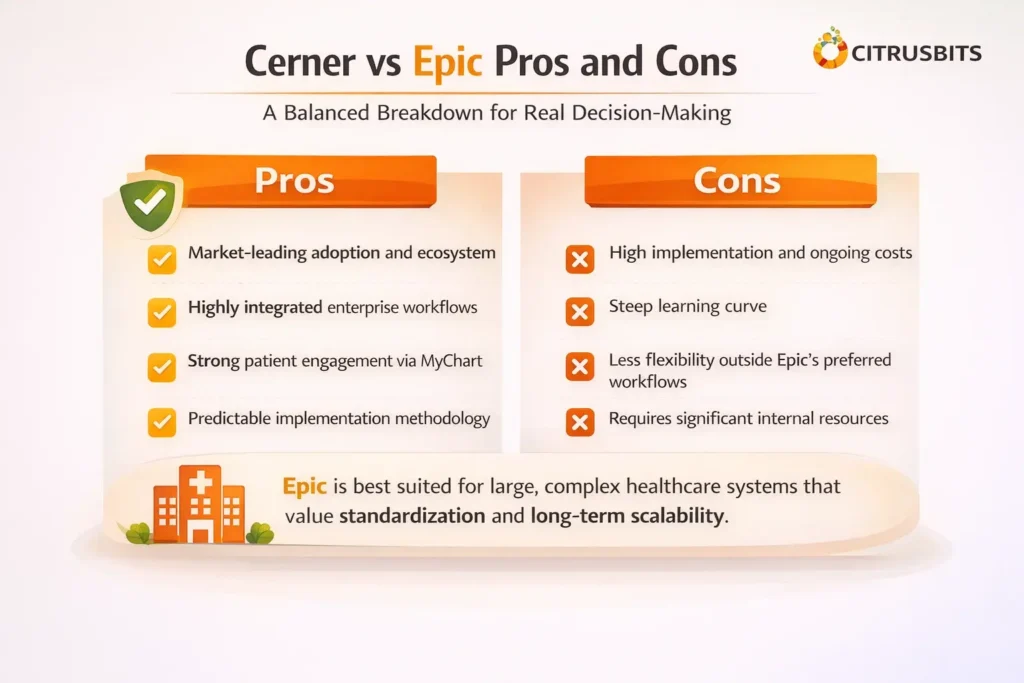
Pros
- Market-leading adoption and ecosystem
- Highly integrated enterprise workflows
- Strong patient engagement via MyChart
- Predictable implementation methodology
Cons
- High implementation and ongoing costs
- Steep learning curve
- Less flexibility outside Epic’s preferred workflows
- Requires significant internal resources
Epic is best suited for large, complex healthcare systems that value standardization and long-term scalability.
Cerner (Oracle Health): Pros and Cons
Pros
- Greater flexibility and configurability
- Strong analytics and population health tools
- Cost-effective for diverse care environments
- Open interoperability philosophy
Cons
- User experience depends heavily on build quality
- Requires disciplined governance to avoid inconsistency
- Ongoing platform evolution under Oracle may require adaptation
Cerner is often a strong choice for organizations balancing innovation, analytics, and interoperability across mixed care settings.
Cerner vs Epic vs Meditech: Where the Third Option Fits
When evaluating enterprise EHR platforms, healthcare leaders often expand the conversation beyond Cerner vs Epic to include Meditech as a third contender. While Epic and Cerner dominate large and mid-sized healthcare systems, Meditech continues to play a meaningful role for organizations that prioritize simplicity, affordability, and focused inpatient workflows.
How Cerner, Epic, and Meditech Compare
Criteria | Epic | Cerner (Oracle Health) | Meditech |
Ideal Organization Size | Large hospitals, IDNs, academic medical centers | Small to large hospitals, ambulatory and specialty networks | Community hospitals, smaller inpatient facilities |
Cost Profile | High total cost of ownership | Moderate and more cost-flexible | Lower upfront and ongoing costs |
Implementation Complexity | High, resource-intensive | Moderate, configurable | Lower, faster to deploy |
Customization & Flexibility | Highly standardized, opinionated workflows | Flexible, build-driven configuration | Limited customization |
Analytics & Reporting | Strong enterprise reporting | Strong population health and analytics | Basic reporting capabilities |
Interoperability | Extensive national exchange networks | Open interoperability and APIs | More limited interoperability |
Scalability & Ecosystem | Extensive ecosystem and long-term scalability | Scalable across diverse care settings | Limited scalability beyond core use cases |
Which Hospitals Use Cerner vs Epic?
Epic Adoption Trends
Epic is widely used by:
- Academic medical centers
- Large integrated delivery networks (IDNs)
- Multi-state health systems
Cerner Adoption Trends
Cerner is commonly used by:
- Regional hospital systems
- Ambulatory networks
- Specialty clinics and mixed-care organizations
This answers a common question: which hospitals use Cerner? Typically, those seeking adaptability across varied care models.
Is Cerner Better Than Epic? How to Decide
There is no universal winner in Cerner and Epic, only better alignment.
Choose Epic If:
- You operate a large, complex health system
- Standardization is a top priority
- You want a single-vendor enterprise ecosystem
- Budget and resources are less constrained
Choose Cerner If:
- You need flexibility across care settings
- Analytics and population health are strategic priorities
- Interoperability with non-Epic systems is critical
- Cost control matters
Many organizations also extend either platform with custom digital solutions, such as patient-facing apps, clinician tools, or analytics dashboards, to close workflow gaps and accelerate innovation.
Final Verdict
The Cerner vs Epic decision is not about which platform is “better,” it’s about which platform best supports your clinical workflows, compliance needs, interoperability goals, and long-term digital strategy.
Epic excels in large-scale standardization and enterprise control. Cerner shines in flexibility, analytics, and cross-system interoperability.
Many healthcare organizations achieve the best outcomes by pairing their chosen EHR with purpose-built digital solutions designed and implemented by an experienced Healthcare Technology Development Company: 👉 https://citrusbits.com/
FAQs
Q: Is Cerner losing to Epic?
Ans: Epic has gained market share among large U.S. health systems, but Cerner remains widely adopted globally and continues to evolve under Oracle Health.
Q: Is Cerner bigger than Epic?
Ans: Epic currently leads in U.S. hospital market share. Cerner, however, has a strong international footprint and serves a broader mix of care environments.
Q: Which hospitals use Cerner?
Ans: Cerner is commonly used by regional hospitals, ambulatory networks, government systems, and specialty providers.
Q: What are the top 3 EHR systems?
Ans: In the U.S., the top three are Epic, Cerner, and Meditech, each serving different organizational needs.
Table of Contents
1) What’s the Difference Between Epic and Cerner?
2) Cerner vs Epic EMR
3) Core EHR Capabilities Compared (Clinical & Operational)
4) User Experience: Which EHR Is Easier for Clinicians?
5) Interoperability & Data Sharing: Epic Versus Cerner
6) Security, Privacy, and Compliance Foundations
7) Implementation Reality Check: Timeline, Cost Drivers, and Risks
8) Cerner vs Epic Pros and Cons
9) Cerner vs Epic vs Meditech: Where the Third Option Fits
10) Which Hospitals Use Cerner vs Epic?
11) Is Cerner Better Than Epic? How to Decide
12) Final Verdict
Innovate the Future of Health Tech
CitrusBits helps MedTech leaders build smarter apps, connected devices, and XR health solutions that truly make an impact.
