

Blog
Blogs
What Is Eye Tracking? Applications, Healthcare Use Cases & Vision Science Innovation
BLOG by
CitrusBits
July 6, 2025
#Citrusbits #AR/VR #Technology
Eye tracking technology is rapidly becoming a critical part of healthcare, XR, and digital vision science innovation. From AI-powered retinal diagnostics and cognitive tracking to immersive healthcare experiences and spatial computing, organizations across healthcare and MedTech are investing heavily in eye tracking applications to improve patient outcomes and clinical decision-making.
Recent research shows the global eye tracking market is expected to surpass $12 billion by 2030, driven largely by growth in medical eye tracking, XR healthcare, and digital diagnostics. At the same time, healthcare organizations are under pressure to build scalable, compliant, and real-time eye tracking systems that can integrate with connected medical devices, AI infrastructure, and clinical workflows.
For engineering leaders, healthcare innovators, and vision science teams, understanding how eye tracking works is no longer just about innovation. It is becoming a competitive advantage in the future of digital ophthalmology and immersive healthcare.
Eye Tracking Technology: How Eye Tracking Works
Modern eye tracking technology combines infrared optics, computer vision, machine learning, and real-time analytics to measure gaze behavior, pupil response, fixation patterns, blink frequency, and ocular movement with high precision.
In healthcare and vision science environments, these systems are increasingly becoming part of enterprise diagnostics infrastructure, immersive healthcare platforms, and AI-driven patient monitoring systems.
How Medical Eye Tracking Systems Capture Gaze Data?
Most advanced medical eye tracking systems operate using near-infrared illumination and high-frequency image sensors to detect corneal reflections and pupil positioning. These systems can capture gaze telemetry at frame rates ranging from 120Hz to over 1000Hz, depending on the clinical or XR use case.

The captured data is processed through specialized eye tracking software pipelines capable of:
- Mapping gaze coordinates
- Measuring visual attention
- Identifying fixation stability
- Tracking pupil dilation
- Analyzing cognitive response patterns
This telemetry is increasingly being used to generate measurable clinical insights across neurology, ophthalmology, cognitive science, and immersive rehabilitation environments.
Research from the National Library of Medicine highlights the growing role of eye tracking in neurological diagnostics, cognitive impairment analysis, and digital biomarker development.
The Role of AI and Real-Time Analytics
The next generation of eye tracking systems is being driven by AI-enabled analytics and edge computing infrastructure. Modern healthcare organizations are no longer looking for standalone tracking tools. They require scalable platforms capable of transforming gaze telemetry into actionable clinical intelligence.
This includes:
- Real-time anomaly detection
- Predictive behavioral analytics
- Digital biomarker generation
- Adaptive XR interactions
- Longitudinal patient monitoring
As AI diagnostics continue to mature, eye tracking is increasingly being positioned as a foundational behavioral intelligence layer for connected healthcare ecosystems.
Eye Tracking in VR and Spatial Healthcare Systems
The rapid adoption of eye tracking in VR and spatial computing environments is transforming how healthcare organizations approach diagnostics, rehabilitation, and patient engagement.
Modern XR healthcare platforms can combine:
- Gaze tracking
- Spatial awareness
- AI-driven interpretation
- Immersive rendering
- Environmental interaction
To create adaptive healthcare experiences tailored to individual patient responses. Platforms like IntelliXR are helping enterprise healthcare organizations accelerate immersive diagnostics, XR healthcare experiences, and connected eye-tracking workflows through scalable infrastructure and healthcare-focused XR engineering.
What Is IntelliXR?
IntelliXR was developed after CitrusBits identified a major gap while building healthcare XR solutions nearly a decade ago. At the time, most XR hardware available in the market was designed for gaming and consumer entertainment, not for healthcare organizations that required customization, clinical usability, patient comfort, and long-term deployment support.
That experience led CitrusBits to create a healthcare-focused XR platform designed specifically for real clinical, diagnostic, rehabilitation, training, and patient engagement use cases.
Today, IntelliXR helps healthcare companies build scalable immersive healthcare solutions through customizable XR hardware, healthcare-focused infrastructure, and advanced eye-tracking capabilities powered by CitrusBits’ partnerships with Tobii and Pupil Labs.
Unlike traditional off-the-shelf XR devices, IntelliXR is designed around clinical workflows, compliance requirements, and real-world healthcare deployment needs, helping organizations build immersive healthcare systems that are practical, scalable, and reliable.
Eye Tracking Applications Across Industries
The adoption of eye tracking applications has expanded rapidly across healthcare, XR, automotive, neuroscience, accessibility, and enterprise research sectors. As AI, immersive computing, and behavioral analytics become more integrated into enterprise systems, eye tracking is evolving into a critical layer for real-time interaction intelligence.
For healthcare and vision science organizations, the most valuable eye tracking use cases are centered around diagnostics, immersive rehabilitation, digital biomarkers, and patient engagement.
Industry | Advanced Eye Tracking Use Cases |
Healthcare | Neurodiagnostics, retinal monitoring, cognitive assessment, patient engagement |
XR & VR | Immersive diagnostics, adaptive rehabilitation, spatial interaction systems |
Vision Science | Ocular behavior mapping, visual cognition analysis, and ophthalmology research |
Accessibility | Assistive gaze interfaces and communication systems |
Automotive | Driver fatigue detection and cognitive load monitoring |
Clinical Research | Behavioral analytics, digital endpoints, decentralized trials |
Leading Companies Using Eye Tracking Across Industries
Healthcare and Vision Diagnostics
RadiusXR
RadiusXR uses immersive vision testing and wearable diagnostics to modernize ophthalmology workflows, patient engagement, and visual field testing through XR-based healthcare systems.
RightEye
RightEye uses eye-tracking technology and AI-driven analytics for vision testing, assessment, rehabilitation, sports vision, and cognitive health applications.
machineMD
machineMD uses eye movement and pupil response analysis inside VR-based neurodiagnostic systems to support the detection and monitoring of eye movement disorders.
Neurology and Brain Health
SyncThink
SyncThink uses eye tracking and neurotechnology for concussion assessment, brain health monitoring, and neurological performance analysis in healthcare and sports medicine environments.
EyeBrain Medical
EyeBrain Medical develops neuro-ophthalmology solutions using eye movement analysis to support neurological and cognitive disorder diagnostics.
Cognixion
Cognixion uses gaze interaction and neurotechnology to help patients with neurological conditions communicate and interact with digital systems.
XR Healthcare and Rehabilitation
XRHealth
XRHealth uses immersive XR environments, behavioral interaction tracking, and patient analytics to support rehabilitation, cognitive therapy, and mental health treatment programs.
SyncVR Medical
SyncVR Medical provides XR healthcare solutions for pain reduction, rehabilitation, patient education, and mental wellness across hospitals and clinical environments.
Floreo
Floreo uses VR-based behavioral learning experiences to support autism spectrum therapy, communication skills, and cognitive engagement programs.
Eye Tracking in Healthcare and Vision Science
Eye tracking in healthcare is rapidly becoming a foundational technology for digital diagnostics, neurocognitive assessment, ophthalmology innovation, and AI-enabled patient monitoring. As healthcare systems transition toward connected and data-centric care models, eye movement analysis is emerging as a measurable source of physiological and behavioral intelligence.
Eye Tracking as a Digital Biomarker Framework
One of the most important developments in vision science engineering is the emergence of eye movement analytics as a digital biomarker framework.
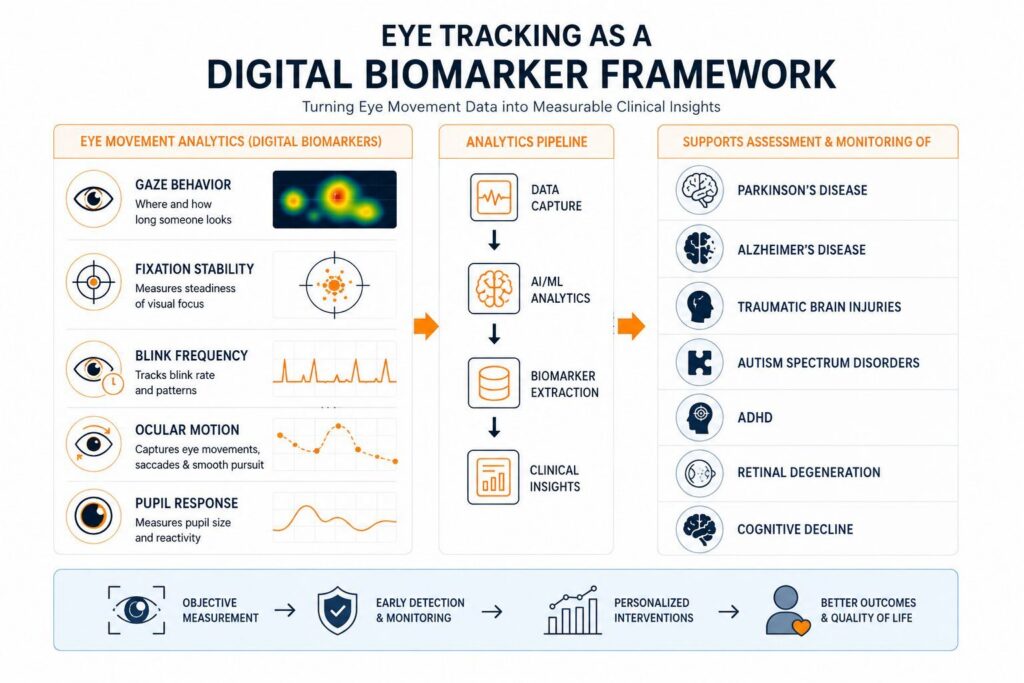
Researchers are increasingly using:
- Gaze behavior
- Fixation stability
- Blink frequency
- Ocular motion
- Pupil response
To support the assessment and monitoring of:
- Parkinson’s disease
- Alzheimer’s disease
- Traumatic brain injuries
- Autism spectrum disorders
- ADHD
- Retinal degeneration
- Cognitive decline
Research from the National Institutes of Health continues to demonstrate the growing clinical relevance of eye tracking for neurodiagnostic and ophthalmology applications, particularly when combined with AI-driven analytics models.
Eye Tracking in VR and XR Healthcare
The convergence of XR, spatial computing, and real-time gaze analytics is redefining how healthcare organizations approach diagnostics, rehabilitation, and patient engagement. As immersive technologies mature, eye tracking in VR is becoming a core capability for adaptive healthcare experiences and intelligent clinical environments.
Immersive Diagnostics and Spatial Healthcare
Modern XR healthcare systems can now analyze gaze behavior, spatial interaction, depth perception, and visual attention in real time. This allows healthcare providers and diagnostics organizations to create immersive assessment workflows capable of generating objective behavioral and neurological insights.
Healthcare organizations are increasingly exploring XR systems for:
- Ophthalmology diagnostics
- Neurocognitive assessment
- Visual field testing
- Motor function analysis
- Cognitive rehabilitation
- Behavioral therapy
The combination of XR environments and eye tracking technology enables more interactive and measurable patient experiences compared to traditional clinical workflows.
Eye Tracking and Rehabilitation Innovation
Immersive rehabilitation platforms are increasingly using eye-tracking telemetry to personalize patient interaction and monitor therapeutic progression.
Advanced XR rehabilitation systems can:
- Dynamically adjust visual stimuli
- Monitor cognitive engagement
- Track rehabilitation progress
- Personalize therapy experiences
- Generate real-time behavioral analytics
This creates new opportunities for enterprise healthcare organizations developing scalable rehabilitation and therapeutic ecosystems
Enterprise XR Infrastructure Challenges
Despite growing adoption, building enterprise-grade XR healthcare platforms remains technically complex. Organizations investing in healthcare XR development company partnerships must solve for:
- Low-latency XR rendering
- Sensor synchronization
- Cloud-native analytics
- Edge processing
- Interoperability with healthcare systems
- Secure patient data orchestration
- HIPAA and FDA readiness
These challenges become even more critical when integrating eye-tracking systems into connected diagnostics platforms and real-time clinical environments.
Challenges in Building Healthcare Eye Tracking Platforms
Building scalable healthcare-grade eye tracking systems requires significantly more than integrating sensors or deploying XR hardware. Enterprise healthcare organizations must address infrastructure, compliance, analytics, interoperability, and real-time performance challenges simultaneously.
For CTOs and engineering leaders, successful eye tracking platform development depends on building resilient ecosystems capable of operating reliably in regulated healthcare environments.
Hardware Integration and Sensor Calibration
Modern eye tracking systems rely on high-frequency cameras, infrared sensors, spatial mapping systems, and AI processing engines operating with minimal latency.
Healthcare organizations often face challenges related to:
- Calibration drift across patient populations
- Hardware variability across XR devices
- Environmental lighting inconsistencies
- Gaze accuracy degradation
- Synchronization between sensors and rendering pipelines
These issues become increasingly complex in immersive healthcare and diagnostics environments where precision directly impacts clinical reliability.
Real-Time Analytics and Low-Latency Processing
Healthcare eye tracking systems must process gaze telemetry in real time to support diagnostics, rehabilitation, and adaptive XR experiences.
Enterprise systems increasingly require:
- Low-latency rendering pipelines
- Edge computing infrastructure
- AI inference acceleration
- High-frequency gaze processing
- Real-time event orchestration
- Scalable analytics pipelines
Without optimized infrastructure, latency can negatively impact diagnostic accuracy, patient interaction, and XR usability.
Compliance and Healthcare Infrastructure
Healthcare organizations developing eye tracking software development ecosystems must also navigate strict regulatory and security requirements.
Enterprise healthcare platforms must support:
- HIPAA compliance
- FDA readiness
- Secure cloud infrastructure
- Encrypted patient telemetry
- Interoperability with EHR systems
- Audit logging and governance
- AI model validation frameworks
Organizations that underestimate compliance complexity often face scalability and commercialization challenges later in the product lifecycle.
The Future of Eye Tracking in Vision Science
The future of eye tracking technology is rapidly converging with AI diagnostics, spatial computing, wearable healthcare systems, and connected medical ecosystems. As healthcare organizations continue shifting toward data-driven and immersive care models, eye tracking is expected to become a foundational component of digital healthcare infrastructure.
AI and Digital Biomarker Expansion
The next generation of healthcare platforms will increasingly use gaze analytics as part of AI-enabled diagnostic and monitoring systems.
Healthcare organizations are already exploring:
- Predictive cognitive analytics
- Behavioral anomaly detection
- Real-time neurodiagnostics
- Digital biomarker generation
- AI-assisted ophthalmology workflows
As machine learning models become more sophisticated, eye movement telemetry will likely play a larger role in early disease detection and longitudinal patient analysis.
Wearable Diagnostics and Spatial Healthcare
Wearable diagnostics and XR systems are also reshaping how healthcare experiences are delivered.
Future immersive healthcare platforms are expected to support:
- Continuous patient monitoring
- Adaptive rehabilitation
- Spatial diagnostics
- Remote ophthalmology assessments
- Real-time patient engagement
The convergence of XR, AI, and connected diagnostics will create new opportunities for enterprise healthcare organizations building scalable digital health ecosystems.
The Rise of Connected Vision Science Platforms
Modern vision science engineering is evolving beyond standalone diagnostic tools into fully connected healthcare intelligence platforms.
Future systems will increasingly integrate:
- XR healthcare environments
- Eye-tracking analytics
- Cloud-native AI infrastructure
- IoMT ecosystems
- Real-time behavioral intelligence
- Enterprise clinical systems
Healthcare organizations that invest early in scalable eye tracking infrastructure and immersive healthcare platforms will be better positioned to accelerate innovation, improve patient engagement, and commercialize next-generation diagnostics experiences.
How CitrusBits Supports Eye Tracking & Vision Science Innovation
Healthcare organizations building immersive diagnostics, connected ophthalmology platforms, and XR healthcare systems need more than generic XR hardware and standalone eye tracking tools. They need scalable solutions designed around real clinical workflows, long-term deployment, and patient usability.
That is why CitrusBits developed IntelliXR, a healthcare-focused XR platform built specifically for diagnostics, rehabilitation, training, and patient engagement use cases.
Why Healthcare Teams Choose IntelliXR
- Healthcare-focused XR infrastructure instead of consumer-grade VR
- Advanced eye-tracking integrations through partnerships with Tobii and Pupil Labs
- Customizable optics, lens configurations, and clinical deployment support
- Scalable cloud, AI, and connected diagnostics infrastructure
- Designed for real-world healthcare, vision science, and rehabilitation workflows
Today, IntelliXR-powered solutions are deployed across 1,000+ clinics with more than 10,000+ end users across healthcare and vision-related environments.
Read more about the Tobii and CitrusBits collaboration.
Building eye tracking or XR healthcare platforms?
Explore how CitrusBits helps healthcare innovators accelerate connected diagnostics, immersive healthcare, and scalable vision science platforms.
Get in Touch with Us Now
FAQs
Q: What industries use eye tracking technology?
Ans: Eye tracking technology is widely used across healthcare, XR, automotive, neuroscience, gaming, accessibility, retail, and clinical research industries. In healthcare, it supports diagnostics, digital biomarkers, rehabilitation, ophthalmology, and cognitive assessment. In XR, it improves immersive interaction and adaptive rendering experiences.
Examples of companies using or advancing eye tracking technology include:
- Tobii for healthcare, XR, and assistive technology
- RadiusXR for immersive vision diagnostics
- Apple Vision Pro for spatial interaction and gaze-based interfaces
- Varjo for enterprise XR and simulation systems
- Pupil Labs for research and behavioral analytics
Q: Can eye tracking be used for neurological disorders?
Ans: Yes. Researchers are increasingly using eye tracking in healthcare to support the assessment of neurological conditions such as Parkinson’s disease, Alzheimer’s disease, concussion, ADHD, and autism spectrum disorders.
Q: How accurate is modern eye tracking technology?
Ans: Modern eye tracking systems can achieve sub-millimeter gaze precision using infrared sensors, AI analytics, and high-frequency cameras. Accuracy depends on calibration quality, environmental conditions, and hardware capabilities.
Q: What is eye tracking software?
Ans: Eye tracking software processes gaze data, fixation behavior, pupil response, and ocular movement into measurable analytics. In healthcare, it is increasingly used for diagnostics, behavioral analysis, and immersive XR experiences.
Q: What is the difference between eye tracking and gaze tracking?
Ans: Eye tracking measures eye movement and ocular behavior, while gaze tracking specifically determines where a person is looking within an environment or interface. Both technologies are often used together in healthcare XR systems.
About the Author

CitrusBits
Content Writer
Related blogs