


Blog
What Does Epic Mean in Healthcare? Essentials to Epic EHR and MyChart
Epic is far more than software. It’s the digital backbone that powers patient care in thousands of hospitals and clinics across the U.S. and beyond. From storing electronic medical records to simplifying documentation, automating billing, improving communication, and even enhancing patient engagement through MyChart, Epic brings nearly every clinical and administrative workflow into one powerful, unified system.
For providers, this means faster charting, fewer errors, and more time focused on delivering exceptional care. For patients, it means transparency, convenience, and a more connected healthcare experience.
Let’s explore what exactly Epic is, how it works, what it looks like, who uses it, why it matters, and what “Epic experience” really means, whether you’re a healthcare professional, administrator, or tech leader navigating digital transformation.
What Is Epic in Healthcare?
Epic in healthcare refers to Epic Systems, a leading U.S. healthcare software company that develops Epic EHR, the most widely used electronic health record (EHR) system in hospitals and clinics. Epic stores, manages, and shares patient information digitally, improving communication, clinical workflows, billing, documentation, and patient engagement.
In simple terms:
Epic is the system hospitals use to access your medical history, record your treatment, schedule appointments, send prescriptions, and manage billing, all in one place.
Epic in the medical field includes:
- Electronic medical records (EMR)
- Electronic health records (EHR)
- Clinical documentation tools
- Patient portals (MyChart)
- Hospital billing systems
- Practice management tools
- Telehealth and mobile apps
What Does Epic Mean in Healthcare?
Epic does not stand for a medical acronym. It is simply the company name, Epic Systems Corporation, founded in 1979 in Wisconsin. However, the term “Epic” has become synonymous with:
- Epic EHR (the full hospital electronic record system)
- Epic EMR (Epic’s clinical charting tools)
- Epic software (all Epic applications and modules)
- Epic experience (skills required to use Epic professionally)
Why Epic Is So Important in Modern Healthcare
Epic solves the foundational challenge of healthcare: centralizing patient information while making it securely accessible across departments.
Epic helps healthcare organizations:
- Deliver consistent patient care across multiple locations
- Access real-time data for safer clinical decisions
- Improve documentation accuracy
- Streamline scheduling and charting
- Enhance billing and revenue cycle management
- Increase efficiency and reduce administrative workload
- Empower patients through MyChart and online visits
Epic isn’t just medical software, it’s the backbone of hospital operations in the U.S. and beyond.
What Type of System Is Epic?
Epic is often described differently by users, which leads to confusion. Officially:
Epic Is:
- An EHR system
- A fully integrated healthcare information system (HIS)
- A practice management and administrative system
- A clinical documentation and charting tool
- A revenue cycle and billing system
Epic Is Not:
- Just a database
- Just an EMR
- A standalone app
Epic is a complete digital ecosystem for hospitals.
What Is the Epic Charting System?
The Epic charting system is a core component of Epic EHR that allows healthcare providers to document patient encounters, record clinical notes, track medications, review test results, and manage treatment plans in a centralized digital environment.
Epic charting helps improve care coordination, reduce documentation errors, and give clinicians real-time access to patient information across different healthcare settings.
Epic Charting Features
Epic charting streamlines clinical workflows by enabling providers to create detailed patient records, monitor health trends, update care plans, and access medical histories from a single platform.
Through integrated charting tools, healthcare organizations can enhance efficiency, support informed decision-making, and deliver better patient outcomes.
Is Epic an EMR or EHR?
One of the most common questions users search is whether Epic is an EMR or EHR, and the answer often determines how people perceive the system. Although people casually call it “Epic EMR,” Epic is officially an EHR system, because it connects data across hospitals, clinics, labs, pharmacies, rehab centers, and even telemedicine platforms.
What Is Epic EMR?
Epic EMR refers to the clinical charting portion of the Epic software used by physicians, nurses, and healthcare staff to document patient care. It includes note-writing, vitals, diagnoses, problem lists, medication histories, allergies, treatment plans, and more.
A few core aspects of Epic EMR include:
- Streamlined digital charting for providers
- Accurate patient identification and tracking
- Customizable templates for faster documentation
- Integration with lab results and imaging
It functions as the physician’s central workspace, supporting efficient patient documentation and improved clinical accuracy.
What Is Epic EHR System?
Epic EHR encompasses the complete, organization-wide system that stores, shares, and manages patient information across all departments and locations. It is designed to unify the entire healthcare workflow, from registration to billing and everything in between.
Key elements of Epic EHR include:
- Multi-facility medical record access
- Interoperability with external networks
- Comprehensive patient histories stored over time
- A single, continuous chart across providers
This is what allows Epic to support care coordination and eliminate duplicate testing, repeated histories, and fragmented documentation.
What Is Epic Software Used for in Healthcare?
Epic software is used for nearly every operational and clinical activity inside a modern healthcare environment. It supports appointment scheduling, clinical documentation, lab workflows, prescriptions, billing processes, patient communication, and analytics, making it a complete digital backbone for hospitals and health systems.
Hospitals use Epic to improve patient safety, reduce administrative effort, and provide physicians with accurate information in real time. It enables departments to coordinate seamlessly, ensuring that every interaction a patient has, from emergency visits to post-surgery follow-ups, is recorded in one unified chart.
1. Patient Records & Clinical Documentation
Epic enables healthcare professionals to create, update, and access comprehensive electronic health records (EHRs). Providers can document patient encounters, review medical histories, monitor treatment plans, and maintain accurate clinical records in real time.
2. Appointment Scheduling & Care Coordination
Hospitals and clinics use Epic to schedule appointments, manage referrals, coordinate specialist visits, and streamline communication between departments. This helps ensure patients receive consistent care throughout their healthcare journey.
3. E-Prescribing & Medication Management
Epic simplifies prescription management by allowing providers to electronically prescribe medications, review drug interactions, monitor allergies, and improve medication safety.
4. Laboratory & Diagnostic Results
Healthcare teams can access laboratory reports, imaging results, and diagnostic data directly within Epic. This centralized access helps providers make faster and more informed clinical decisions.
5. Patient Engagement Through MyChart
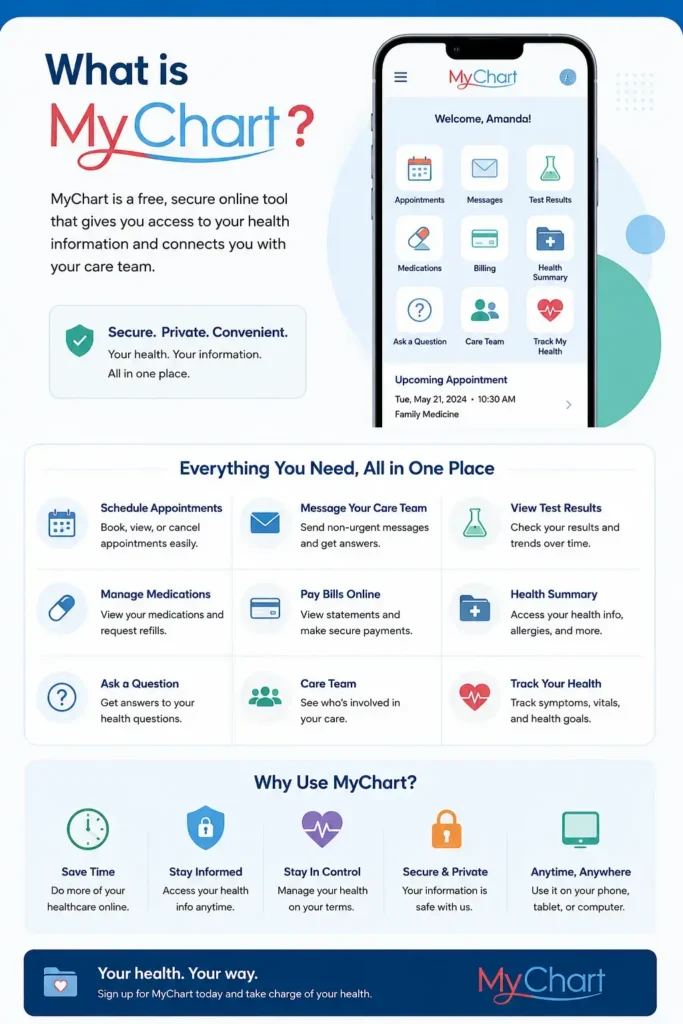
Epic’s MyChart patient portal enables individuals to schedule appointments, view test results, communicate with providers, request prescription refills, and access their health information online.
6. Billing & Revenue Cycle Management
Epic automates insurance verification, claims processing, charge capture, payment tracking, and reimbursement workflows. These tools help healthcare organizations improve financial performance while reducing administrative burdens.
7. Healthcare Analytics & Reporting
Epic provides advanced reporting and analytics capabilities that allow organizations to track patient outcomes, identify operational inefficiencies, monitor performance metrics, and support data-driven decision-making.
How Does Epic Work Behind the Scenes?
Epic’s internal architecture is one of the reasons it performs so well at scale. The system runs on Chronicles, a highly optimized version of the InterSystems Cache database, which Epic has adapted specifically for healthcare. This database structure allows Epic to store millions of patient records in a format that is both extremely fast and secure.
Chronicles isn’t a traditional relational database. Instead, it uses a multi-model structure that allows data to be stored in flexible, non-tabular ways. This gives Epic the speed hospitals need for real-time access while maintaining strong reliability and disaster-recovery features.
Epic’s architecture also includes Clarity and Caboodle, which are used for analytics, reporting, and big-data-driven insights. Clarity transforms clinical data into structured tables for advanced reporting, while Caboodle supports population health and predictive modeling.
Is Epic a Database?
Epic is not a database by itself, but it uses highly specialized databases to function. The main database is Chronicles, which stores clinical and operational information efficiently.
Some important traits include:
- High-speed retrieval for real-time charting
- Encryption and strong security protections
- Support for distributed systems and scalability
What Does Epic EMR Look Like?
Epic’s interface is designed to resemble a familiar workspace with a clear layout that gives healthcare providers quick access to patient charts, schedules, and essential tools. While versions vary by organization, most Epic dashboards feature customizable panels that allow clinicians to view patient lists, upcoming appointments, alerts, lab results, and documentation tools.
The layout is intentionally organized to minimize clicks and reduce time spent navigating between screens. For example, physicians can review vital signs, past notes, lab results, and medication lists all within a single chart view. This immediate access helps avoid mistakes and improves clinical efficiency.
Epic’s note-writing tool, commonly known as NoteWriter, allows providers to insert templates, smart phrases, and structured data elements to speed up documentation. The system can also pull in relevant chart data automatically, reducing typing and improving accuracy.
Epic Interface for Daily Clinical Use
Most clinicians experience Epic through personalized dashboards that highlight the information they use most frequently.
Typical elements include:
- A patient list tailored to the provider’s current schedule
- Tabs for histories, notes, orders, vitals, and results
- A documentation pane for writing assessments and plans
- Smart shortcuts for medications, diagnoses, and order entry
Even though Epic has robust features, new users sometimes feel overwhelmed. However, once trained, providers find the interface intuitive, organized, and efficient.
What Are Epic Modules?
Epic is not a single application; it is an ecosystem made up of specialized modules designed for different departments, clinical workflows, and organizational needs. Each module focuses on a specific function, allowing hospitals to tailor Epic to their operations while maintaining a unified patient record.
Modules like EpicCare Ambulatory, EpicCare Inpatient, ASAP, Beacon, Beaker, Radiant, and Healthy Planet allow everything from outpatient charting to oncology treatments and lab workflows to run seamlessly within the same system.
This modular design is why Epic can support small practices and massive health systems with equal effectiveness. Each module integrates data into the core EHR, ensuring that all providers share a single source of truth for patient care.
1. Clinical Modules That Support Direct Patient Care
Clinical modules focus on frontline care, helping physicians, nurses, and specialists deliver accurate and efficient treatment.
Common examples include:
- EpicCare Ambulatory for outpatient visits
- EpicCare Inpatient for hospital and acute care
- Epic Beacon for oncology treatment workflows
- Epic Radiant for radiology imaging and scheduling
- Epic Beaker for laboratory management
These modules streamline clinical documentation, order entry, diagnostic reporting, and communication between clinical teams.
2. Administrative and Operational Modules
Epic also supports administrative efficiency by centralizing tasks like scheduling, registration, resource allocation, insurance verification, and billing.
Notable operational modules include:
- Cadence for appointment scheduling
- Prelude for registration and patient demographics
- Resolute Hospital Billing for financial operations
- Resolute Professional Billing for physician billing
By integrating operations with clinical care, Epic helps reduce errors and ensure patients experience smooth, well-coordinated visits.
3. Patient Engagement Modules
Epic’s patient-facing tools are central to its popularity.
Key modules include:
- MyChart, a secure portal for patients to view records, message providers, and access test results
- MyChart Bedside is designed for hospitalized patients to communicate with their care team
These tools empower patients and create a more interactive healthcare experience.
What Is Epic Experience in Healthcare? Meaning, Importance & Skills
“Epic experience” is a term frequently seen in healthcare job descriptions. It refers to a person’s ability to use the Epic EHR system effectively, whether in clinical roles like nursing and medicine or administrative areas like billing and scheduling.
Healthcare organizations value Epic experience because the system plays such a central role in operations. When employees already know how to use Epic, onboarding is faster, documentation is more accurate, and workflows remain efficient. This is especially important for nurses and medical assistants who must document patient care quickly and consistently.
What Does Epic Experience Include?
Epic experience may refer to skills such as:
- Navigating charts and patient lists
- Documenting notes, assessments, and care plans
- Placing orders for labs, medications, and procedures
- Communicating through messaging tools
- Managing billing-related tasks or work queues
Professionals with deeper experience may also have skills in troubleshooting workflows, customizing templates, or training others.
Why Employers Value Epic Experience
Hospitals prefer candidates with Epic experience because it:
- Reduces onboarding time for new staff
- Improves patient documentation quality
- Enhances compliance and coding accuracy
- Prevents errors in charting and billing workflows
In a rapidly digitalizing healthcare landscape, Epic experience is becoming as essential as clinical knowledge itself.
Epic Experience in Nursing: What Nurses Need to Know
Nurses are among the most frequent users of Epic, which is why “Epic experience required” is common in nursing job postings. Epic allows nurses to monitor patient vitals, administer medications, document assessments, review histories, and coordinate care in real time.
Nursing responsibilities rely heavily on accurate documentation, and Epic’s tools help streamline this process. Many organizations sponsor nurses for Epic training so they can become certified or proficient in modules such as Ambulatory, Inpatient, Stork (maternity), or Rover (mobile nursing).
Epic experience is also critical for safe patient care. With instant access to orders, labs, alerts, and medication details, nurses can make faster decisions and reduce the risk of medical errors.
Epic Training & Certification: How Healthcare Staff Learn to Use Epic
Epic Systems requires organizations to train their employees based on their roles. Training may vary, but most users complete a structured program that includes prerequisite e-learning, hands-on labs, and supervised practice. This ensures that clinicians understand both the software and the workflows that support their duties.
Training typically begins with e-learning modules that explain navigation, chart structure, and documentation basics. Afterward, users attend lab sessions where they perform real tasks in a simulated patient chart. For more advanced users, Epic Certification courses are available, focusing on configuration, customization, reporting, or technical aspects of Epic.
Organizations also manage training internally using resources from Epic UserWeb, where staff can access manuals, videos, workflows, and troubleshooting guides.
Advantages of Epic Software in Healthcare
Epic offers a level of integration, reliability, and functionality that few healthcare systems can match. This is why it remains the leading EHR system in hospitals and large health networks. One of the major advantages of Epic is its ability to unify clinical, financial, and operational workflows into one seamless platform.
This reduces duplication, eliminates communication gaps, and ensures every department benefits from real-time patient information.
Key Benefits of Using Epic
Epic offers several advantages that strengthen clinical and organizational workflows:
- Enhanced physician productivity through streamlined workflows
- Fully integrated scheduling, billing, and clinical systems
- Improved patient experience via MyChart access and telehealth
- Strong interoperability for data exchange between care settings
- Advanced analytics supporting clinical and financial decisions
Disadvantages of Epic Software
Despite its strengths, Epic also comes with limitations that healthcare organizations must consider. One challenge is its steep learning curve. Because the system is highly customizable and feature-rich, new users, especially nurses and medical assistants, may require weeks of training before feeling confident. This can be overwhelming in busy care environments.
Common Drawbacks Reported by Users
Users often mention:
- Complex navigation for new staff
- High implementation and maintenance costs
- Disruptive updates that require retraining
- Time-consuming documentation without proper training
How Epic Ensures HIPAA Compliance and Patient Data Security
Epic is designed with security and privacy at the core, which is essential for compliance with HIPAA regulations. The system uses multiple layers of encryption to protect patient data both in transit and at rest. This ensures that sensitive medical records remain confidential and protected from unauthorized access.
Access controls are another major part of Epic’s compliance model. Every user must log in with unique credentials, and their access is restricted to the information required for their job role.
This principle, known as “least privilege” reduces the risk of internal misuse. Detailed audit logs track every interaction with patient data, allowing healthcare organizations to monitor suspicious activity or errors.
What Do Epic Accounts Mean for Healthcare Organizations?
An Epic account refers to how healthcare organizations deploy Epic across their facilities, allowing every department, clinical, administrative, financial, to work from a shared system. Instead of relying on fragmented tools from different vendors, an Epic account unifies all workflows into a complete, integrated platform.
This consolidated system allows physicians to access the same patient chart whether they are in primary care, specialty care, imaging departments, or inpatient settings. It also ensures that billing teams have accurate and timely data for claims processing, while administrative teams can manage scheduling and registration from the same platform.
Having an Epic account gives organizations a competitive edge in interoperability, patient satisfaction, and operational efficiency. It also enables secure data sharing within the healthcare community, ensuring continuity of care for patients moving between providers or facilities.
What Is a Billing Indicator in Epic?
A billing indicator in Epic is a tool used to highlight specific services or actions that require billing attention. These indicators alert staff when a charge must be added, reviewed, or verified before a claim is submitted. This is essential for preventing revenue loss, especially in high-volume clinical environments.
Billing indicators are automated whenever possible, reducing the burden on staff and decreasing the likelihood of missing critical charges. This helps healthcare organizations maintain financial accuracy and stay compliant with billing regulations. By identifying services that need review ahead of time, Epic reduces denied claims and speeds up the reimbursement cycle.
How Epic Supports Interoperability and Integration
Interoperability is one of Epic’s defining strengths. Epic supports seamless data exchange through industry standards like HL7, FHIR, and APIs, allowing the system to communicate with external EHRs, pharmacy networks, imaging systems, labs, and national health exchanges. This ensures continuity of care even when patients visit different providers or facilities. Learn more about what is HL7 in Healthcare.
One of Epic’s most powerful interoperability tools is Care Everywhere, which enables hospitals to share patient records instantly with other Epic and non-Epic systems. This allows clinicians to access complete medical histories without waiting for paper records or faxed reports. The result is faster diagnosis, reduced duplication of tests, and improved patient outcomes.
Examples of Epic’s Impact
Real-world use cases highlight Epic’s ability to improve clinical and operational performance:
- Faster decision-making through consolidated medical histories
- Reduced medical errors with automatic alerts and checks
- Improved communication across inpatient and outpatient teams
- Stronger patient engagement through MyChart and mobile tools
- Cost reduction through better billing accuracy and streamlined workflows
The Future of Epic in Healthcare
Epic continues evolving as healthcare becomes more digital, mobile, and data-driven. The future of Epic will focus on advanced analytics, AI-powered suggestions, predictive modeling, and deeper interoperability across global health networks.
As Epic expands its capabilities, hospitals will rely even more heavily on its integrated framework to support both clinical and administrative processes.
Artificial intelligence is becoming central to Epic’s roadmap. Tools like automatic note summaries, predictive risk scoring, and AI-driven diagnostic support will help providers make more informed decisions with less manual work. This improves not only efficiency but also ensures they spend more time on patient care instead of documentation.
Key Trends Shaping Epic’s Future
Some trends that will define the next generation of Epic include:
- AI-assisted documentation to reduce provider workload
- Predictive algorithms for improved patient safety
- Cloud-based scaling to support diverse health systems
- Advanced interoperability for seamless record sharing
- Enhanced patient tools for remote care and engagement
Summary
Epic stands out as the leading EHR because it unifies clinical care, documentation, billing, scheduling, and patient engagement into one powerful system. By giving providers real-time access to accurate patient information, Epic improves decision-making, reduces errors, and enhances care coordination across hospitals and clinics.
Its patient tools like MyChart encourage greater participation in personal health, while its strong interoperability and analytics capabilities support long-term organizational growth. As healthcare continues to move toward digital, AI-driven solutions, Epic’s scalable and integrated design ensures it will remain central to how modern healthcare operates.
Table of Contents
1) What Is Epic in Healthcare?
2) What Does Epic Mean in Healthcare?
3) Why Epic Is So Important in Modern Healthcare
4) What Type of System Is Epic?
5) Is Epic an EMR or EHR?
6) What Is Epic Software Used for in Healthcare?
7) How Does Epic Work Behind the Scenes?
8) What Does Epic EMR Look Like?
9) What Are Epic Modules?
10) What Is Epic Experience in Healthcare? Meaning, Importance & Skills
11) Epic Experience in Nursing: What Nurses Need to Know
12) Epic Training & Certification: How Healthcare Staff Learn to Use Epic
13) Advantages of Epic Software in Healthcare
14) Disadvantages of Epic Software
15) How Epic Ensures HIPAA Compliance and Patient Data Security
16) What Do Epic Accounts Mean for Healthcare Organizations?
17) What Is a Billing Indicator in Epic?
18) How Epic Supports Interoperability and Integration
19) The Future of Epic in Healthcare
20) Summary
Innovate the Future of Health Tech
CitrusBits helps MedTech leaders build smarter apps, connected devices, and XR health solutions that truly make an impact.
