


Blog
The HealthTech Compliance Roadmap - How Strategic Sequencing Turns One Framework Into Five Certifications
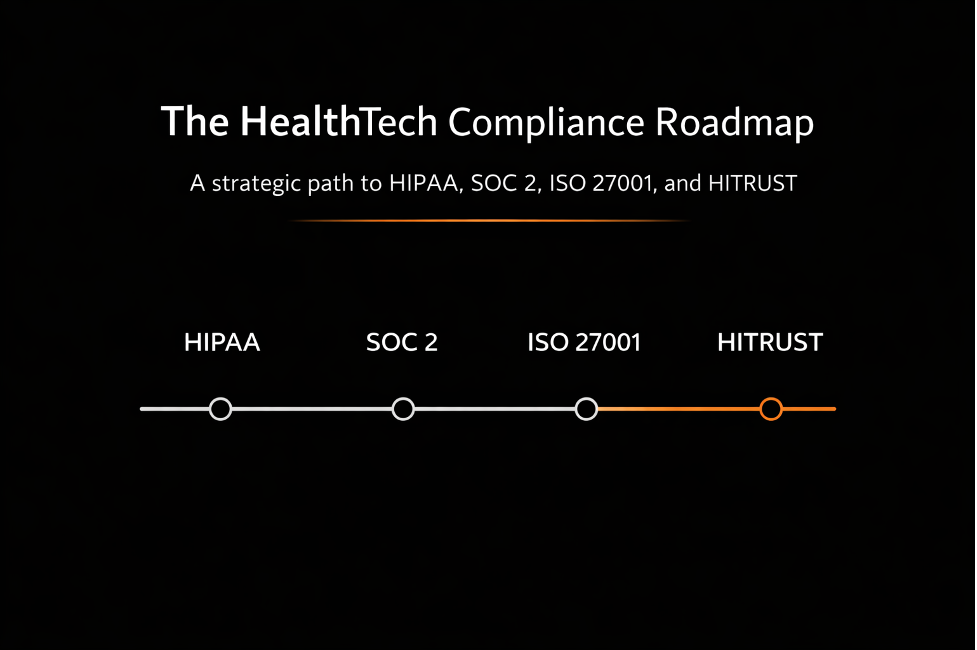
- Three months into conversations with a major health system worth $3M in potential ARR (Annual Recurring Revenue), their procurement team asked a straightforward question: “Can you provide your SOC 2 Type II report?” And you don’t have it. This single certification gap can cost you a good opportunity. We’ve seen this repeatedly in healthtech compliance conversations where organizations had FDA clearances and device certifications, but those weren’t what healthcare clients cared about anymore. They wanted HIPAA compliance, GDPR readiness, SOC 2 attestations, and ISO 27001 certification.
Here’s what made this genuinely difficult: every compliance consultant had an opinion, every vendor promised their platform would solve everything, and every framework looked equally urgent. But nobody answers an important question: which certifications should one pursue first, in what order, and with what resources?
Your certification priorities will determine which markets you can enter, which customers you can pursue, how long your sales cycles will be, and how you’ll allocate resources for the next 12 to 24 months. Get this sequencing wrong, and you’ll waste six months pursuing certifications that don’t unlock revenue. Get it right, and compliance becomes your competitive advantage.
Drawing from our experience of achieving compliance with GDPR, HIPAA, ISO 27001:2022, ISO 27701, and SOC 2 in compressed timelines, this article shares a replicable framework you can adapt. This strategic approach has closed deals, opened conversations, and established sustainable compliance foundations for multiple organizations.
Why Compliance Sequencing Actually Matters
You’re probably facing some version of these pressures: Sales is blocked on deals requiring SOC 2. Leadership wants to expand internationally but isn’t sure which certifications are necessary. A major hospital partnership hinges on HITRUST, and you’re uncertain if that’s realistic given current maturity. Meanwhile, you’re managing product development, fundraising, and growth targets.
The fundamental problem isn’t understanding that you need compliance. The problem is strategic sequencing with limited resources. HIPAA compliance takes 3 to 6 months. GDPR takes 3 to 6 months. SOC 2 roughly takes 3 to 6 months, but Type II requires a minimum of 3 months observation period. ISO 27001 takes 6 to 12 months. HITRUST can take 12 to 18 months or more.
In our case, we had a small compliance team that had to write policies with a few engineers who could implement technical controls. Sound familiar? That’s the reality for most early-stage healthtech companies. You can’t hire your way out of this problem in the timeframe you have. Building a compliance team takes months. Even with more headcount, many compliance tasks can’t be parallelized when the work is sequential and depends on organizational readiness.
What made this feasible for us was automation through a modern Governance, Risk, and Compliance (GRC) platform (e.g., Vanta, Drata, or Sprinto). Automated evidence collection and continuous control monitoring removed much of the manual coordination, allowing us to complete tasks like access reviews, device compliance, and policy acknowledgments in days instead of weeks. This significantly shortened our implementation timeline and enabled a small team to stay audit-ready without becoming a bottleneck.
The “Which Markets Require What?” Filter
Before diving into certification timelines and frameworks, you need strategic clarity on which market segments you’re targeting and what those markets demand. The question “which markets require what compliance?” should be your primary decision filter.
For example, if you’re targeting European digital health markets, ISO 27001 and GDPR compliance are baseline requirements. If you’re pursuing U.S. healthcare markets, HIPAA compliance is the foundational requirement, SOC 2 is increasingly expected for enterprise deals, and HITRUST is the gold standard that unlocks the largest health system contracts. That strategic market decision determines your entire certification roadmap.
Geographic Market Requirements:
- European markets: ISO 27001 and GDPR are table stakes
- U.S. mid-market and enterprise healthcare: HIPAA compliance is mandatory; SOC 2 is baseline for enterprise procurement; HITRUST differentiates and accelerates deals
- Government/Public sector: FedRAMP, StateRAMP, or NIST-based frameworks, depending on agency level
Your 30-Minute Market Mapping Exercise
- Define your target market segments (not individual customers):
- Geographic regions (US, EU, APAC, etc.)
- Customer size tiers (Enterprise, Mid-Market, SMB)
- Industry verticals (Health Systems, Payers, Digital Health, MedTech)
- For each market segment, document:
- Must-have certifications (deal-blocking)
- Competitive differentiators (nice-to-have)
- Procurement timeline expectations
- Identify patterns:
- Which certifications appear as “must-haves” across your highest-value segments?
- Are requirements consistent within a geography/vertical?
- Which segments have the fastest time-to-revenue?
- Prioritize strategically:
- Where is your largest revenue opportunity?
- Which markets have the shortest sales cycles?
- Where do certifications create the strongest competitive moat?
This single exercise reveals your phase 1 certification priorities based on market strategy, not generic compliance advice or individual market segment requests.
The Three-Tier Compliance Framework
The breakthrough came when we stopped treating each certification as an independent project and started viewing compliance as an integrated system. We developed a three-tier framework categorizing certifications by timeline, complexity, resource requirements, and strategic value. Each tier serves a distinct strategic purpose and builds upon the previous layer.
Tier 1: Geographic Specific Compliance (The Legal Foundation)
They are non-negotiable regulatory requirements determined by your geographic markets and data processing activities. They are legally mandated, not voluntary. It is determined by where you operate and the type of data you process. Its violations carry legal penalties and regulatory enforcement. You cannot skip Tier 1. These are prerequisites, not options.
- HIPAA (U.S. Market Foundation): HIPAA is a legal requirement for U.S. healthcare operations. The timeline is 3 to 6 months, including gap analysis, control implementation, and documentation. Without HIPAA, you cannot execute Business Associate Agreements or work with U.S. healthcare providers. Violations carry fines up to $1.5 million per violation category annually. Organizations with mature NIST 800-53 Rev. 5 implementations find that a significant portion of HIPAA Security Rule requirements are already addressed through NIST controls.
- GDPR (European Market Access): GDPR applies to any organization serving EU citizens, regardless of location. Health data requires the highest level of protection. The timeline is 3 to 6 months, including data mapping, gap assessment, policy development, and implementation. Legal requirement with fines reaching €20 million or 4% of global revenue, whichever hurts more. GDPR enables EU market expansion and is increasingly expected by U.S. customers as a baseline privacy commitment.
Tier 2: Foundational Certifications (The Market Credibility Ticket)
They are voluntary security certifications that demonstrate baseline security practices to customers and partners. These are your entry requirements for enterprise conversations. They are Industry-standard frameworks with third-party validation. Enterprise customers often require it in procurement processes. It demonstrates security maturity and operational readiness
- ISO 27001 (Global Security Standard): ISO 27001 is the international ISMS standard with 93 controls. Certification is valid for three years with annual surveillance audits. The timeline is 6 to 12 months. ISO 27001 overlaps significantly with NIST 800-53 Rev. 5. It is predominantly preferred by European customers and is required for many EU/UK public sector contracts. ISO 27001 provides the mandatory foundation for ISO 27701 (privacy extension) and creates substantial groundwork for HITRUST certification.
- SOC 2 (Initial B2B Credibility): SOC 2 is the de facto standard for U.S. SaaS and technology service providers, examining operational effectiveness over an observation period, testing both control design and operation. The timeline is 3 to 6 months total, with a minimum 3-month observation period that cannot be accelerated. The observation period can run parallel to other work, like ISO 27001 implementation, enabling efficient timeline compression for dual-market strategies.
Tier 3: Specialized Certifications (The Competitive Differentiator)
These comprehensive frameworks provide the highest level of assurance for specific market segments. These are competitive weapons, not baseline requirements. They are market-segment specific (not universally required). It requires significant investment in time and resources. It creates a substantial competitive moat in target segments
- ISO 27701 (Privacy Leadership): ISO 27701 extends ISO 27001 with extensive privacy-specific controls and control extensions (commonly referenced as 180+ requirements, depending on scope). ISO 27001 certification is a mandatory prerequisite. The timeline is 6 to 9 months post-ISO 27001 certification. ISO 27701 maps directly to GDPR requirements, making it particularly valuable for organizations demonstrating GDPR compliance to European customers or global enterprises. Pursue this when operating across multiple jurisdictions with high PII/PHI volumes or when you need demonstrable GDPR compliance beyond self-assessment.
- HITRUST CSF (Healthcare Gold Standard): HITRUST consolidates HIPAA, NIST, ISO 27001, PCI DSS, and 60+ authoritative sources into one unified framework accepted by the majority of U.S. health plans, with major health systems increasingly requiring it for vendor contracts.
It has three progressive assessment levels
- The e1 Assessment (Essentials, 1-Year) includes 44 fixed controls designed for small organizations and lower-risk environments. It’s the lightest HITRUST certification, making it ideal for initial credibility and budget-constrained startups.
- The i1 Assessment (Implemented, 1-Year) expands to 219 fixed controls with implementation maturity requirements, providing moderate assurance for mid-market healthcare IT vendors.
- The r2 Assessment (Risk-Based, 2-Year) represents the highest assurance level with a variable control scope determined by risk-based scoping. Organizations complete a risk assessment questionnaire that tailors their specific control requirements from a pool of over 2,000 available controls in the HITRUST CSF.
Start with e1 if targeting the broad U.S. healthcare vendor market, where “HITRUST certified” opens doors without tier specification. Progress to i1 when pursuing mid-market health systems and regional payers that require moderate assurance. Reserve r2 for the enterprise health system and national payer market segments where it’s explicitly required
- NIST 800-53 Rev. 5 (Federal/High-Security Foundation): NIST 800-53 Rev. 5 is the comprehensive federal framework with over 1,000 controls (full catalog) across 20 control families. Most healthtech organizations implement the moderate baseline, which includes 280–300 controls depending on overlays and agency requirements.The timeline from a strong baseline is 12 to 18 months; from scratch, expect 18 to 24 months.
NIST is essential for government/public sector markets and required for FedRAMP, StateRAMP (TX-RAMP Level 2), and federal agency contracts. Organizations with mature NIST 800-53 Rev. 5 implementations find that most HIPAA Security Rule requirements are already addressed, significant portions of SOC 2 technical controls are covered, and many ISO 27001 controls align with their NIST baseline. HITRUST implementation benefits from NIST as one of several foundational frameworks. This makes it the most leverageable investment for multi-framework compliance. This makes NIST the most leverageable investment for multi-framework compliance when targeting government or high-security markets.
Four Foundational Stages: Building Your Roadmap
Before beginning your implementation journey, you need to complete these four foundational stages. Think of these as prerequisites that inform your sequencing decisions:
- Stage 1: Market-Driven Prioritization – You’ve already completed this with the 30-minute market mapping exercise above. This reveals which certifications unlock your target market segments and which investments can wait. Your geographic market focus (U.S. vs. EU), market segment strategy (enterprise vs. mid-market vs. SMB), and vertical specialization (health systems vs. payers vs. digital health) determine your certification pathway more than any generic compliance advice.
- Stage 2: Resource Assessment – Identify who on your team can own documentation and who can implement technical controls. If you don’t have these two roles covered, compliance will fail regardless of budget. Be honest about this gap.
- Stage 3: Control Inventory/Gap Analysis – Document what security controls you already have in place. Do you have centralized authentication? Encryption at rest? Incident response procedures? Access controls? This inventory reveals how close you are to various certifications.
- Stage 4: Phased Roadmap Development – Build Your Phased Roadmap. Using your market-driven prioritization, resource assessment, and control inventory, plot your three implementation phases. Identify which certifications are legally required, which unlock immediate revenue, and which can wait. Focus on sequential progress, building leverage for subsequent certifications.
Implementation Journey: A Three-Phase Market Alignment Approach
With your market mapping complete, the most successful certification pathway follows a three-phase approach that builds from legal compliance through market entry to competitive differentiation.
- Phase 1 (Months 3 to 6): Legal Compliance Foundation
The first phase establishes mandatory regulatory compliance for your target markets. This phase focuses on implementing HIPAA if processing U.S. PHI, GDPR if processing EU personal data, and other regional requirements as determined by your geographic expansion strategy. This phase comes first because you cannot legally operate in these markets without compliance. These aren’t competitive differentiators; they’re prerequisites. Attempting to sell into regulated markets without compliance creates legal liability and immediate deal disqualification. The typical timeline for Phase 1 is 3-6 months, depending on geographic scope and current maturity.
- Phase 2 (Months 6 to 12+): Foundational Market Credibility Certifications
The second phase achieves third-party validated security certifications required for enterprise procurement. Your implementation strategy depends entirely on market focus.
- European/Global Markets: Start with ISO 27001, which provides the foundation for ISO 27701, shares significant control overlap with SOC 2, and demonstrates GDPR compliance. Then add SOC 2, leveraging existing ISO 27001 controls to reduce implementation effort.
- U.S.-Only Markets: Start with SOC 2 and skip ISO 27001 unless European expansion is planned within 18 months. Focus resources on certifications that your primary market demands.
- Dual-Market Strategy: Implement in parallel, start ISO 27001 in month 6, begin SOC 2 observation in month 8-9, map controls between frameworks, and complete both by month 15-18. This parallel approach compresses the overall timeline compared to sequential implementation.
Why sequence matters: ISO 27001 creates the structured ISMS framework that SOC 2 can inherit. Reversing this order means re-documenting controls. Exception: U.S.-only companies can start with SOC 2 and add ISO 27001 if strategy changes.
- Phase 3 (Months 18-36): Specialized Competitive Positioning
With foundational certifications complete, pursue HITRUST, TX-RAMP, and NIST 800-53 Rev. 5 based on specific customer requirements and market opportunities. For U.S. enterprise healthcare markets, the HITRUST pathway offers three progressive levels. ISO 27701 for global privacy-intensive markets. Pursue this when operating across multiple jurisdictions with high PII/PHI volumes or when you need demonstrable GDPR compliance beyond self-assessment. For government and public sector markets, NIST 800-53 Rev. 5 compliance, necessary when pursuing state government contracts through TX-RAMP.
Most security controls overlap significantly across frameworks. Understanding and leveraging this overlap made our compressed timeline possible, and it’s why we could achieve multiple certifications with a small team. We mapped controls across frameworks early. This revealed where single controls satisfied multiple requirements and where gaps existed. Instead of treating each certification as a separate implementation, we focused on comprehensive control implementation once, then adapted that foundation for each framework.
Building a Sustainable Compliance Program
Compliance is not a project with an end date. It’s an operational function that becomes part of how you run your business. After achieving initial certifications, you’ll face annual renewals, surveillance audits, and continuous monitoring. If you build compliance into your operational DNA, you’ll succeed sustainably.
Healthcare is becoming increasingly digital, with AI enabling new products to handle sensitive patient data. As more companies enter this space, compliance credentials will separate companies that can compete for enterprise business from those stuck in small markets.
The healthtech companies successfully closing major enterprise deals in 2025 share a common trait: strategic compliance roadmaps. Organizations that sequence certifications strategically unlock stalled deals, reduce sales cycles significantly, and access premium markets that remain closed to non-compliant competitors. The difference between companies that thrive and those that stall isn’t technical capability; it’s compliance strategy executed thoughtfully.
Your compliance roadmap is one of the most important strategic decisions you’ll make for your healthtech company. The roadmap you build in the next 90 days will determine which markets you can access for the next two years. Approach it thoughtfully, sequence it strategically, and build it sustainably. The effort you invest now creates competitive advantages that persist for years. Make it count.
Disclaimer: This content is based on our experience across multiple compliance frameworks and implementation observations. Timelines, costs, and control overlap percentages may vary based on organization size, existing controls, and implementation approach. Actual results depend on numerous factors, including organizational maturity, resource allocation, and specific audit requirements. This article is for informational purposes only and does not constitute legal or compliance advice.
Table of Contents
1) The HealthTech Compliance Roadmap
2) Why Compliance Sequencing Actually Matters
3) The “Which Markets Require What?” Filter
4) Geographic Market Requirements
5) The Three-Tier Compliance Framework
6) Four Foundational Stages: Building Your Roadmap
7) Implementation Journey: A Three-Phase Market Alignment Approach
8) Why sequence matters
9) Building a Sustainable Compliance Program
10) Disclaimer
Innovate the Future of Health Tech
CitrusBits helps MedTech leaders build smarter apps, connected devices, and XR health solutions that truly make an impact.
