


Blog
Blogs
A Practical Approach to Scaling SaMD in Regulated Environments
BLOG by
CitrusBits
January 29, 2026
SaMD teams are under more pressure than ever to move fast. Advances in AI, remote monitoring, and digital diagnostics have accelerated expectations from investors, clinicians, and healthcare organizations alike. At the same time, SaMD products must operate within regulatory frameworks that demand rigor, traceability, and patient safety at every stage.
This creates a tension many teams struggle to resolve. Moving too slowly risks losing relevance in a competitive market, while moving too quickly can introduce regulatory, clinical, and operational risk that surfaces later, often after clearance, when the cost of change is highest.
What many organizations discover too late is that scaling SaMD is not primarily a technical challenge. The hardest problems emerge when early design decisions fail to account for regulatory intent, real-world clinical workflows, and long-term system evolution. In regulated environments, speed and compliance are not opposing forces. They are outcomes of how deliberately a system is designed and governed from the start.
Why Scaling SaMD Is Harder Than It Looks
At a glance, SaMD appears to scale like any other software product. Features can be iterated, models retrained, and infrastructure expanded. However, once a product transitions from controlled validation environments into live clinical use, hidden constraints begin to surface.
Regulatory clearance validates a product’s intended use at a moment in time. It does not guarantee that the system will behave predictably as usage grows, data variability increases, or clinical practices diverge across sites. Many SaMD teams experience early success in pilots, only to encounter friction when scaling across multiple deployments, devices, or patient populations.
What makes scaling difficult is not a lack of innovation, but the gap between early assumptions and real-world complexity.
Common pressures that emerge during scale include:
- Increased data volume and variability beyond initial validation assumptions
- Diverging clinical workflows across care settings
- Higher frequency of updates driven by market and customer feedback
- Greater regulatory exposure with each post-clearance change
At this stage, SaMD stops behaving like a flexible product and starts behaving like regulated infrastructure. Teams that planned primarily for clearance often find themselves retrofitting governance, reworking validation strategies, or slowing releases at precisely the moment demand accelerates.
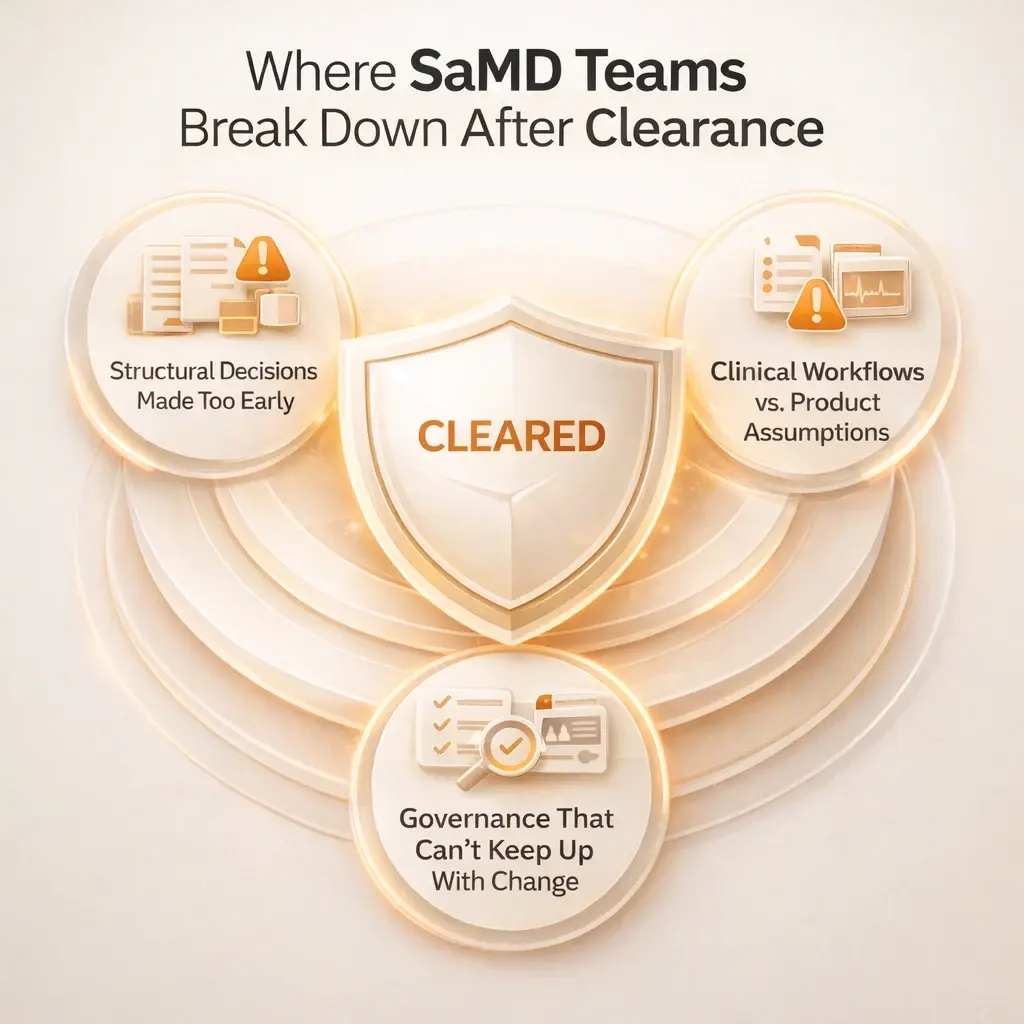
Where SaMD Teams Break Down After Clearance
Most SaMD programs that stall after clearance do not fail because of algorithmic performance or engineering capability. They fail because early structural decisions were made without enough alignment across regulatory, clinical, and system domains.
Structural Decisions Made Too Early
In fast-moving environments, teams often finalize key decisions before there is enough clarity. These decisions may seem minor early on, but they become costly as scale increases.
Examples include:
- Loosely defined intended use statements
- Clinical claims that evolve faster than documentation
- System boundaries that are unclear or overly coupled
When these elements shift post-clearance, teams are forced into broad revalidation efforts that slow development and increase regulatory risk.
Clinical Workflows vs. Product Assumptions
Clinical adoption is where many cleared SaMD products quietly lose momentum. Clinicians operate under time pressure, cognitive load, and accountability that product roadmaps often underestimate.
Even clinically valid tools can fail when they:
- Interrupt established workflows
- Introduce additional manual steps
- Generate excessive alerts or non-actionable outputs
Common adoption breakdowns include:
- Behavioral friction: tools are bypassed to save time
- Operational friction: latency or downtime during high-acuity periods
- Systemic friction: poor EHR or device integration requiring workarounds
When trust erodes, usage drops, often without formal feedback, making adoption issues harder to detect and correct.
Governance That Can’t Keep Up With Change
As SaMD products scale, change frequency typically increases. Without structured governance, this creates compounding risk.
Teams often struggle with:
- Fragmented audit trails across environments
- Validation scope expanding faster than capacity
- Monitoring systems focused on uptime rather than clinical risk signals
In these situations, every update feels like a regulatory event. Mature SaMD organizations avoid this not by freezing change, but by designing systems and processes that can absorb it safely.
Why Speed and Compliance Are Not Competing Priorities
In many SaMD organizations, speed and compliance are treated as opposing forces. Teams assume that regulatory rigor slows innovation, while rapid delivery increases risk. In practice, this framing is misleading. The most common delays in SaMD programs are not caused by compliance requirements themselves, but by late-stage rework triggered by misalignment.
When intended use, clinical claims, or system boundaries are unclear, new information forces foundational changes. These changes cascade across validation, documentation, and risk management, adding weeks or months to timelines. What looks like regulatory friction is often the cost of decisions made without enough structure early on.
Industry analyses consistently show that rework driven by late regulatory or clinical corrections can add 20–40% to overall program timelines. Teams that appear fast in early development often slow dramatically post-clearance, while more deliberate teams maintain steadier velocity across the product lifecycle.
In regulated environments, speed is not achieved by cutting corners. It is achieved by reducing uncertainty.
Deliberate SaMD teams invest early in:
- Clear and stable intended use definitions
- Well-scoped clinical claims tied to evidence
- Explicit system boundaries that contain change
- Risk-based approaches to validation and testing
By doing so, they limit the blast radius of updates. Changes can be assessed, validated, and released without triggering broad rework. Compliance becomes an enabling constraint rather than a bottleneck, allowing teams to move faster over time with greater confidence.
What a Practical SaMD Scaling Strategy Looks Like
Scaling SaMD successfully requires shifting focus from short-term delivery speed to long-term execution quality. Practical strategies are not about adding more process, but about applying structure where it reduces risk and friction.
Design for Scale, Not Just Clearance
Products designed solely to meet clearance requirements often struggle later. Practical scaling starts with anticipating growth and variability from the outset.
This includes:
- Modular system architectures that isolate high-risk components
- Clear data flows and traceability across the system
- Explicit assumptions about where and how change is expected
When scale is treated as a design constraint rather than a future problem, teams avoid costly retrofits and maintain flexibility as usage grows.
Build Change Tolerance Into the System
Change is inevitable in SaMD, whether driven by clinical feedback, new data, or market demand. The goal is not to minimize change, but to control its impact.
Effective teams:
- Apply risk-based validation strategies instead of blanket revalidation
- Maintain disciplined release management and documentation
- Evaluate updates based on clinical and regulatory impact, not just technical scope
This approach allows frequent iteration without turning every release into a regulatory event, preserving both momentum and compliance.
Treat Clinical Adoption as a Core Metric
Deployment does not equal adoption. SaMD products only deliver value when they are trusted, used, and integrated into real clinical workflows.
Practical scaling strategies treat adoption as a first-class signal by:
- Designing integration with EHRs and devices from the start
- Monitoring reliability and performance during peak clinical hours
- Measuring usage patterns, not just technical uptime
When adoption is measured and designed explicitly, teams can identify friction early and adjust before disengagement becomes entrenched.
Scaling Without Slowing Down Compliance
As SaMD products scale, the volume of change increases. New customers, broader patient populations, additional integrations, and evolving clinical expectations all place pressure on systems that were originally validated under narrower conditions. Without the right foundations, teams quickly reach a point where compliance activities begin to slow progress.
This slowdown is not inevitable. Mature SaMD organizations scale without sacrificing velocity by ensuring compliance is embedded into execution rather than treated as a separate phase.
Key practices that support compliant scale include:
- Centralized and continuous audit trails across environments and releases
- Clear traceability between requirements, risks, validation activities, and changes
- Monitoring systems that surface clinical risk signals, not just uptime or performance metrics
When compliance is operationalized this way, teams can evaluate the impact of change quickly and confidently. Updates become predictable events rather than disruptive ones, allowing organizations to respond to market needs without compromising regulatory posture or clinical safety.
This is also where many organizations recognize the value of experienced software as a medical device (SaMD) partners, teams that understand how to design, build, and scale regulated software without introducing unnecessary friction.
What Does This Mean for You?
For SaMD leaders, scaling is no longer just a growth milestone; it is a test of execution maturity. Early success can mask structural weaknesses that only appear once products are exposed to real-world complexity.
Rather than focusing solely on delivery speed or clearance timelines, effective leaders are asking more strategic questions:
- Where are we accumulating regulatory or clinical debt without visibility?
- Can our systems absorb change without triggering broad revalidation?
- Are we measuring clinical adoption with the same rigor as regulatory compliance?
These questions shift the conversation from short-term output to long-term sustainability. In regulated environments, leadership decisions directly influence not only business outcomes, but also clinical trust and patient safety.
Final Verdict
Scaling Software as a Medical Device is not about choosing between speed and rigor. It is about recognizing how deeply they are connected. Teams that invest early in structure, clarity, and disciplined execution are better positioned to grow without losing control.
As SaMD continues to mature, success will increasingly depend on an organization’s ability to treat execution as a clinical responsibility, not just a technical one. In environments defined by scrutiny, complexity, and urgency, deliberate approaches consistently outperform reactive ones.
Designing and scaling Software as a Medical Device requires more than technical execution. Explore how CitrusBits supports end-to-end SaMD development and scale.
About the Author

CitrusBits
Content Writer
Related blogs