


Blog
Software as a Medical Device (SaMD) vs Software in a Medical Device (SiMD)
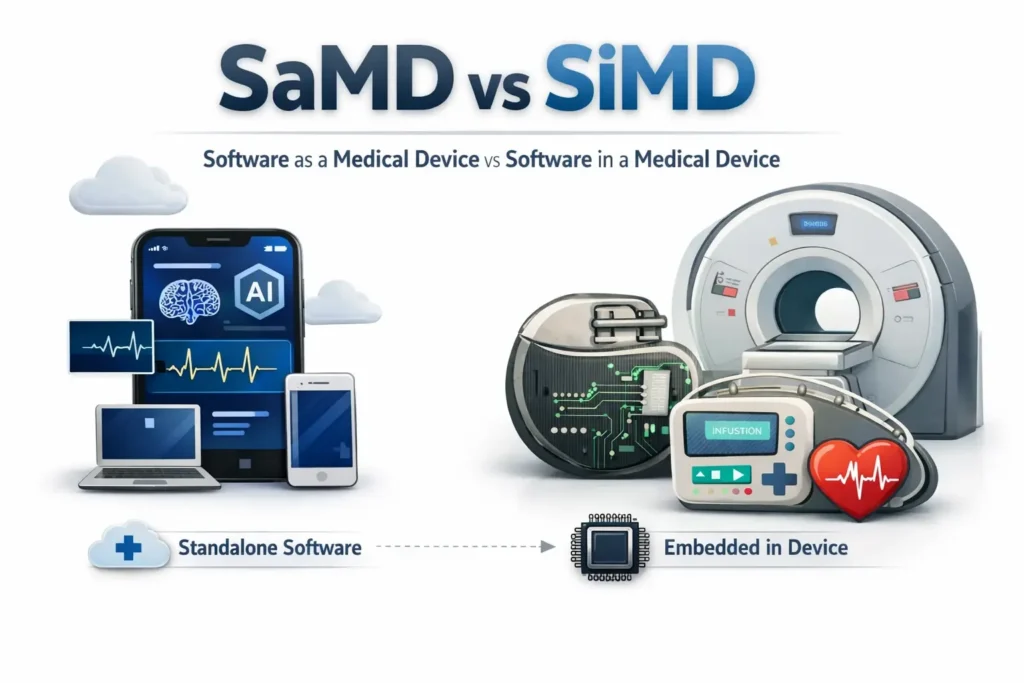
Healthcare software isn’t “just software” anymore, especially when it influences diagnosis, treatment, monitoring, or patient safety. If you’re building a digital health product, the very first strategic decision you must get right is this: are you creating Software as a Medical Device (SaMD) or Software in a Medical Device (SiMD)?
That single classification affects everything: your regulatory pathway, documentation, validation, cybersecurity requirements, development timeline, and even how quickly you can update and scale your product.
This article explains SaMD vs SiMD, decodes the SiMD medical abbreviation, shares practical examples, and helps you decide the right route so you can reduce compliance risk, speed up go-to-market, and build medical software that’s ready for real-world use.
What Is Software in a Medical Device (SiMD)?
SiMD is the medical abbreviation for Software in a Medical Device. It refers to software that is embedded within a physical medical device and is essential for that device to operate safely and effectively. In other words, the software is not standalone; it exists as part of the medical hardware.
In the context of software in medical device classifications, SiMD is treated as a component of the overall device rather than a separate product.
Key Characteristics of SiMD Medical Software:
SiMD medical software has several defining traits that distinguish it from SaMD:
- Fully integrated into a physical medical device
- Cannot function independently of the hardware
- Directly controls, drives, or influences device behavior
- Regulated as part of the entire medical device system
- Any software failure can directly impact patient safety
Because of this tight coupling, regulatory authorities evaluate SiMD within the same risk framework as the device itself.
Examples of SiMD Medical Software
Common real-world examples of SiMD medical software include:
- Embedded control software inside infusion pumps
- Firmware running within pacemakers and defibrillators
- Software controlling imaging functions in MRI or CT scanners
- Embedded algorithms inside ventilators
In all these cases, the software has no medical purpose on its own; its value exists only through the hardware it operates.
What Is SaMD (Software as a Medical Device)
If you’re wondering what SaMD is, the definition is simple but powerful. Software as a Medical Device (SaMD) refers to software that performs a medical function without being part of a physical medical device. It runs on general-purpose platforms such as mobile phones, tablets, desktops, or cloud infrastructure.
Unlike SiMD medical software, SaMD operates independently and delivers medical value through data processing, algorithms, analytics, or artificial intelligence.
👉 For a deeper technical and regulatory breakdown, read our complete guide on Software as a Medical Device (SaMD)
Core Characteristics of SaMD:
SaMD products share several defining features:
- Standalone software with a direct medical purpose
- Not embedded in medical hardware
- Runs on consumer or enterprise platforms
- Often cloud-based and scalable
- Frequently updated through software releases
This flexibility makes SaMD especially popular in digital health, telemedicine, and AI-driven healthcare solutions.
Examples of SaMD in Healthcare
Common examples of SaMD include:
- Clinical decision support software
- AI-based diagnostic tools analyzing medical images
- Remote patient monitoring applications
- Digital therapeutics delivering treatment through software
In all cases, the software itself is the medical device.
SaMD vs SiMD: Core Conceptual Difference
At the highest level, the SaMD vs SiMD debate comes down to dependency.
- SiMD software depends on hardware to fulfill its medical purpose
- SaMD software delivers medical value independently
This distinction may sound subtle, but it has massive implications for regulatory strategy, development complexity, validation requirements, and long-term scalability.
When comparing SiMD vs SaMD, regulatory authorities always ask one key question:
“Does the software still serve a medical purpose if the hardware is removed?”
If the answer is no, it’s SiMD.
If the answer is yes, it’s SaMD.
SaMD vs SiMD: Side-by-Side Comparison
| Feature | SaMD | SiMD |
| Full Form | Software as a Medical Device | Software in a Medical Device |
| Hardware Dependency | Independent | Fully embedded |
| Platform | Cloud, mobile, desktop | Physical medical hardware |
| Update Frequency | High and flexible | Controlled and limited |
| Regulatory Scope | Software-only | Entire device system |
| Risk Source | Algorithm & data | Hardware + software |
Why SaMD vs SiMD Classification Matters Early
Correctly identifying whether your product is SaMD or SiMD medical software impacts:
- Regulatory approval timelines
- Required clinical validation
- Cybersecurity obligations
- Software lifecycle documentation
- Post-market surveillance requirements
For healthcare startups and medical device companies, early misclassification can result in months or even years of lost momentum.
Regulatory Considerations You Must Know
Regulatory requirements are one of the biggest differentiators when comparing SaMD vs SiMD, and misunderstanding them can significantly delay product approval.
- Regulatory Oversight for SiMD Medical Software:
Since SiMD medical software is embedded within a physical device, regulators assess it as part of the entire medical device system.
Key regulatory implications include:
- Risk classification based on the full device
- Software validation tied to hardware performance
- Limited flexibility for post-market updates
- Stricter change-control processes
Any update to the SiMD software may require partial or full revalidation of the device itself.
- Regulatory Oversight for SaMD:
SaMD follows a software-centric regulatory pathway, which is typically more flexible but still rigorous.
Regulatory authorities such as the FDA, EU MDR, and IMDRF evaluate:
- Intended medical purpose
- Clinical evidence and performance
- Data integrity and cybersecurity
- Software lifecycle and update management
Because SaMD is independent, updates can often be deployed faster, provided regulatory controls are maintained. Learn how we help companies navigate SaMD compliance here: Software as a Medical Device Solutions
SiMD vs SaMD: Which One Should You Choose?
Choosing between SiMD vs SaMD depends on your product’s architecture, use case, and long-term vision.
Choose SaMD If:
- Your software performs diagnosis, monitoring, or treatment independently
- You need cloud scalability and frequent updates
- AI, analytics, or algorithms drive clinical value
- You want faster iteration cycles
SaMD is ideal for modern digital health platforms and data-driven healthcare solutions.
Choose SiMD If:
- Your software must control or operate physical medical hardware
- Real-time device response is critical
- Safety depends on hardware-software interaction
- Embedded systems are required
SiMD remains essential for traditional medical devices where software directly controls physical behavior.
Development Challenges in SaMD and SiMD
Both SaMD and SiMD development come with unique challenges that must be addressed early.
Common SaMD Challenges
- Clinical validation of algorithms
- Data privacy and cybersecurity compliance
- Continuous software updates under regulation
- Interoperability with healthcare systems
Common SiMD Challenges
- Hardware-software dependency risks
- Lengthy validation cycles
- Limited update flexibility
- Device-level risk management
Whether you’re building software in a medical device or standalone medical software, having an experienced development and compliance partner is critical.
The Bottom Line
Exploring SaMD vs SiMD is not just a regulatory exercise; it’s a strategic decision that shapes your product’s success. SaMD offers flexibility, scalability, and faster innovation, while SiMD provides precise control over physical medical devices. The key is aligning your software’s purpose, architecture, and compliance strategy from day one.
If you’re planning to build regulated healthcare software, partnering with experts who understand both technology and compliance can save you time, cost, and risk.
👉 Learn how we help healthcare innovators build compliant, scalable medical software: CitrusBits – Healthcare Software Development Experts
FAQs
Q: What is SaMD in healthcare?
Ans: SaMD is standalone software intended for medical purposes that operates independently of physical medical devices.
Q: What does the SiMD medical abbreviation mean?
Ans: SiMD stands for Software in a Medical Device, meaning software embedded within and essential to a medical device’s operation.
Q: What is the main difference between SaMD and SiMD?
Ans: The main difference is dependency; SaMD works independently, while SiMD requires hardware to perform its medical function.
Q: Is SaMD regulated differently from SiMD?
Ans: Yes. SaMD follows software-focused regulatory pathways, while SiMD is regulated as part of a complete medical device system.
Q: Can software be both SaMD and SiMD?
Ans: No. Software is classified as either SaMD or SiMD based on whether it depends on medical hardware.
References
- U.S. FDA: Software as a Medical Device (SaMD): https://www.fda.gov/medical-devices/digital-health-center-excellence/software-medical-device-samd
- Gilero: Understanding Regulatory Difference Between SaMD and SiMD: https://www.gilero.com/regulatory-difference-samd-simd/
- RQM+ – SaMD vs. SiMD: What You Must Know: https://www.rqmplus.com/blog/samd-vs-simd-what-you-must-know-for-accurate-classification/
- ICS – SaMD vs. SiMD: Do You Know the Difference?: https://www.ics.com/blog/samd-vs-simd-do-you-know-difference
Table of Contents
1) What Is Software in a Medical Device (SiMD)?
2) What Is SaMD (Software as a Medical Device)
3) SaMD vs SiMD: Core Conceptual Difference
4) Why SaMD vs SiMD Classification Matters Early
5) SiMD vs SaMD: Which One Should You Choose?
6) Development Challenges in SaMD and SiMD
7) The Bottom Line
Innovate the Future of Health Tech
CitrusBits helps MedTech leaders build smarter apps, connected devices, and XR health solutions that truly make an impact.
