


Blog
Choosing the Right Healthcare AI Tech Stack for AI Agent Development
Selecting the right healthcare AI tech stack is one of the most critical engineering decisions in any AI initiative. While many organizations focus on choosing the most advanced Large Language Model (LLM), successful healthcare AI development depends on the entire technology ecosystem working together, from backend frameworks and orchestration layers to vector databases, interoperability standards, cloud infrastructure, and observability. An AI agent is only as reliable as the platform supporting it.
Healthcare presents challenges that traditional AI applications rarely encounter. Clinical systems must process sensitive patient data, integrate with Electronic Health Records (EHRs), support standards such as FHIR, maintain high availability, and deliver low-latency responses while operating within strict security and compliance requirements.
These constraints make technology selection an architectural decision rather than a development preference.
What Makes a Healthcare AI Tech Stack Different?
Selecting a healthcare AI tech stack is fundamentally different from building AI applications for finance, retail, or customer support. Healthcare systems operate in regulated environments where every architectural decision affects security, interoperability, latency, and patient safety. As a result, engineering teams must evaluate technologies based on production requirements rather than popularity.
Unlike general AI applications, healthcare AI development requires the technology stack to support:
- Secure processing of Protected Health Information (PHI)
- Standards-based interoperability through FHIR and HL7
- Deterministic workflow orchestration
- Human-in-the-loop validation
- Auditability and traceability
- High availability and disaster recovery
- Enterprise authentication and authorization
For example, a clinical documentation assistant processing physician conversations cannot tolerate unpredictable latency or inconsistent structured outputs. The backend must coordinate streaming transcription, context retrieval, clinical reasoning, documentation generation, and EHR integration while maintaining response times suitable for real-time clinical workflows.
The technology stack should therefore be evaluated across four engineering dimensions:
Requirement | Engineering Goal |
Reliability | Fault-tolerant services and high availability |
Scalability | Independent horizontal scaling of AI workloads |
Security | Zero-trust architecture with role-based access |
Interoperability | Standards-based integration with healthcare ecosystems |
Organizations often fail by selecting technologies because they are trending instead of asking a more important question:
Can this technology operate reliably inside a regulated healthcare environment?
That question should guide every technology decision throughout the platform.
Designing the AI Layer: Choosing the Right Foundation Models
The language model is the computational engine of an AI agent, but it should never become the architecture itself. A production healthcare AI development stack should abstract model providers behind an orchestration layer, allowing engineering teams to upgrade or replace models without affecting downstream services.
Instead of standardizing on one model, many enterprise healthcare platforms assign different models to different workloads.
Clinical Task | Engineering Priority |
Clinical documentation | Structured output consistency |
Medical summarization | Long-context reasoning |
Coding assistance | Deterministic JSON generation |
Patient communication | Natural conversation quality |
Knowledge retrieval | Tool calling and context utilization |
Model selection should be based on measurable engineering characteristics rather than benchmark scores.
Evaluate models against:
- Context window
- Function/tool calling capabilities
- Structured JSON generation
- Token efficiency
- Streaming support
- Latency
- Cost per inference
- Enterprise deployment options
For example, a clinical documentation workflow benefits from models capable of maintaining long clinical conversations while producing structured outputs. Conversely, scheduling or patient support agents often prioritize response speed and lower operational cost over advanced reasoning.
A model abstraction layer also minimizes vendor lock-in. As the AI ecosystem evolves, organizations can adopt newer foundation models without redesigning the surrounding AI tech stack for healthcare.
Backend Technologies That Power Healthcare AI Platforms
The backend serves as the orchestration engine for every AI interaction. While frontend frameworks influence user experience, backend technologies determine scalability, maintainability, and operational resilience.
Python has become the dominant language for AI agent development because of its mature ecosystem and extensive machine learning libraries. However, language selection alone is only one part of the architecture.
A modern backend typically includes:
Layer | Recommended Technology |
API Framework | FastAPI |
Background Processing | Celery or Temporal |
Authentication | OAuth 2.0 / OpenID Connect |
Messaging | Kafka or RabbitMQ |
API Gateway | Kong or NGINX |
Containerization | Docker |
Among Python frameworks, FastAPI has emerged as a preferred choice for healthcare AI platforms due to:
- Native asynchronous request handling
- Automatic OpenAPI specification generation
- Strong type validation with Pydantic
- High-performance API execution
- Seamless integration with AI inference services
Long-running AI tasks should never block synchronous API requests. Instead, orchestration services should distribute workloads across background workers or event-driven pipelines, allowing AI inference, transcription, retrieval, and document generation to execute independently.
This separation significantly improves throughput while preventing resource-intensive AI operations from degrading user-facing application performance.
Selecting the Right Agent Framework
Large Language Models generate responses, but they do not coordinate enterprise workflows. That responsibility belongs to the agent framework.
A well-designed AI agent tech stack should separate reasoning, orchestration, memory management, and tool execution into modular services rather than embedding these concerns directly into prompts.
Several frameworks have emerged to support agent orchestration, each addressing different engineering requirements.
Framework | Best For | Considerations |
LangGraph | Stateful multi-agent workflows | Excellent for production orchestration |
Semantic Kernel | Enterprise .NET ecosystems | Strong Microsoft integration |
CrewAI | Collaborative multi-agent systems | Rapid prototyping and role-based agents |
AutoGen | Research and conversational workflows | Flexible but requires additional production hardening |
For healthcare AI development, the framework should support capabilities such as:
- Stateful workflow execution
- Tool invocation
- Human approval checkpoints
- Retry and recovery mechanisms
- Agent memory management
- Distributed execution
- Workflow observability
For example, a clinical documentation workflow may execute multiple agents in sequence:

Rather than embedding every decision inside one prompt, the framework orchestrates each agent independently while preserving workflow state throughout the request lifecycle.
This modular execution model simplifies debugging, enables independent prompt optimization, and supports incremental deployment of new capabilities without disrupting existing clinical workflows. It also aligns with modern healthcare AI tech stack design principles, where scalability is achieved through orchestration rather than increasingly complex prompts.
Databases and Vector Storage: Building the Data Foundation
A production healthcare AI development stack requires multiple data stores, each optimized for a specific workload. Attempting to manage transactional data, semantic retrieval, caching, and AI memory within a single database often results in performance bottlenecks and unnecessary complexity.
Instead, modern healthcare AI platforms adopt a polyglot persistence architecture where each storage technology serves a dedicated purpose.
1. Relational Database
Relational databases remain the system of record for structured healthcare data.
Typical workloads include:
- User accounts
- Clinical workflows
- Audit records
- Session metadata
- Application configuration
- Workflow execution history
For most enterprise deployments, PostgreSQL is an excellent choice because it provides:
- ACID transactions
- JSONB support
- Strong indexing capabilities
- Native partitioning
- High availability options
- Extension support, such as pgvector
2. Vector Database
Unlike relational databases, vector databases enable semantic similarity searches by storing embeddings generated from clinical documents, treatment guidelines, research papers, and patient records.
A Retrieval-Augmented Generation (RAG) pipeline typically performs the following workflow:

Popular options include:
Technology | Best Use Case |
pgvector | Existing PostgreSQL deployments |
Pinecone | Managed enterprise vector search |
Weaviate | Knowledge graph and semantic search |
Milvus | Large-scale self-hosted AI platforms |
Qdrant | High-performance vector retrieval |
For organizations already standardizing on PostgreSQL, pgvector often provides the best balance between operational simplicity and retrieval performance by eliminating the need to maintain separate database infrastructure.
3. In-Memory Cache
Healthcare AI applications frequently retrieve the same contextual information multiple times during a workflow.
Using Redis as a distributed cache significantly reduces latency by storing:
- Session state
- Authentication tokens
- Temporary workflow context
- Frequently accessed clinical guidelines
- Prompt templates
- Short-lived retrieval results
This minimizes repeated database queries while improving response times for real-time clinical interactions.
Building Scalable Infrastructure for Healthcare AI
The infrastructure supporting a healthcare AI tech stack must handle unpredictable inference workloads while maintaining high availability and low latency. Unlike traditional web applications, AI workloads consume significantly more compute resources, particularly during inference, embedding generation, and document processing.
Production platforms typically separate infrastructure into independent services that can scale horizontally based on workload characteristics.
A common deployment architecture includes:
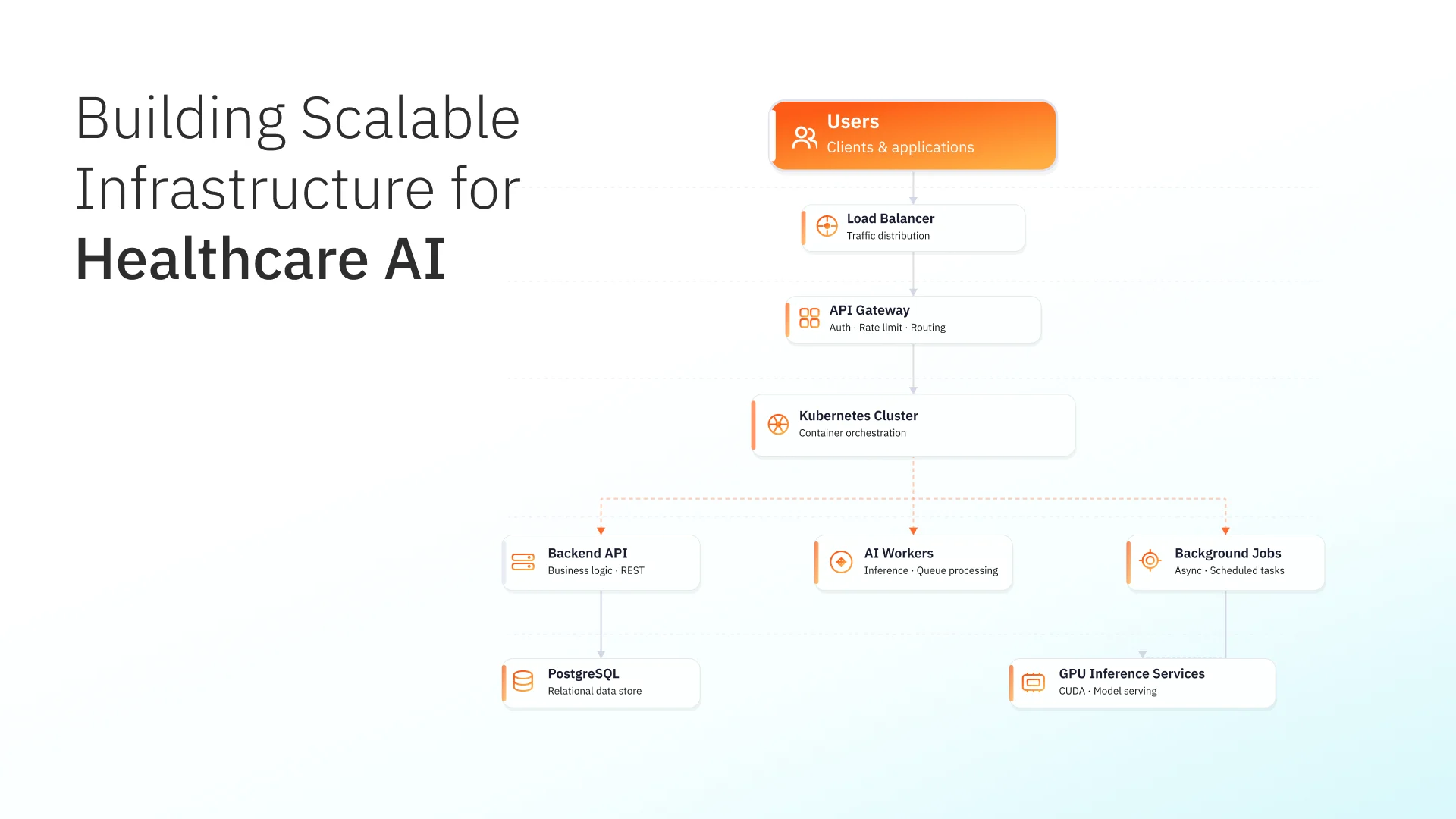
This architecture enables:
- Independent scaling of inference services
- Automatic workload distribution
- Fault tolerance
- Zero-downtime deployments
- Rolling model upgrades
- Resource isolation between services
Containerization with Docker provides deployment consistency across environments, while Kubernetes manages orchestration, autoscaling, health checks, and workload scheduling.
For GPU-intensive inference, organizations often isolate model-serving infrastructure from backend APIs, allowing AI workloads to scale independently without impacting application responsiveness.
Observability: The Missing Layer in Most Healthcare AI Platforms
Many organizations invest heavily in model selection but overlook one of the most important components of a production AI tech stack for healthcare: observability.
Traditional application monitoring focuses on metrics such as CPU utilization, memory consumption, and API response times. AI systems introduce an entirely different set of operational challenges.
Engineering teams need visibility into questions such as:
- Which agent produced this response?
- Which model version was used?
- Which prompt template generated the output?
- What context was retrieved?
- How long did each workflow stage take?
- Why did retrieval quality decrease?
- Which responses required physician correction?
Without these insights, debugging AI systems becomes largely guesswork.
A mature observability platform should collect telemetry across every stage of the inference pipeline.
Layer | Metrics to Monitor |
API Layer | Response time, throughput, error rate |
AI Layer | Token usage, inference latency, model version |
Retrieval Layer | Retrieval accuracy, context relevance |
Agent Layer | Execution time, success rate, retry count |
Infrastructure | CPU, GPU, memory, network utilization |
Modern engineering teams often combine application monitoring with AI-specific observability platforms to track both infrastructure health and model behavior.
Observability should not be treated as an operational afterthought. It is a core architectural capability that enables safe deployments, continuous optimization, and reliable production support.
Security Infrastructure for Enterprise Healthcare AI
Security within a healthcare AI development stack extends far beyond encrypting patient records. Every service, API, model, and integration introduces potential attack surfaces that must be protected through a layered security architecture.
A Zero Trust security model is increasingly becoming the preferred approach for enterprise healthcare platforms.
Rather than assuming internal services are trusted, every request should be authenticated, authorized, and validated regardless of its origin.
A production security architecture typically includes:

Critical security capabilities include:
- OAuth 2.0 and OpenID Connect authentication
- Role-Based Access Control (RBAC)
- Multi-Factor Authentication (MFA)
- Secret management for API keys and credentials
- End-to-end encryption
- Secure API gateways
- Immutable audit logging
- Network segmentation between AI and enterprise services
Equally important is protecting interactions between AI agents themselves. Agent-to-agent communication should use authenticated service identities, encrypted transport, and clearly defined authorization boundaries to prevent unauthorized access to clinical resources.
By designing security into every architectural layer rather than adding it during deployment, engineering teams can build healthcare AI applications that remain resilient, scalable, and compliant as they evolve. This layered approach also reduces operational risk while supporting enterprise adoption across hospitals, health systems, and medical device organizations.
Reference Healthcare AI Tech Stack for Production Deployments
There is no universal healthcare AI tech stack that fits every organization. A startup building an AI medical scribe has different infrastructure requirements than a hospital network deploying clinical decision support across multiple facilities. However, enterprise healthcare platforms typically converge around a common architecture because it balances scalability, maintainability, interoperability, and operational efficiency.
The following reference stack represents a production-ready foundation for most healthcare AI applications.
Layer | Recommended Technology | Why It Matters |
Frontend | React / Next.js | Component-based UI with server-side rendering |
Mobile | React Native | Cross-platform clinical applications |
API Layer | FastAPI | High-performance asynchronous APIs |
Authentication | OAuth 2.0 / OpenID Connect | Enterprise identity management |
Agent Framework | LangGraph | Stateful multi-agent orchestration |
LLM | Claude / GPT-4.1 | Clinical reasoning and structured generation |
Embeddings | OpenAI / Voyage AI | High-quality semantic retrieval |
Database | PostgreSQL | ACID-compliant transactional storage |
Vector Store | pgvector | Semantic search without infrastructure sprawl |
Cache | Redis | Session state and low-latency caching |
Messaging | Kafka | Event-driven workflow orchestration |
Object Storage | Amazon S3 / Azure Blob | Audio, documents, and model artifacts |
Containerization | Docker | Consistent deployment across environments |
Orchestration | Kubernetes | Horizontal scaling and workload management |
Monitoring | Prometheus + Grafana | Infrastructure monitoring |
AI Observability | Langfuse | Prompt, retrieval, and inference monitoring |
One architectural principle remains consistent regardless of technology selection:
Every layer should remain replaceable without requiring changes to the rest of the platform.
For example, migrating from Claude to another enterprise LLM should only require updating the inference service rather than rewriting orchestration logic, API services, or frontend applications. This level of abstraction protects organizations from vendor lock-in while allowing continuous adoption of emerging AI technologies.
Choosing the Right Tech Stack Based on Your Healthcare Use Case
The optimal healthcare AI development stack depends more on the clinical workflow than the model itself. Different healthcare applications place different demands on latency, scalability, reasoning depth, and interoperability.
The table below illustrates how engineering priorities shift across common healthcare AI solutions.
Healthcare Solution | Primary Engineering Priority | Recommended Stack Characteristics |
AI Medical Scribe | Real-time transcription and structured outputs | Streaming APIs, LangGraph, Redis, PostgreSQL |
Clinical Decision Support | Clinical reasoning accuracy | Long-context LLMs, RAG, FHIR integration |
Patient Engagement | High concurrency and low latency | FastAPI, Redis, Kubernetes autoscaling |
Remote Patient Monitoring | Event-driven processing | Kafka, microservices, background workers |
Revenue Cycle Automation | Workflow orchestration | Multi-agent architecture with deterministic APIs |
Medical Coding | Structured JSON generation | Tool-calling LLMs with validation pipelines |
Notice that every solution shares common architectural components while emphasizing different parts of the stack.
This modularity enables organizations to reuse infrastructure across multiple AI initiatives instead of creating isolated applications for every clinical workflow.
Final Thoughts
Choosing a healthcare AI tech stack is not about identifying the most powerful language model or the newest AI framework. It is about designing a platform capable of supporting clinical workflows that demand security, interoperability, scalability, and operational resilience.
The strongest healthcare AI platforms share several characteristics:
- They separate orchestration from reasoning.
- They treat AI models as replaceable services.
- They prioritize interoperability over proprietary integrations.
- They build observability into every workflow.
- They scale infrastructure independently across backend services, AI inference, and data processing.
- They maintain security and governance as architectural foundations rather than deployment checklists.
Building the right AI tech stack for healthcare is only one part of the engineering journey. The next challenge is enabling AI agents to securely retrieve patient context, communicate with enterprise systems, and reason over trusted clinical knowledge.
In the next guide, we’ll explore FHIR, MCP & RAG: Connecting AI Agents to Healthcare Data, where you’ll learn how modern healthcare AI platforms integrate with EHRs, retrieve contextual information, and deliver grounded, clinically relevant responses through interoperable architectures.
Table of Contents
1) What Makes a Healthcare AI Tech Stack Different?
2) Designing the AI Layer: Choosing the Right Foundation Models
3) Backend Technologies That Power Healthcare AI Platforms
4) Selecting the Right Agent Framework
5) Databases and Vector Storage: Building the Data Foundation
6) Building Scalable Infrastructure for Healthcare AI
7) Observability: The Missing Layer in Most Healthcare AI Platforms
8) Security Infrastructure for Enterprise Healthcare AI
9) Reference Healthcare AI Tech Stack for Production Deployments
10) Choosing the Right Tech Stack Based on Your Healthcare Use Case
11) Final Thoughts
Innovate the Future of Health Tech
CitrusBits helps MedTech leaders build smarter apps, connected devices, and XR health solutions that truly make an impact.
