


Blog
Building a Connected Medical Device? Get the Architecture and Execution Right
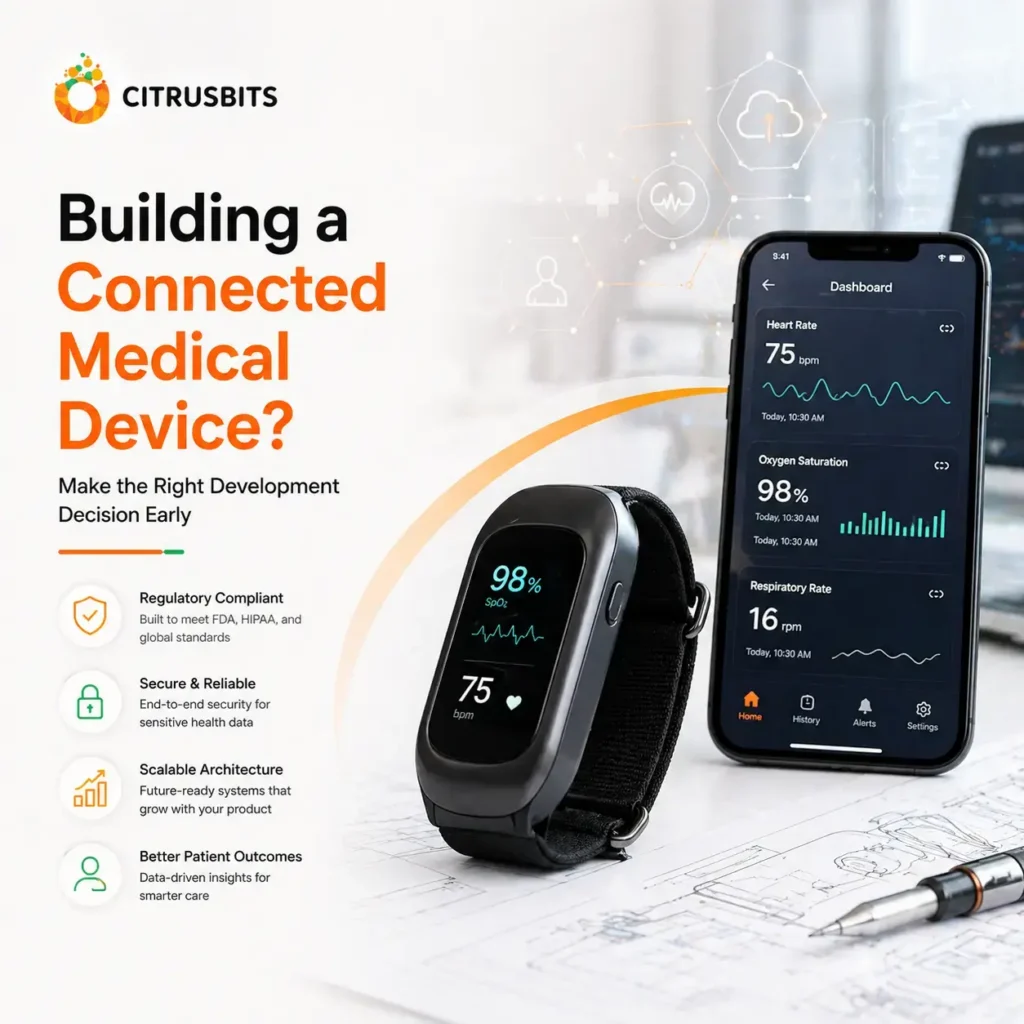
Building a connected medical device is not just about writing software or integrating hardware. It is about engineering a system that can handle real-time data, meet strict regulatory requirements, and perform reliably in high-stakes clinical environments. One wrong decision early in architecture or execution can delay approvals, increase costs, and put your entire product roadmap at risk.
For people like you, the challenge is not whether the product can be built. It is whether it can be built correctly, compliantly, and fast enough to compete. Most teams underestimate the complexity of combining embedded systems, cloud infrastructure, and healthcare compliance into a single cohesive product. That is where the right development approach becomes critical.
Companies that succeed in this space do not just focus on development. They focus on building scalable, compliance-ready systems from day one, often by partnering with teams that already understand the technical and regulatory landscape.
Why Connected Medical Devices Require a Different Development Approach
Connected medical devices are fundamentally different from traditional software products. You are not building a standalone application. You are engineering a multi-layered system where hardware, firmware, cloud infrastructure, and user interfaces must work together seamlessly under strict regulatory constraints.
At the core, a typical connected MedTech product includes:
- Embedded systems handling sensor data and device behavior
- Edge processing for real-time responsiveness
- Cloud infrastructure for storage, analytics, and interoperability
- Mobile or web applications for patients and providers
Each layer introduces its own complexity. When combined, the margin for error becomes extremely small.
On top of this, regulatory bodies like the FDA require traceability, validation, and risk management across the entire system. You can review these expectations directly through the FDA’s Digital Health Center of Excellence:
https://www.fda.gov/medical-devices/digital-health-center-excellence
This is why companies building connected devices often turn to specialized teams like CitrusBits, a healthcare app development company that understands how to design and execute across all layers without compromising compliance or performance.
The Real Risk Lies in Early Architectural Decisions
The biggest risks in connected medical device development are not visible during development. They surface later when scaling, integrating, or going through regulatory review.
Early architectural decisions determine:
- How your system handles data at scale
- Whether your product meets compliance requirements
- How easily can you integrate with healthcare systems
- Whether your infrastructure can support future features
Common mistakes include:
- Designing without considering HIPAA or FDA requirements
- Weak device-to-cloud communication models
- Lack of audit trails and logging
- Choosing an infrastructure that cannot scale
These are not small issues. They often require complete rework.
Core Capabilities Required to Build Connected MedTech Products
Building a connected medical device requires a combination of highly specialized capabilities. Missing even one of these can slow development or introduce serious risk.
1. Embedded and Firmware Engineering
This is where your device comes to life.
- Sensor integration and calibration
- Real-time data processing
- Low-power optimization for battery efficiency
- Reliable device performance under varying conditions
Without strong embedded expertise, your product may fail at the hardware level before software even becomes a factor.
2. Secure Cloud Architecture
Once data leaves the device, it must be handled securely and efficiently.
- HIPAA-compliant data pipelines
- Encryption in transit and at rest
- Scalable cloud infrastructure
- Data storage and retrieval optimization
Security is not optional here. It is foundational.
3. Mobile and Clinical Interface Development
Your product must be usable by both patients and healthcare professionals.
- Patient-facing mobile applications
- Provider dashboards and analytics
- UX tailored for clinical workflows
- Accessibility and usability considerations
Real-world usability directly impacts adoption.
You can see how these elements come together in real-world implementations through the CitrusBits portfolio, where healthcare products are designed for both performance and usability.
4. Regulatory and Compliance Engineering
This is where most general development teams fall short.
- Design controls aligned with FDA expectations
- Risk management processes (ISO 14971)
- Documentation for audits and approvals
- Validation and verification processes
Without this layer, your product may never reach the market.
Where Most Teams Underestimate Complexity
Even experienced engineering teams underestimate the demands of connected MedTech products.
The most common blind spots include:
- Treating compliance as documentation instead of engineering
- Underestimating testing and validation cycles
- Ignoring interoperability until late stages
- Assuming the MVP architecture will scale
These assumptions lead to delays, increased costs, and failed approvals.
The reality is that connected medical devices require a different mindset. You are not building fast and fixing later. You are building correctly from the beginning.
How Leading MedTech Companies Structure Development Today
High-performing MedTech companies approach development strategically. They understand that building everything internally can slow them down, especially when dealing with highly specialized requirements.
Instead, they focus on:
- Keeping core product vision and ownership internal
- Leveraging specialized partners for execution and compliance-heavy components
- Accelerating MVP timelines without compromising quality
- Building scalable systems from day one
This approach allows teams to move faster while reducing risk.
Companies working with experienced partners like CitrusBits gain access to teams that already understand the complexity of connected healthcare systems, enabling them to focus on innovation instead of operational challenges.
When Internal Teams Become a Bottleneck
Even strong internal teams can struggle when building connected medical devices.
The challenges are not about capability. They are about specialization and speed.
Common bottlenecks include:
- Difficulty hiring niche talent like embedded engineers and compliance experts
- Limited experience with FDA-regulated systems
- Slower iteration cycles due to internal dependencies
- High operational costs without proportional output
Over time, these challenges delay product timelines and increase pressure on leadership.
This is why many CTOs shift toward a more strategic execution model, ensuring their internal teams focus on innovation while specialized partners handle the complexity of building compliant, scalable systems.
What to Look for in a MedTech Development Partner?
At this stage, the question is not whether you need external expertise. It is how to identify a partner who can actually deliver at the level your product demands.
A strong MedTech development partner should not just talk about capabilities. They should demonstrate them through systems, processes, and real-world outcomes.
Here is how CTOs and decision-makers should evaluate technically:
Proven Experience with FDA-Regulated Systems
Regulatory alignment is not theoretical. It is operational.
Your partner should have:
- Experience with FDA submission processes
- Understanding of design controls and validation
- Clear documentation workflows
If they have not worked on regulated products before, your timelines will reflect that gap.
Architecture for Connected Systems
You are building an ecosystem, not a feature.
Evaluate whether they can design:
- Device-to-cloud communication pipelines
- Real-time data synchronization models
- Scalable backend infrastructure
Weak architecture decisions early will limit everything you build later.
Security-First Engineering Approach
Healthcare data demands a higher standard.
Your partner should demonstrate:
- End-to-end encryption strategies
- Secure authentication and access control
- Compliance with HIPAA and global privacy standards
Security should be part of the architecture, not an added layer.
Interoperability Expertise (FHIR, HL7)
Your product will not exist in isolation.
It must integrate with:
- EHR systems
- Hospital platforms
- Third-party healthcare tools
Standards like FHIR and HL7 are critical here. Without them, your product becomes difficult to adopt in real clinical environments.
End-to-End Ownership Capability
Fragmented teams create fragmented products.
Look for partners who can handle:
- Product strategy
- UX and clinical design
- Development and testing
- Post-launch scaling
You can evaluate this by reviewing full-cycle delivery examples on https://citrusbits.com/work/
and understanding how solutions are built holistically, not in silos.
Build It Right the First Time
Connected medical device development leaves very little room for error. Every decision you make early on impacts compliance, scalability, and time to market.
The companies that succeed are not just building products. They are building systems that are designed to pass audits, scale efficiently, and perform reliably in real-world environments.
That requires more than execution. It requires the right technical foundation and the right partner.
If you are planning to build or scale a connected MedTech product, it is worth starting with a team that already understands the complexity and regulatory landscape.
You can start that conversation here: https://citrusbits.com/contact/
Table of Contents
1) Why Connected Medical Devices Require a Different Development Approach
2) The Real Risk Lies in Early Architectural Decisions
3) Core Capabilities Required to Build Connected MedTech Products
4) Where Most Teams Underestimate Complexity
5) How Leading MedTech Companies Structure Development Today
6) When Internal Teams Become a Bottleneck
7) What to Look for in a MedTech Development Partner?
8) Build It Right the First Time
Innovate the Future of Health Tech
CitrusBits helps MedTech leaders build smarter apps, connected devices, and XR health solutions that truly make an impact.
