


Blog
AI & Portable Medical Device Development for Scalable, Market-Ready Healthcare Products
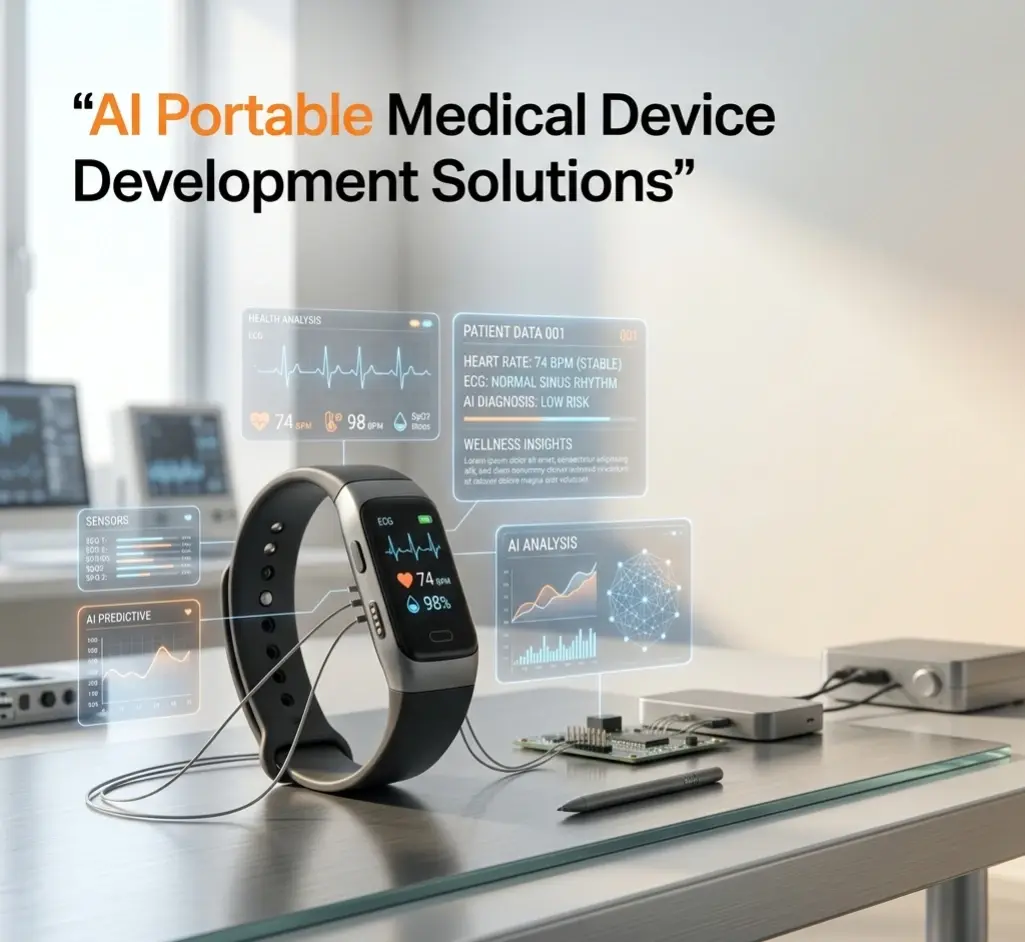
AI & portable medical device development is no longer a future-facing innovation. It is a competitive necessity for companies building next-generation healthcare products. Yet most teams struggle to move beyond prototypes, facing fragmented development, underperforming AI models, and delays caused by poor system integration.
Bringing a smart medical device to market requires more than isolated expertise. It demands a unified approach across hardware engineering, AI model deployment, and software development, all aligned with real-world performance and regulatory expectations. Without that alignment, even the most promising ideas fail to scale.
This is where the right development strategy becomes a growth driver. By combining intelligent systems with portable device engineering, businesses can accelerate time-to-market, improve patient outcomes, and unlock entirely new revenue streams. The difference lies in execution and in choosing a partner that can deliver across every layer of the product lifecycle.
Struggling to Build a Scalable AI-Powered Medical Device? Here’s What Most Teams Get Wrong
Most companies entering AI & portable medical device development underestimate the complexity of turning an idea into a clinically viable, scalable product. The challenge is rarely innovation. It is execution across disconnected systems, teams, and technologies.
Instead of a unified product strategy, many organizations operate in silos, where hardware, AI, and software evolve independently. This creates friction at the integration stage, where performance, compliance, and usability must align under real-world conditions.
Here are the most common failure points that delay or completely derail product launches:
Fragmented development across teams: AI engineers, embedded developers, and software teams often work without a shared architecture, leading to integration failures and costly rework
AI models that fail in real device environments: Models trained in controlled environments struggle with latency, power constraints, and noisy real-world data
Lack of regulatory readiness from day one: Compliance is treated as a final step rather than a design constraint, causing delays when moving toward approval
Overlooking edge computing limitations: Portable and wearable medical devices require optimized AI that can run efficiently without relying heavily on the cloud
Poor scalability from prototype to production: Many smart medical devices work in MVP stages but fail when scaled due to weak architecture and infrastructure planning
The result is predictable. Extended timelines, increased costs, and products that never reach commercialization. Solving this requires a fundamentally different approach, one built around integration, not iteration.
What It Takes to Engineer a Market-Ready Smart Medical Device
Building a smart medical device is not about adding AI to existing hardware. It is about engineering a system where intelligence, portability, and reliability are designed to function together under strict constraints.
A portable medical device must operate in dynamic environments, process data in real time, and maintain clinical-grade accuracy, all while remaining energy-efficient and secure. This requires a deeper level of engineering discipline than traditional product development.
Core Requirements for Market-Ready Devices
Real-time data processing capabilities:
Devices must capture, analyze, and respond to patient data instantly without compromising accuracy or speed
Optimized power consumption:
Battery efficiency directly impacts usability, especially in wearable medical devices that require continuous monitoring
High-performance embedded systems:
Microcontrollers and sensors must support AI workloads without overheating or performance degradation
Seamless connectivity and interoperability:
Integration with healthcare systems, mobile apps, and cloud platforms is essential for data continuity
Clinical-grade reliability and accuracy:
Every output must meet strict performance standards, especially in diagnostic and monitoring devices
Where Most Smart Medical Device Development Falls Short?
Even with strong concepts, many products fail to meet commercial expectations due to gaps in execution:
- Disconnected software and hardware design: Without synchronized development, performance bottlenecks emerge during integration
- Underestimating software complexity: Software development for medical devices involves far more than UI. It includes data pipelines, security layers, and system interoperability
- Ignoring long-term scalability: Devices designed without future updates or AI model retraining capabilities quickly become obsolete
A successful product is not just functional. It is deployable, scalable, and compliant from day one. This is where companies with true expertise in wearable medical device development and AI medical devices development create a measurable competitive advantage.
Our Approach to AI & Portable Medical Device Development
Successful AI & portable medical device development is not built on isolated capabilities. It requires a tightly integrated architecture where hardware, AI models, and software systems are designed to function as a single unit from the start.
Our approach focuses on eliminating fragmentation and accelerating development by aligning every layer of the system early in the process.
1. Unified Architecture Across Hardware, AI, and Software
Instead of treating components as separate workstreams, we engineer them as part of a cohesive system. This reduces integration risks and ensures consistent performance across the device lifecycle.
- Cross-functional system design:
Hardware specifications, AI model requirements, and software architecture are defined together to avoid downstream conflicts - Embedded-AI compatibility planning:
AI models are designed based on actual device constraints such as memory, processing power, and thermal limits - Reduced integration overhead:
Early alignment eliminates last-minute redesigns that typically delay product launches
2. Edge AI Optimization for Portable Devices
AI in portable medical devices cannot rely entirely on cloud processing. Latency, connectivity, and privacy concerns demand efficient on-device intelligence.
We focus on deploying optimized AI models that perform reliably within constrained environments.
- Low-latency inference systems:
Enables real-time decision-making for critical healthcare applications like monitoring and diagnostics - Model compression and optimization:
Reduces computational load while maintaining accuracy, essential for wearable medical device performance - Hybrid edge-cloud architecture:
Balances on-device processing with cloud-based analytics for scalability and deeper insights
3. Scalable Software Design for Medical Devices
Software is the backbone of any smart medical device. It connects data, intelligence, and user interaction into a seamless experience.
Our development strategy ensures scalability, security, and compliance readiness from the ground up.
- Robust firmware and application layers:
Ensures stable device operation while enabling user-facing functionality and integrations - Secure data pipelines:
Protects sensitive healthcare data across device, cloud, and application layers - Interoperability with healthcare ecosystems:
Enables integration with EHR systems, mobile platforms, and remote monitoring tools
This integrated approach allows businesses to move faster, reduce technical debt, and bring smart wearable medical devices to market with confidence.
End-to-End Development Workflow We Use to Build Smart Medical Devices
A structured, execution-focused workflow is critical for delivering reliable and scalable medical device development outcomes. Without it, teams often face delays, compliance issues, and performance gaps.
Our process is designed to ensure that every stage contributes directly to a market-ready product.
1. Product Strategy & Technical Feasibility
Every successful device starts with validating both the idea and its technical viability.
- Align product goals with real-world healthcare needs
- Evaluate feasibility of AI integration within device constraints
- Define system architecture early to guide development
2. Rapid Prototyping & MVP Development
Speed matters, but not at the cost of quality. We build functional prototypes that reflect real-world performance expectations.
- Develop early-stage prototypes for testing core functionality
- Validate user experience and device behavior
- Identify performance bottlenecks before scaling
3. AI Model Development & Validation
AI is only as effective as its real-world performance. We ensure models are accurate, efficient, and deployment-ready.
- Train models using relevant and high-quality datasets
- Optimize for edge deployment in portable environments
- Continuously validate performance under real-world conditions
4. Embedded Systems & Software Integration
This is where most products fail. We ensure seamless interaction between all system components.
- Integrate firmware, AI models, and application software
- Ensure stable communication between hardware and software layers
- Optimize system performance under real usage conditions
5. Testing, Performance Optimization & Compliance Readiness
Before deployment, every device must meet strict performance and regulatory expectations.
- Conduct rigorous functional and stress testing
- Optimize for battery life, latency, and reliability
- Prepare documentation and systems for regulatory pathways
6. Deployment, Scaling & Continuous Improvement
Launching the product is only the beginning. Scalability and adaptability define long-term success.
- Deploy devices with scalable backend infrastructure
- Enable continuous AI model updates and improvements
- Support long-term product evolution and feature expansion
This workflow ensures that your smart medical device development process is not just fast, but also reliable, scalable, and aligned with industry expectations.
Key Technical Challenges in AI Medical Device Development & How They’re Solved
Building an AI-powered medical device is not just a technical exercise. It is a constant negotiation between performance, constraints, and compliance. Most teams hit the same wall, but the difference lies in how those challenges are addressed early in the architecture.
Let’s break this down from a problem → impact → solution perspective.
Challenge: Running AI on Constrained Hardware
AI models are typically built for performance, not efficiency. Portable devices demand the opposite.
Impact: High latency, overheating, battery drain, and inconsistent outputs in real-world usage.
What actually works:
- Lightweight model architectures designed specifically for embedded environments
- Quantization and pruning techniques to reduce model size
- Dedicated AI accelerators or optimized chipsets
Challenge: Data Quality and Model Reliability
AI in healthcare cannot afford inconsistency. Yet most datasets are fragmented or biased.
Impact: Unreliable predictions, reduced clinical trust, and failure in edge-case scenarios.
What high-performing systems implement:
- Continuous data validation pipelines
- Real-world dataset augmentation
- Feedback loops for model retraining post-deployment
Challenge: Security and Compliance Alignment
Security is not just a feature. It is a requirement that affects architecture decisions from day one.
Impact: Regulatory delays, data breaches, and inability to scale across markets.
Critical implementation areas:
- End-to-end encryption across device and cloud
- Secure firmware updates (OTA)
- Compliance-ready architecture aligned with medical standards
Challenge: Scaling Beyond Prototype
Many portable medical devices work in controlled demos but fail during real deployment.
Impact: Increased costs, delayed launches, and failed commercialization.
What scalable systems require:
- Modular architecture for easy upgrades
- Cloud integration for data expansion
- Infrastructure designed for high-volume device management
Every challenge in AI medical devices development is predictable. The real differentiator is whether your development approach is built to handle them from day one.
High-Impact Use Cases Driving Demand for Smart Medical Devices
Instead of theory, let’s focus on where businesses are actively investing and generating ROI with smart medical devices.
These are not experimental concepts. They are commercially viable products shaping the next wave of healthcare innovation.
AI-Powered Wearable Monitoring Systems
Continuous monitoring has shifted from hospitals to everyday life.
- Devices track vitals like heart rate, oxygen levels, and activity in real time
- AI identifies anomalies before they become critical conditions
- Enables proactive healthcare instead of reactive treatment
This is a major driver behind wearable medical device development growth.
Portable Diagnostic Devices
Diagnostics are moving closer to the patient.
- Handheld or compact devices deliver rapid test results
- AI enhances accuracy by analyzing complex medical data instantly
- Reduces dependency on centralized labs
Smart Rehabilitation and Recovery Tools
Post-treatment care is becoming more intelligent and personalized.
- Devices monitor recovery progress continuously
- AI adjusts therapy recommendations based on patient data
- Improves outcomes while reducing clinical workload
Remote Patient Monitoring Ecosystems
This is where multiple technologies converge into a single system.
- Devices, mobile apps, and cloud platforms work together
- Enables long-term tracking of chronic conditions
- Reduces hospital visits while maintaining care quality
Why These Use Cases Matter for Businesses?
- Faster product-market fit in high-demand segments
- Stronger differentiation through AI capabilities
- Recurring revenue opportunities via connected ecosystems
This is where companies investing in smart wearable medical devices are gaining a significant competitive edge. The opportunity is not just in building devices, but in creating intelligent healthcare systems around them.
Choosing the Right Medical Device Development Company Can Make or Break Your Product
At this stage, most companies are no longer asking “Can we build this?”
The real question becomes: “Who can actually deliver this at scale without failure?”
Because in AI & portable medical device development, the wrong partner doesn’t just slow you down. It can set your product back by months or even years.
What Most Companies Get Wrong When Selecting a Partner
Instead of evaluating execution capability, decisions are often based on surface-level factors like cost or generic portfolios.
Here’s where that leads:
Vendors with isolated expertise: Strong in software but weak in embedded systems or AI integration, leading to fragmented delivery
Lack of healthcare-specific experience: Missing understanding of compliance, data sensitivity, and clinical expectations
Overpromised capabilities: Agencies that claim end-to-end development but outsource critical components
What Actually Defines a High-Performance Development Partner
The difference is not in claims. It is in technical depth + execution consistency.
A reliable partner in medical device development should demonstrate:
Integrated expertise across AI, hardware, and software: Not separate teams, but a unified engineering approach that ensures system compatibility from day one
Proven experience with wearable and portable medical devices: Understanding real-world constraints like battery life, latency, and device reliability
Regulatory-aware development practices: Building systems that are already aligned with compliance expectations, not retrofitted later
Scalable architecture mindset: Designing products that evolve with updates, data growth, and market expansion
The Real Cost of Choosing the Wrong Partner
This is rarely discussed, but it is where most losses occur:
- Delayed product launches → missed market opportunities
- Re-engineering costs → fixing poor architecture decisions
- Performance failures → loss of trust from stakeholders or users
The right partner like CitrusBits doesn’t just build your product. They de-risk your entire development journey while accelerating time-to-market.
Build In-House vs Partner with Experts: A Strategic Decision
This decision directly impacts your speed, cost, and long-term scalability. And yet, many companies underestimate the complexity of building internal capabilities for smart medical device development.
Let’s break this down from a strategic lens.
Building In-House: Where It Looks Strong (But Breaks Down)
At first glance, building internally seems like the ideal approach. Full control, dedicated teams, and direct oversight.
But in reality:
- Hiring specialized talent is slow and expensive:
AI engineers, embedded developers, and healthcare software experts are difficult to acquire and retain - Long ramp-up time:
Teams need months to align, experiment, and establish working systems - Hidden infrastructure costs:
Tooling, testing environments, compliance preparation, and scaling infrastructure quickly add up
Partnering with Experts: Where Speed Meets Execution
Working with a specialized team changes the equation entirely.
- Immediate access to cross-functional expertise:
AI, embedded systems, and software development already aligned and battle-tested - Faster time-to-market:
Proven workflows eliminate trial-and-error phases - Lower execution risk:
Experienced teams anticipate and solve challenges before they impact delivery
Factor | In-House | Expert Partner |
Time to Launch | Slow | Accelerated |
Technical Expertise | Limited/Siloed | Integrated |
Cost Efficiency | Unpredictable | Optimized |
Scalability | Challenging | Built-in |
Risk Level | High | Controlled |
When Partnering Becomes the Smarter Move
- When your product involves AI + hardware + software integration
- When speed to market is critical
- When compliance and scalability cannot be compromised
- When internal teams lack specialized medical device experience
Take the Next Step Toward Building Your Medical Device
If you’re planning to develop an AI-powered portable medical device, the fastest way forward is to align with a team that understands both the technology and the stakes.
Ready to move from concept to a scalable, market-ready product?
Get in touch with CitrusBits to discuss your requirements and start building with confidence:
References
- AI-enabled medical device regulations
- ISO 13485 quality management standard for medical devices
https://www.iso.org/standard/38421.html
- portable medical electronics design considerations
https://www.starfishmedical.com/resource/portable-medical-electronics-design/
Table of Contents
1) Struggling to Build a Scalable AI-Powered Medical Device? Here’s What Most Teams Get Wrong
2) What It Takes to Engineer a Market-Ready Smart Medical Device
3) Our Approach to AI & Portable Medical Device Development
4) End-to-End Development Workflow We Use to Build Smart Medical Devices
5) Key Technical Challenges in AI Medical Device Development & How They’re Solved
6) High-Impact Use Cases Driving Demand for Smart Medical Devices
7) Choosing the Right Medical Device Development Company Can Make or Break Your Product
8) Build In-House vs Partner with Experts: A Strategic Decision
9) Take the Next Step Toward Building Your Medical Device
Innovate the Future of Health Tech
CitrusBits helps MedTech leaders build smarter apps, connected devices, and XR health solutions that truly make an impact.
