


Blog
Looking for a Worldwide Partner to Build AI Diagnostics? Here’s What End-to-End Delivery Really Means
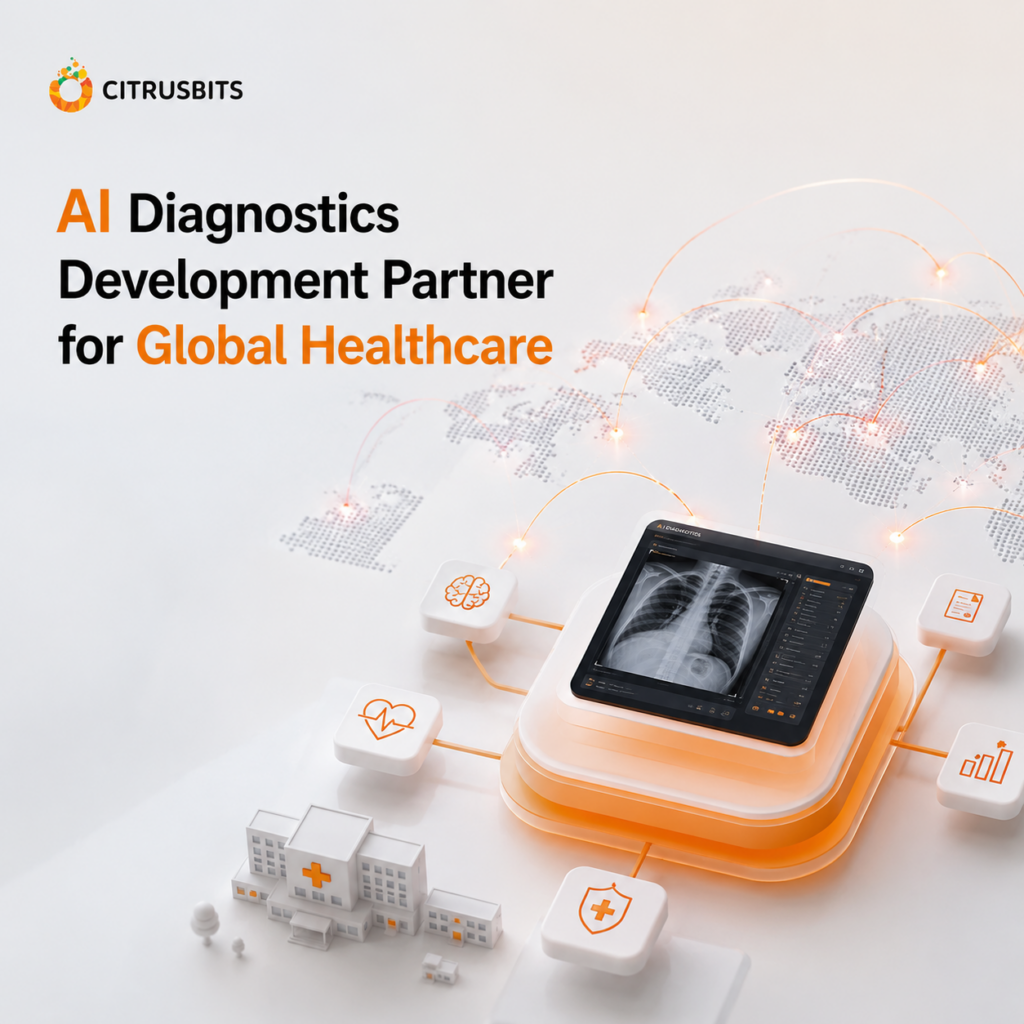
Healthcare organizations are rapidly investing in AI medical diagnostics to improve clinical accuracy, automate workflows, and scale patient care. The global AI healthcare market is expected to exceed $187 billion by 2030, fueled by advancements in predictive analytics, medical imaging AI, and intelligent diagnostics.
Yet many companies struggle to move beyond prototypes because building compliant, scalable, and production-ready AI systems requires far more than just machine learning expertise. Choosing the right AI diagnostics development company is now a critical decision for MedTech innovators, SaMD companies, and digital health leaders.
From HIPAA-compliant AI diagnostics and FDA compliance to interoperability, healthcare data security, and clinical workflow integration, successful healthcare AI products demand true end-to-end delivery.
Why Healthcare Companies Are Investing in AI Diagnostics?
Healthcare organizations are rapidly adopting AI medical diagnostics to improve clinical accuracy, reduce operational pressure, and accelerate patient care. From medical imaging AI to predictive analytics and intelligent diagnostics, AI is helping providers make faster and more informed decisions across clinical workflows.
According to McKinsey, AI could generate up to $100 billion annually for healthcare, particularly in diagnostics and automation. But success depends on much more than AI models. Healthcare companies need scalable healthcare platforms, secure infrastructure, and HIPAA-compliant AI tools that work reliably in real-world clinical environments.
That’s why many organizations partner with experienced teams specializing in Healthcare Software Development and AI Development Services to accelerate development while maintaining compliance and scalability.
The Biggest Challenges in Building AI Diagnostics Platforms
Building AI diagnostics platforms is far more complex than developing machine learning models. Healthcare companies must navigate compliance, interoperability, infrastructure, and clinician adoption simultaneously.
Common Challenges Healthcare Companies Face
- FDA compliance and SaMD regulations
- HIPAA-compliant AI diagnostics requirements
- Integrating AI into existing clinical workflows
- Managing healthcare data security
- Scaling cloud-native healthcare systems
- Interoperability with EHRs and medical devices
- Clinician adoption and workflow disruption
The FDA’s AI/ML SaMD guidance continues to evolve, making regulatory readiness a critical factor for any AI diagnostics development company.
At the same time, standards such as HL7 FHIR are becoming essential for interoperability across modern healthcare infrastructure.
Healthcare companies building custom AI solutions for healthcare often struggle because they lack a partner experienced in compliance, integrations, and long-term platform scalability.
What End-to-End AI Diagnostics Delivery Actually Means
Many vendors can build AI models. Very few can deliver a production-ready diagnostics ecosystem.
True end-to-end delivery means supporting healthcare innovators across every stage of development:
Stage | What It Includes |
Strategy & Discovery | Clinical workflow mapping, compliance planning, product validation |
AI Engineering | Predictive analytics, medical imaging AI, data pipelines |
Platform Development | Secure architecture, APIs, cloud-native healthcare systems |
Compliance | HIPAA, FDA, healthcare data security |
Integrations | EHRs, wearables, IoT medical devices |
Deployment & Scaling | Infrastructure optimization, monitoring, enterprise scalability |
This is where experienced partners in Custom Software Development, Healthcare App Development, and connected healthcare engineering become critical.
Healthcare AI products are not just software projects. They are long-term clinical platforms that must evolve alongside providers, patients, regulations, and infrastructure demands.
Why Most AI Healthcare Projects Fail Before Deployment?
Many AI healthcare initiatives fail long before they reach hospitals, clinics, or diagnostic labs. The issue is rarely the AI itself. Most failures happen because companies underestimate the complexity of healthcare delivery, compliance, and infrastructure.
1. Building AI Without Clinical Context
AI models trained without understanding real clinical workflows often create friction instead of efficiency. If physicians cannot trust or easily use the platform, adoption drops quickly.
2. Treating Compliance as an Afterthought
Healthcare companies that delay HIPAA or FDA planning usually face expensive redevelopment later. Regulatory readiness must be built into the platform from day one.
Resources from the U.S. Department of Health & Human Services continue to emphasize the importance of healthcare data security and patient privacy in modern digital health systems.
3. Poor Interoperability
Many platforms struggle because they cannot integrate properly with EHRs, connected devices, or healthcare infrastructure. Interoperability is no longer optional for scalable healthcare platforms.
4. Infrastructure That Cannot Scale
Prototype AI systems often fail when handling real-world patient loads, imaging volumes, and enterprise deployment requirements. Cloud-native healthcare systems and scalable architecture are essential for long-term success.
What to Look for in an AI Diagnostics Development Company
Choosing the right AI diagnostics development company can significantly impact product timelines, compliance readiness, and long-term scalability.
Instead of focusing only on AI expertise, healthcare organizations should evaluate partners based on their ability to support the entire healthcare product lifecycle.
Key Capabilities to Look For
- Experience with AI medical diagnostics and healthcare workflows
- Understanding of HIPAA-compliant AI diagnostics
- FDA and SaMD development knowledge
- Expertise in interoperability and EHR integrations
- Scalable cloud-native healthcare systems
- Medical imaging, AI, and predictive analytics experience
- UX design tailored for clinicians and patients
- Secure healthcare infrastructure and data engineering
The best partners combine healthcare domain expertise with strong engineering capabilities across AI, connected devices, and enterprise healthcare systems.
Healthcare innovators also benefit from teams experienced in Digital Health Product Strategy and scalable Custom Healthcare Software Development.
Why Healthcare Innovators Need Long-Term Engineering Partners
Building intelligent diagnostics platforms is not a one-time development effort. Healthcare products evolve continuously through clinical validation, compliance updates, AI retraining, infrastructure scaling, and patient feedback.
This is especially true for:
- SaMD companies
- AI MedTech startups
- Medical device manufacturers
- Connected healthcare platforms
- XR healthcare innovators
As healthcare AI adoption grows, companies increasingly need strategic engineering partners who can support long-term platform growth rather than short-term development cycles.
According to the World Health Organization, scalable and trustworthy healthcare AI systems require ongoing governance, monitoring, and infrastructure optimization to ensure safe deployment across healthcare environments.
Modern healthcare companies are no longer just building apps. They are building intelligent healthcare ecosystems that depend on interoperability, compliance, automation, and continuous innovation.
How CitrusBits Helps Build Intelligent AI Diagnostics Platforms
At CitrusBits, we help healthcare innovators transform complex ideas into scalable, compliant, and production-ready AI healthcare platforms. Our teams work closely with MedTech startups, SaMD companies, enterprise healthcare organizations, and connected device manufacturers to build intelligent diagnostics solutions that align with real clinical and operational needs.
Our approach combines:
- AI engineering
- healthcare product strategy
- cloud-native healthcare systems
- interoperability
- regulatory readiness
- clinician-focused UX
From predictive analytics and medical imaging AI to connected healthcare platforms and intelligent diagnostics systems, we focus on building solutions that are secure, scalable, and designed for long-term growth.
Our Core Capabilities Include
Capability | What We Support |
AI Healthcare Platforms | Intelligent diagnostics, predictive analytics, automation |
Connected Healthcare | Wearables, IoT medical devices, remote monitoring |
Compliance & Security | HIPAA-compliant AI tools, secure healthcare infrastructure |
Interoperability | EHR integrations, HL7 FHIR workflows |
Product Engineering | End-to-end healthcare software delivery |
XR & Emerging Tech | Immersive healthcare and diagnostics experiences |
The Future of AI Diagnostics Will Belong to End-to-End Healthcare Innovators
AI is rapidly reshaping diagnostics, clinical decision-making, and patient care delivery. But as healthcare systems become more connected and data-driven, building successful AI diagnostics platforms will require far more than standalone AI models.
Healthcare organizations need platforms that can:
- Integrate seamlessly into clinical workflows
- Maintain healthcare data security
- Support interoperability
- Scale across enterprise healthcare environments
- Adapt to evolving compliance requirements
The future belongs to healthcare companies that can combine intelligent diagnostics, scalable healthcare infrastructure, and real-world clinical usability into a single ecosystem.
According to the FDA, AI-driven healthcare technologies will continue to evolve rapidly, making long-term engineering strategy and regulatory readiness critical for sustainable growth.
For MedTech innovators, choosing the right AI diagnostics development company is no longer just a technical decision. It is a strategic investment in product scalability, compliance, and long-term healthcare impact.
Ready to build a secure, scalable, and compliant AI diagnostics platform?
Talk to the experts at CitrusBits to accelerate your healthcare AI vision from strategy to deployment.
FAQs
Q: What does an AI diagnostics development company do?
Ans: An AI diagnostics development company builds intelligent healthcare platforms that support diagnostics, automation, compliance, integrations, and clinical workflows.
Q: Are AI diagnostics platforms HIPAA compliant?
Ans: Yes, AI diagnostics platforms can be HIPAA compliant when they include secure infrastructure, encryption, access controls, and protected healthcare data workflows.
Q: How is AI used in medical diagnostics?
Ans: AI is commonly used in radiology, ophthalmology, pathology, cardiology, and remote patient monitoring to improve accuracy and automate analysis.
Q: Why is interoperability important in healthcare AI?
Ans: Interoperability allows AI systems to securely exchange data with EHRs, medical devices, and healthcare platforms for seamless clinical operations.
Q: What are the biggest challenges in AI healthcare development?
Ans: The biggest challenges include FDA compliance, healthcare data security, interoperability, clinical workflow integration, and infrastructure scalability.
Q: How long does it take to develop an AI healthcare platform?
Ans: Depending on complexity and compliance requirements, AI healthcare platforms can take several months to over a year to design, validate, and deploy.
Q: Can AI diagnostics integrate with EHR systems?
Ans: Yes, modern AI diagnostics platforms often integrate with EHR systems using interoperability standards like HL7 FHIR.
Q: What industries are adopting AI diagnostics the fastest?
Ans: Radiology, ophthalmology, digital health, connected medical devices, pathology, and remote patient monitoring are among the fastest-growing sectors for AI diagnostics adoption.
Table of Contents
1) Why Healthcare Companies Are Investing in AI Diagnostics?
2) The Biggest Challenges in Building AI Diagnostics Platforms
3) What End-to-End AI Diagnostics Delivery Actually Means
4) Why Most AI Healthcare Projects Fail Before Deployment?
5) What to Look for in an AI Diagnostics Development Company
6) Why Healthcare Innovators Need Long-Term Engineering Partners
7) How CitrusBits Helps Build Intelligent AI Diagnostics Platforms
8) The Future of AI Diagnostics Will Belong to End-to-End Healthcare Innovators
Innovate the Future of Health Tech
CitrusBits helps MedTech leaders build smarter apps, connected devices, and XR health solutions that truly make an impact.
