


Blog
Agile Software Development Life Cycle Phases, Process, and Practical Implementation
Software projects fail more often due to rigid processes and late-stage surprises than poor technical skills. Missed requirements, shifting priorities, budget overruns, and delayed releases are common symptoms of development models that struggle to adapt to change. The Agile Software Development Life Cycle was designed to solve exactly these challenges.
Instead of treating software development as a linear sequence of fixed stages, Agile introduces a flexible, iterative life cycle that enables teams to plan, build, test, and improve software in short, controlled cycles.
This approach allows organizations to respond quickly to feedback, manage risk early, and deliver usable software continuously. Today, we are going to explain what the Agile SDLC really is, break down its key phases and process flow, especially in complex, enterprise, and regulated environments where execution and accountability matter most.
What Is the Agile Software Development Life Cycle?
The Agile Software Development Life Cycle (Agile SDLC) is a delivery-oriented software lifecycle model designed to manage uncertainty, requirement volatility, and continuous change throughout development. Instead of treating software delivery as a one-time, linear sequence of stages, Agile defines the lifecycle as a repeatable execution loop that produces incremental, usable software over time.
In the agile software development lifecycle, work progresses through a series of iterations, each acting as a complete development cycle with its own planning, implementation, testing, and validation activities.
These iterations collectively form the agile development life cycle, allowing teams to continuously refine both the product and the process based on real outcomes rather than assumptions made early in the project.
From an SDLC perspective, Agile shifts the primary objective from phase completion to value delivery. The lifecycle is structured to:
- Reduce late-stage risk through early validation
- Enable controlled adaptation to changing requirements
- Support continuous integration and incremental releases
Agile Methodology in the Software Development Life Cycle
Agile methodology defines the governing principles that shape how the Agile software development life cycle is executed. Within the context of the SDLC, Agile methodology provides the rules for planning, prioritization, collaboration, and validation, rather than prescribing rigid procedural steps.
When applied to the software development life cycle, Agile methodology replaces upfront, exhaustive planning with progressive elaboration. Requirements are captured as evolving backlog items, design decisions are refined incrementally, and validation occurs continuously rather than at the end of the lifecycle.
From a technical delivery standpoint, the agile methodology in the software development life cycle emphasizes:
- Iterative planning instead of fixed-scope definition
- Continuous stakeholder feedback as an input to development
- Embedded quality assurance across all lifecycle stages
- Adaptive control over scope, cost, and schedule
How the Agile Development Cycle Works?
The Agile development cycle operates as a closed feedback system that continuously converts requirements into validated software increments. Each iteration within the agile development life cycle functions as a self-contained execution loop, producing measurable output while feeding insights back into future planning.
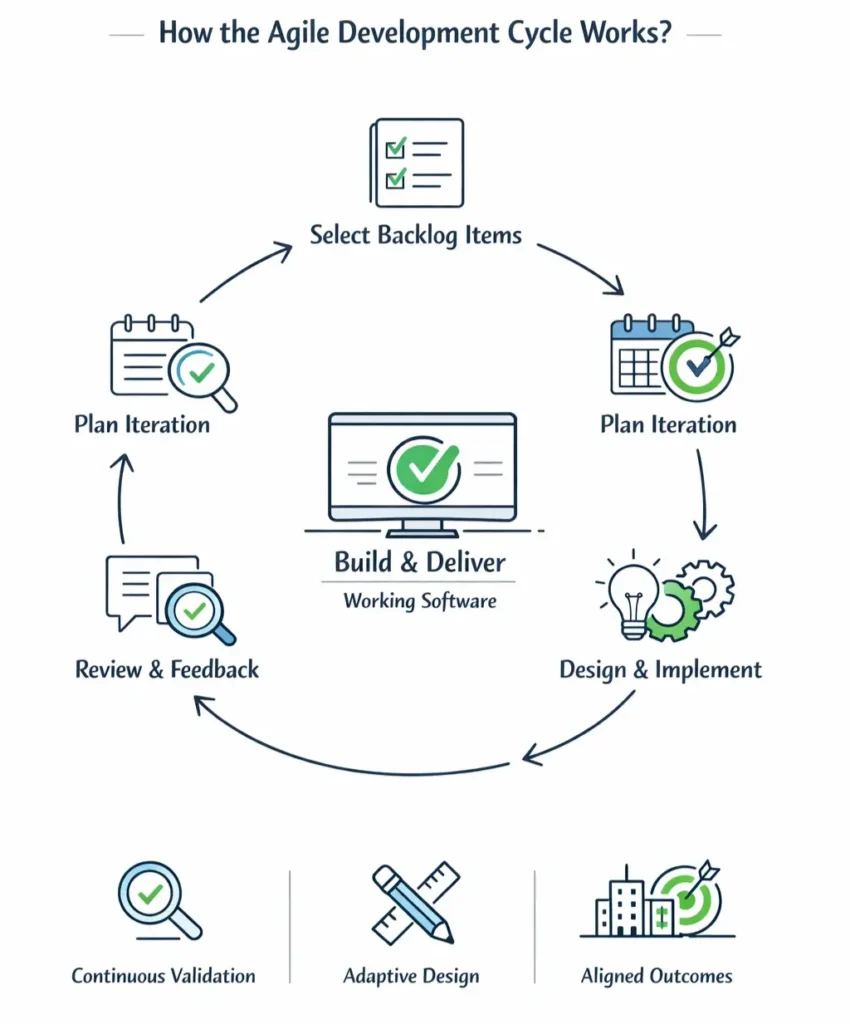
A standard Agile development cycle follows this pattern:
- Select and refine backlog items
- Plan iteration objectives and acceptance criteria
- Design and implement features incrementally
- Test and validate functionality
- Review outcomes and incorporate feedback
This repeated flow is what practitioners refer to as the agile cycle or agile methodology cycle. Unlike traditional SDLC models, where testing and validation occur late, the software development life cycle agile model distributes risk by validating assumptions continuously.
Technically, this approach enables:
- Early detection of integration and design issues
- Progressive architectural refinement
- Continuous alignment between business intent and system behavior
Because each cycle produces a potentially deployable increment, the agile software development cycle supports predictable delivery even in complex, long-running projects. This makes Agile particularly effective for enterprise systems, platform-based products, and software environments where requirements evolve in response to operational feedback.
Agile Software Development Life Cycle Phases
The Agile Software Development Life Cycle is executed through repeatable phases that occur across each iteration. These agile phases (also called agile development stages or agile SDLC phases) define how teams convert prioritized requirements into a validated increment of working software, while maintaining control over quality, risk, and delivery cadence.
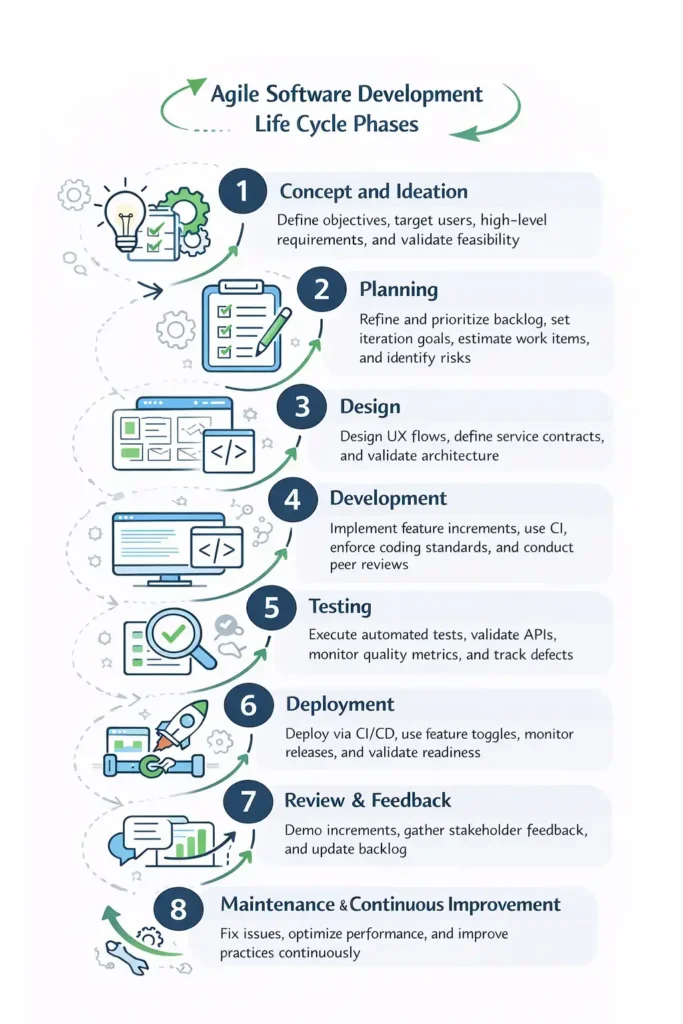
Phase 1: Concept and Ideation
This phase establishes the product intent and delivery constraints before work is decomposed into executable backlog items. In B2B environments, it typically includes stakeholder alignment, success metrics, and high-level feasibility to ensure the agile lifecycle starts with clear outcomes rather than assumptions.
- Define business objectives and success criteria (KPIs/OKRs)
- Identify target users, workflows, and system boundaries
- Capture high-level requirements and non-functional requirements (NFRs)
- Validate feasibility (technical, timeline, regulatory/compliance, budget)
Phase 2: Planning
Planning is not a one-time event in the agile development life cycle; it happens continuously. This phase focuses on converting goals into a prioritized plan for the next iteration by refining the backlog, defining acceptance criteria, and ensuring dependencies and risks are visible.
- Refine and prioritize the product backlog (value, risk, dependencies)
- Define iteration goals, scope, and acceptance criteria
- Estimate work items and confirm team capacity
- Identify dependencies, integration needs, and delivery risks
Phase 3: Design
Agile design is intentionally incremental. Instead of freezing the full design upfront, teams apply “just-enough” design for the current iteration while safeguarding architecture and system integrity, critical for enterprise-scale software development.
- Produce iteration-level UX flows, UI specs, and interaction behaviors
- Define service/API contracts and data models where required
- Validate architecture decisions against scalability, security, and performance
- Document critical design decisions (ADRs) to support maintainability
Phase 4: Development
This is where backlog items become working software. In an agile software development lifecycle, development includes implementation plus continuous integration to prevent late-stage merge conflicts and reduce integration risk.
- Implement features based on acceptance criteria and Definition of Done
- Use branching strategy and continuous integration (CI) practices
- Conduct peer reviews (PRs) and enforce coding standards
- Integrate with dependent systems/services incrementally
Phase 5: Testing
In the software development life cycle agile model, testing is embedded throughout the cycle rather than deferred. The goal is to validate behavior and quality continuously, ensuring each increment is production-credible.
- Execute automated tests (unit, integration, contract)
- Perform functional QA validation against acceptance criteria
- Validate non-functional requirements (performance, security, reliability)
- Track defects, regressions, and quality metrics continuously
Phase 6: Deployment
Deployment in Agile is designed to be repeatable and low-risk. In mature organizations, this phase aligns closely with the agile software delivery lifecycle, leveraging automation and progressive rollout patterns.
- Package and deploy via automated pipelines (CI/CD)
- Use release strategies (feature flags, canary, blue/green) where applicable
- Validate deployment health via monitoring and rollback readiness
- Release incrementally based on readiness and business priorities
Phase 7: Review and Feedback
This phase closes the loop by validating what was delivered and capturing feedback that informs the next cycle. In B2B delivery, reviews often include operational stakeholders to ensure real-world workflow fit.
- Demo completed work against the acceptance criteria
- Collect stakeholder feedback and usage insights
- Confirm what is “done” vs deferred (scope clarity)
- Update backlog based on validated learning and new requirements
Phase 8: Maintenance and Continuous Improvement
The Agile SDLC does not end at deployment. Maintenance includes operational stability and continuous enhancement, especially important for enterprise products where systems evolve over long lifecycles.
- Fix defects and address production issues (triage, RCA)
- Optimize performance, scalability, and security posture
- Refactor to reduce technical debt and improve maintainability
- Continuously improve delivery practices (retrospectives, metrics)
Agile Development Life Cycle Diagram
The Agile development life cycle diagram represents the Agile SDLC as a repeating execution loop, not a sequence of one-time stages. From a systems perspective, this diagram illustrates how backlog-driven work continuously flows through planning, implementation, validation, and feedback, producing incremental software outcomes at regular intervals.
In a technical agile SDLC process flow, each iteration acts as a complete mini software development life cycle. The output of one cycle (a validated product increment and stakeholder feedback) becomes a direct input into the next cycle through backlog refinement. This closed-loop structure is what differentiates the agile system development life cycle from linear SDLC models.
Key characteristics typically shown in an agile development cycle diagram include:
- Continuous backlog refinement feeding each iteration
- Parallel execution of design, development, and testing activities
- Early and repeated validation points
- Incremental integration and deployment readiness
From an engineering and delivery standpoint, the diagram makes it clear that:
- Risk is addressed early through frequent validation
- Integration happens incrementally rather than at the end
- Architectural and non-functional concerns are revisited continuously
In enterprise environments, this visual model helps align engineering, product, and delivery stakeholders around how work actually progresses through the agile software development lifecycle, eliminating the misconception that Agile is “unstructured” or lacks control.
Agile vs Waterfall Software Development Life Cycle
Choosing between the Agile software development life cycle and a traditional SDLC model, such as Waterfall, is fundamentally a delivery and risk-management decision. The two approaches differ in how they handle requirement change, validation timing, and system integration.
Traditional SDLC models follow a phase-gated lifecycle. Each stage’s requirements, design, development, testing, and deployment are completed once, with formal sign-offs and limited backward movement. This approach assumes that requirements can be fully defined upfront and remain stable throughout execution.
Dimension | Agile SDLC | Traditional SDLC (Waterfall) |
Lifecycle Structure | Iterative, loop-based | Linear, phase-gated |
Requirement Change | Expected and continuously managed | Restricted after sign-off |
Planning Model | Incremental and adaptive | Upfront and fixed |
Validation Timing | Continuous throughout iterations | Primarily late-stage |
Integration Strategy | Incremental and ongoing | Deferred until later phases |
Delivery Pattern | Frequent, incremental releases | Single final delivery |
Risk Exposure | Reduced through early feedback | Concentrated toward the end |
Fit for Long-Lived Systems | High | Limited |
Agile Methodology vs Scrum, Kanban, and SAFe
The Agile software development life cycle defines how software moves through a delivery system. Agile frameworks, on the other hand, define how teams organize and execute work within that lifecycle.
From a technical standpoint, the agile life cycle is framework-agnostic. It establishes:
- Iterative execution
- Incremental delivery
- Continuous validation
- Feedback-driven planning
Frameworks operate inside this lifecycle and provide execution mechanics such as roles, events, and workflow controls. Choosing a framework does not change the Agile SDLC itself; it changes how the lifecycle is operationalized.
Aspect | Agile SDLC (Lifecycle) | Agile Frameworks |
Primary Purpose | Govern end-to-end delivery flow | Organize team execution |
Scope | Product and system lifecycle | Team- or program-level |
Focus | Iteration, increment, validation | Roles, ceremonies, workflows |
Dependency | Framework-independent | Lifecycle-dependent |
Change Impact | Affects delivery model | Affects execution mechanics |
Common Agile Frameworks in Practice
Scrum:
Scrum structures execution around fixed-length iterations (sprints) and formal roles. It fits well within the agile development life cycle when work can be planned and reviewed in predictable timeboxes.
- Sprint-based execution
- Defined roles (Product Owner, Scrum Master, Team)
- Formal review and retrospective loops
Kanban:
Kanban emphasizes flow efficiency and work-in-progress (WIP) control rather than timeboxed iterations. It integrates naturally with the Agile SDLC in environments requiring continuous delivery.
- Pull-based workflow
- Visualized work states
- Continuous planning and release
SAFe (Scaled Agile Framework):
SAFe extends Agile principles across large organizations and multi-team systems. It adds governance, portfolio alignment, and dependency management while still operating within the Agile lifecycle.
- Program and portfolio-level planning
- Coordinated delivery across teams
- Strong alignment with enterprise governance
Benefits of the Agile Software Development Life Cycle
The benefits of the Agile software development life cycle emerge from its structural design rather than from any single practice. By distributing planning, development, and validation across repeated cycles, Agile optimizes delivery outcomes in complex and evolving systems.
Early risk exposure
Iterative execution surfaces design, integration, and requirement risks early when corrective action is less costly.
Controlled adaptability
The Agile lifecycle allows scope and priority changes without destabilizing delivery, making it suitable for long-lived products and platforms.
Incremental system validation
Continuous testing and review ensure that both functional and non-functional requirements are validated throughout development.
Predictable delivery cadence
Frequent increments provide measurable progress and improve forecasting accuracy for stakeholders.
Improved alignment between business and engineering
Regular feedback loops reduce the gap between business intent and implemented system behavior.
Unlike traditional SDLC models, where value is realized late, the agile development lifecycle enables organizations to derive value continuously, reducing time-to-market while maintaining delivery control.
These characteristics make Agile particularly effective for:
- Enterprise software platforms
- Product-based development
- Systems with evolving regulatory, operational, or market constraints
Industry bodies such as the Project Management Institute (PMI) and Scaled Agile consistently highlight these benefits as key reasons organizations adopt Agile-based SDLC models at scale.
Challenges and Limitations of the Agile Software Development Life Cycle
While the Agile software development life cycle is effective for managing change and complexity, it is not universally applicable. From a technical and organizational standpoint, Agile introduces trade-offs that must be understood and managed, especially in enterprise environments.
Governance and compliance overhead
In regulated industries, Agile requires additional controls to ensure traceability, documentation, and audit readiness without slowing delivery.
Dependency management at scale
As systems grow and teams multiply, unmanaged cross-team dependencies can disrupt iteration flow and reduce delivery predictability.
Architectural erosion risk
Without intentional architectural governance, continuous change can lead to fragmented designs and increased technical debt.
Stakeholder availability requirements
Agile assumes consistent stakeholder engagement. Limited access to decision-makers weakens feedback loops and reduces effectiveness.
Fixed-scope constraints
Projects with immovable scope, cost, and timelines may struggle to fully leverage Agile’s adaptive planning model
Agile Product Development Life Cycle
The Agile product development life cycle applies Agile principles beyond project execution and focuses on long-term product evolution. Unlike project-based delivery, product-centric Agile assumes ongoing development, optimization, and lifecycle management.
In this model, the Agile SDLC supports:
- Continuous discovery and delivery
- Feature evolution based on usage data and feedback
- Long-term architectural sustainability
Key Characteristics of Agile Product Development
- Outcome-driven planning: Product roadmaps focus on value delivery rather than fixed feature lists.
- Continuous backlog evolution: Backlog items are refined based on real-world usage, analytics, and customer feedback.
- Incremental value realization: Each iteration contributes measurable product value rather than interim artifacts.
- Lifecycle ownership: Teams remain accountable for the product beyond initial delivery, including maintenance and enhancement.
This approach aligns particularly well with SaaS platforms, enterprise products, and digital health solutions where software is continuously refined rather than “completed.”
Common Mistakes in Agile Development
Failures in Agile initiatives are rarely caused by the Agile software development life cycle itself. More often, they result from incorrect implementation or misunderstanding of Agile’s role within the SDLC.
Treating Agile as ceremony-driven: Focusing on meetings instead of delivery mechanics weakens lifecycle effectiveness.
Skipping architectural planning entirely: Agile does not eliminate architecture; it requires architecture to evolve deliberately.
Deferring non-functional requirements: Performance, security, and scalability must be addressed continuously, not postponed.
Lack of Definition of Done (DoD): Without clear completion criteria, increments lose quality and predictability.
“Agile in name only” implementations: Retaining rigid approval chains while claiming agility undermines the lifecycle.
Avoiding these mistakes requires viewing Agile as a delivery system, not a methodology checklist.
The Bottom Line
The Agile Software Development Life Cycle functions as a structured yet adaptive delivery system that enables organizations to manage change, reduce risk, and deliver value incrementally across complex software initiatives. When Agile is treated as an end-to-end SDLC, supported by disciplined execution, architectural oversight, and continuous validation, it becomes a reliable foundation for enterprise-scale delivery.
For organizations looking to implement Agile beyond theory and into production-ready systems, partnering with a team experienced in software development helps ensure Agile practices translate into measurable, long-term outcomes.
FAQ
Q: What is the Agile software development life cycle?
Ans: The Agile software development life cycle (Agile SDLC) is an iterative delivery model in which software is developed, tested, and validated in repeated cycles. Each cycle produces a working increment of the system, enabling continuous feedback, early risk detection, and controlled adaptation to changing requirements.
Q: What are the phases of Agile methodology?
Ans: The phases of Agile methodology include concept, planning, design, development, testing, deployment, review, and maintenance. Unlike traditional SDLC stages, these agile phases are repeatable and occur across every iteration rather than once in a fixed sequence.
Q: How does the Agile development process work in practice?
Ans: In practice, the agile development process works by maintaining a prioritized backlog, executing work in short iterations, validating results continuously, and refining future work based on feedback. Each iteration functions as a complete mini software development life cycle.
Q: What is the Agile model in the software development life cycle?
Ans: The Agile model is an adaptive SDLC model that replaces phase-gated delivery with iterative execution. It emphasizes incremental delivery, continuous testing, stakeholder collaboration, and responsiveness to change throughout the software development lifecycle.
Q: Is Agile suitable for large or regulated projects?
Ans: Yes, Agile can be applied to large-scale and regulated projects when combined with appropriate governance, documentation, and architectural controls. Many enterprises use scaled or hybrid Agile SDLC models to balance adaptability with compliance and risk management.
Table of Contents
1) What Is the Agile Software Development Life Cycle?
2) Agile Software Development Life Cycle Phases
3) Agile Development Life Cycle Diagram
4) Agile vs Waterfall Software Development Life Cycle
5) Benefits of the Agile Software Development Life Cycle
6) Challenges and Limitations of the Agile Software Development Life Cycle
7) Agile Product Development Life Cycle
8) Common Mistakes in Agile Development
9) The Bottom Line
Innovate the Future of Health Tech
CitrusBits helps MedTech leaders build smarter apps, connected devices, and XR health solutions that truly make an impact.
