


Blog
Why Healthcare Needs RPA Now and How Hospitals Can Get Started
Healthcare systems everywhere are under more pressure than ever. Costs are rising, staff are burned out, and manual administrative work is slowing down patient care. In a world where accuracy and speed can literally save lives, hospitals are turning to a technology that works quietly in the background yet delivers a massive impact.
Robotic Process Automation, or RPA, is becoming one of the most powerful tools reshaping how healthcare organizations operate. From eliminating repetitive data entry to accelerating patient onboarding to reducing billing errors, automation is helping hospitals achieve results that were nearly impossible with manual processes alone.
If you are exploring how to improve efficiency, reduce operational stress, and create a smoother experience for both patients and healthcare teams, RPA might be the breakthrough you are looking for.
What Is Robotic Process Automation in Healthcare?
Robotic Process Automation in healthcare refers to the use of software bots that mimic human actions to perform repetitive, rule-based tasks across clinical, administrative, and financial workflows. These bots interact with hospital systems the same way humans do; they click, type, read information, copy data, validate fields, and move information between systems, only faster, more accurately, and without fatigue.
While traditional automation requires deep system changes or coding, RPA works on top of existing healthcare platforms, making it ideal for hospitals still running legacy systems or disconnected databases. It helps healthcare organizations eliminate manual data entry, reduce errors, accelerate processes, and free staff to focus on patient-facing responsibilities.
RPA in healthcare is often confused with AI automation, but they serve different roles. RPA follows rules to perform repetitive tasks, while AI makes decisions using data. When combined, they form intelligent automation that delivers far more advanced outcomes in the healthcare ecosystem.
Why Healthcare Needs Automation More Than Any Other Industry
Healthcare systems worldwide are under unprecedented pressure. With labor shortages, clinician burnout, rising operational costs, and increasingly complex administrative requirements, hospitals must do more with fewer resources.
Manual workflows, patient registration, billing, prior authorization, record updates, consume thousands of staff hours every year and remain one of the top causes of delays, errors, and inefficiencies.
Automation in healthcare solves these pain points by:
Reducing administrative burden: More than 40% of healthcare staff time is spent on paperwork, not patient care. RPA automates these repetitive tasks, giving clinicians more time for patients.
Improving accuracy and compliance: Human error in billing, coding, or record management leads to costly mistakes and compliance risks. Automation ensures accuracy and maintains audit-friendly trails.
Accelerating patient care workflows: Automated appointment scheduling, lab result routing, and triage support ensure faster turnaround and fewer bottlenecks.
Lowering operational costs: By handling high-volume tasks efficiently, RPA helps hospitals reduce labor costs, cut processing times, and improve ROI without hiring additional staff.
Supporting interoperability challenges: Hospitals use a mix of EMRs, billing tools, and third-party systems that rarely communicate. RPA bridges these gaps without requiring expensive system overhauls.
Simply put, healthcare needs automation more urgently because the system can’t scale manually anymore. RPA offers a practical, immediate solution that supports both clinical and operational growth.
How RPA Works in the Healthcare Ecosystem?
RPA works by deploying digital bots that replicate user actions across healthcare systems, EMRs, billing platforms, CRMs, and databases. These bots log into systems, extract data, validate fields, populate forms, update patient records, and complete workflows at a speed and accuracy level no human team can match.
In the healthcare ecosystem, RPA operates in three fundamental steps:
Triggering the workflow
A bot begins an action based on a schedule, a system event, or a rule (e.g., new patient registration submitted).
Executing the task
The bot reads information, enters data, routes files, checks eligibility, updates EMRs, or communicates with multiple platforms simultaneously.
Completing and validating the outcome
Bots provide confirmations, send alerts, or escalate exceptions that require human review.
This enables hospitals to automate tasks across revenue cycle management, patient engagement, compliance, pharmacy operations, diagnostics support, and more.
Types of RPA in Healthcare
To understand how automation applies across different hospital functions, it helps to know the main types of RPA used in healthcare:
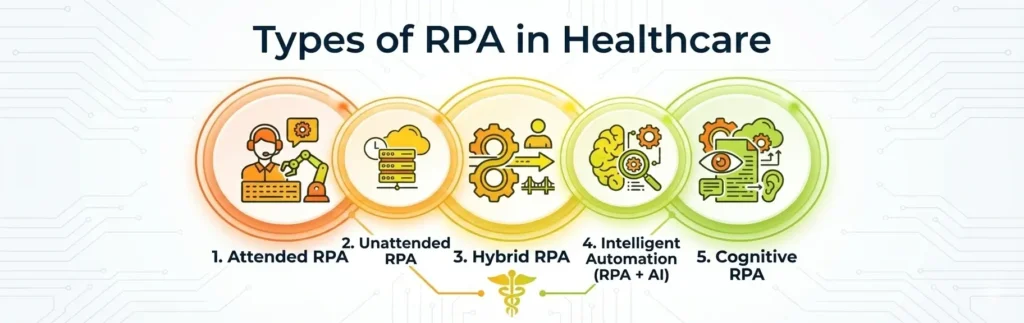
- Attended RPA
Bots that work alongside healthcare staff in real time.
Example: A front-desk staff triggers a bot to quickly validate insurance eligibility during patient registration.
- Unattended RPA
Fully automated bots that operate independently in the background.
Example: Overnight processing of claims batches, updating EMR records or generating compliance reports.
- Hybrid RPA
A blend of attended and unattended automation.
Example: A clinician initiates a bot to gather lab data while the system independently routes results back into the EMR.
- Intelligent Automation (RPA + AI)
This advanced model integrates AI for decision-making, enabling bots to handle unstructured data, analyze documents or interpret medical text.
Example: AI models read handwritten prescriptions, while RPA updates digital records.
- Cognitive RPA
Uses NLP, machine learning and OCR to understand language, extract insights, and process documents.
Example: Automatically extracting clinical data from scanned forms or referral documents.
These types of RPA help hospitals deploy automation in the right context, supporting staff where needed or handling end-to-end workflows without human involvement.
Examples of RPA in Healthcare
The strongest proof of RPA’s impact comes from real-world applications already transforming hospitals and health systems. These examples highlight where automation is driving the most value and where organizations are seeing immediate ROI.
Because RPA operates across clinical, administrative, and financial areas, it brings a level of efficiency that traditional processes simply cannot match.
- Patient Onboarding and Registration Automation
- Insurance Eligibility and Benefits Verification
- Claims Processing and Billing Automation
- Medical Coding Support
- Lab Results Routing
- Appointment Scheduling and Follow-Ups
- Prior Authorization Automation
- Pharmacy Inventory and Refill Automation
- Discharge and Post-Care Instructions
- Audit and Compliance Reporting
These examples demonstrate how RPA frees staff from routine tasks while enabling hospitals to improve speed, compliance, and patient satisfaction.
Robotic Process Automation Use Cases in Healthcare
To understand the true impact of automation, it’s helpful to group RPA use cases by function. These categories reflect the areas where hospitals consistently see the greatest performance improvements and the highest ROI.
A. Administrative & Front-Office Automation
- Patient Demographics Entry: Eliminates repetitive EMR data entry and ensures accurate records from the start.
- Document Processing: Extracts data from referral forms, insurance cards, and lab requisitions and uploads them automatically.
- Call Center and Support Automation: Bots assist with triage questions, queue routing, appointment reminders, and follow-up communications.
B. Revenue Cycle Management (RCM)
- Claims Creation & Submission: Automates claim preparation and validates data before submission to reduce denials.
- Payment Posting: Identifies EOB/ERA data and updates financial systems automatically.
- Denial Management: Bots categorize denials, extract reasons and generate appeal letters or escalate cases.
This is one of the most profitable automation areas for hospitals.
C. Clinical Support Workflows
- Lab and Radiology Workflow Automation: Automates the retrieval, routing and tracking of diagnostic results.
- Electronic Health Record (EHR) Updates: Ensures real-time syncing of patient information across systems.
- Clinical Documentation Assistance: Extracts information from physician notes (when paired with NLP or AI).
D. Compliance & Regulatory Automation
- HIPAA Documentation Management: Bots manage access logs, audit trails, and compliance documentation.
- Reporting Automation: Generates required reports for payers, accreditation bodies, and state regulations.
- Error and Exception Alerts: Monitors workflows for potential compliance risks.
Applications of RPA in Healthcare
While use cases represent individual tasks, applications refer to deeper, strategic areas where RPA creates systemic impact.
Below are the major application areas shaping modern healthcare automation:
- Patient Experience Enhancement: RPA improves patient journeys by accelerating onboarding, eliminating paperwork, reducing waiting times, and providing timely communication. The result is a smoother, more predictable experience.
- Operational Efficiency Across Departments: Whether it’s scheduling, record management, or inventory control, automation ensures no task lingers unresolved, and no bottleneck stalls essential patient services.
- Financial Performance Optimization: Hospitals gain faster revenue cycles, fewer denied claims, cleaner billing, and reduced cost per patient encounter, critical benefits in an industry with tight margins.
- Workforce Reinforcement and Burnout Reduction: RPA handles repetitive tasks that often overwhelm staff. This allows clinical and administrative teams to focus on meaningful work, reducing burnout and improving job satisfaction.
- Enhanced Data Quality, Accuracy, and Security: Bots eliminate manual errors that lead to misdiagnoses, billing mistakes, or compliance breaches. With controlled access and audit trails, RPA strengthens data governance.
- Strengthening Hospital Interoperability: RPA bridges gaps between disconnected systems without requiring expensive API development or full platform migrations. This makes it easier for hospitals to modernize at minimal cost.
Healthcare Automation Solutions
Healthcare automation solutions extend far beyond simple task automation. They include a full ecosystem of tools that streamline administrative, clinical, and financial operations. As hospitals work to modernize digital workflows, they rely on automation platforms that integrate with EMRs, billing systems, CRM tools, and third-party applications without disrupting existing infrastructure.
RPA Platforms for Hospitals:
These solutions provide software bots that execute rule-based tasks. Leading platforms integrate easily with Epic, Cerner, Athenahealth, and other EMRs. Hospitals use them to accelerate claims processing, update medical records, verify insurance, and perform data entry at scale.
Intelligent Automation (RPA + AI):
Combines RPA with artificial intelligence elements such as machine learning, NLP, and OCR. This enables bots to read documents, understand clinical terminology, interpret medical forms, and make judgment-based decisions.
Workflow Automation Engines:
These solutions orchestrate end-to-end processes across departments. Instead of automating individual tasks, they automate entire workflows, such as patient onboarding or prior authorization, ensuring each step triggers the next seamlessly.
Document Automation Systems: Designed for environments with heavy paperwork, these solutions automatically extract information from scanned documents, PDFs, lab reports, referrals, and handwritten notes.
Communication and Engagement Automation: Tools designed to improve patient communication through automated reminders, follow-up messages, chatbots, call routing, and personalized engagement workflows.
Predictive AI Automation:
AI-driven systems analyze trends, predict delays, forecast inventory needs, and anticipate staffing shortages, allowing hospitals to take proactive action.
API-Based Automation Solutions:
For more advanced digital infrastructure, API automation provides direct, secure data transfer between systems. While RPA imitates human actions, APIs enable deeper integrations when systems support them.
Healthcare automation solutions collectively reduce operational strain, improve patient satisfaction, and make digital transformation achievable without massive system overhauls.
Workflow Automation in Healthcare
Workflow automation in healthcare focuses on streamlining multi-step processes that involve several people, departments, or systems. Instead of manually pushing tasks from one stage to another, automation takes over all repetitive transitions, ensuring speed, consistency, and accuracy.
Hospitals typically automate workflows such as:
Patient Intake and Onboarding: From capturing initial information to adding it to EMRs and verifying insurance, workflow automation ensures a smooth start to the patient journey.
Appointment Management: Automates booking, reminders, rescheduling, cancellations, and follow-up communication to reduce no-shows and improve operational flow.
Medical Documentation Routing: Sends notes, lab results, prescriptions, and updates directly to the right provider without manual intervention.
Billing and Revenue Cycle Workflows: Automates everything from charge capture to claim submission, denial management, and payment posting.
Clinical Workflow Support: Automation assists with test ordering, report routing, clinical triage, and data extraction from care notes.
Compliance and Reporting Processes: Whether generating audit logs or preparing accreditation reports, automation reduces the administrative burden on staff.
Workflow automation plays a critical role in delivering consistent patient experiences, reducing manual delays, and creating more predictable healthcare operations. It speaks directly to the industry’s need for efficiency at scale.
Benefits of RPA in Healthcare
Robotic process automation delivers measurable advantages across all tiers of healthcare operations: administrative, clinical, and financial. These benefits make RPA not only a digital improvement but a strategic necessity for hospitals aiming to stay competitive.
- Reduced Operating Costs
- Improved Patient Experience
- Increased Accuracy and Fewer Errors
- Faster Turnaround Times
- Enhanced Staff Productivity
- Better Compliance and Audit Readiness
- Scalable Across Departments
- Improved Interoperability Without Replacing Existing Systems
- Higher Revenue and Faster Payments
RPA vs AI in Healthcare: What’s the Difference?
RPA and AI are often mentioned together, but they solve different problems in the healthcare industry. Understanding their roles helps hospitals choose the right digital strategy and unlock the full potential of automation.
Robotic Process Automation (RPA):
RPA follows predefined rules and performs repetitive, structured tasks. It excels at jobs that require accuracy, speed, and consistency, like data entry, claims processing, or updating EMRs. RPA replicates human actions, not decisions.
Artificial Intelligence (AI)
AI imitates human intelligence. It analyzes data, learns from patterns, and makes decisions. AI is ideal for tasks that involve interpretation, prediction, or unstructured data, like diagnosing medical images, understanding clinical notes, or predicting patient risk.
When RPA + AI Work Together (Intelligent Automation)
This combination creates advanced automation capable of reading documents, understanding context, and making judgment-based decisions.
Examples include:
- Automated prior authorizations
- Smart clinical documentation
- Predictive scheduling
- Real-time triage support
Key Differences
| Feature | RPA | AI |
| Task Type | Repetitive, rule-based | Cognitive, decision-based |
| Data Type | Structured | Unstructured or semi-structured |
| Learning | No learning capability | Learns and improves with data |
| Best For | Claims, billing, data entry | Diagnostics, predictions, interpretation |
Together, RPA and AI reshape the healthcare ecosystem by increasing efficiency and enabling smarter, faster decision-making.
Challenges & Limitations of RPA in Healthcare
While RPA brings enormous value, hospitals must address a few challenges to ensure successful implementation. These limitations don’t diminish automation’s power but highlight the need for proper planning and execution.
Integration With Legacy Systems: Many hospitals rely on outdated software that isn’t designed for modern automation. RPA works well over interfaces, but stability issues in old systems can slow deployment.
Process Complexity: Not all workflows are ideal for RPA. If a process requires frequent judgment or unpredictable human decisions, it may require AI enhancement or redesign before automation.
Change Management Resistance: Staff may resist automation due to fears of job loss or workflow changes. Successful adoption requires clear communication and proper training.
Data Security & Compliance: Although RPA can enhance compliance, bots still require access to sensitive patient data. Hospitals must implement strict access controls and audit oversight to stay HIPAA-compliant.
Maintenance and Bot Governance: As hospital systems evolve, bots must be updated to match new interfaces or rules. Without proper governance, bot performance can degrade.
High Initial Misconceptions: Some organizations believe RPA alone will solve all inefficiencies. In reality, automation must work alongside human expertise and proper process improvement.
Scalability Challenges Without Strategy: Many hospitals automate one workflow at a time without a long-term vision. Scalable automation requires an enterprise-level approach and a Center of Excellence (CoE).
When hospitals address these challenges proactively, RPA delivers significantly higher efficiency, ROI, and user adoption.
Future of RPA Services for Healthcare (2026–2030 Trends)
Between 2026 and 2030, RPA will evolve into a core pillar of hospital operations, powered by major advancements in AI, machine learning, and cloud technology. Automation will shift from simple task execution to intelligent, systemwide optimization that improves efficiency and elevates patient care.
AI-driven bots will read documents, extract clinical insights, and communicate naturally, while predictive automation will help hospitals anticipate patient volumes, staffing needs, and supply demands. Revenue Cycle Management will become highly automated, reducing costs and speeding reimbursements.
Hospitals will move toward more autonomous operations, with scheduling, registration, documentation, and billing managed by interconnected automation systems. RPA combined with AI will enhance clinical decision support by delivering instant, relevant patient data. Voice-activated automation will enable hands-free documentation and faster data retrieval.
Interoperability will improve through FHIR-based automation, making data exchange more seamless and secure. At the same time, more healthcare providers will rely on specialized vendors offering robotic process automation services to accelerate deployment and scale automation effectively.
How to Choose the Right RPA Tool for Healthcare?
Selecting the right RPA platform is crucial for long-term success. Hospitals need solutions that meet regulatory, operational, and technical requirements while remaining flexible enough to scale across departments.
Below is a checklist to guide the selection process:
- Healthcare-Specific Compliance (HIPAA, HITRUST):
Ensure the platform offers secure data handling, role-based access, and full audit logging capabilities.
- Integration With EMRs and Billing Systems:
Verify compatibility with major healthcare systems such as:
- Epic
- Cerner
- Athenahealth
- Meditech
- NextGen
- Allscripts
RPA must work seamlessly with clinical and financial tools. Explore more about Epic in Healthcare here!
- Scalability and Bot Orchestration:
Choose a platform that allows multiple bots to run in parallel, schedule tasks, monitor performance, and manage exceptions centrally.
- AI and OCR Capabilities:
Intelligent automation is the future. Select a tool that supports:
- Document understanding
- Natural language processing
- Machine learning integrations
- Low-Code or No-Code Design:
Healthcare teams should be able to design and modify automations without advanced coding skills.
- Strong Security Architecture:
Look for end-to-end encryption, secure credential storage, and role-based access controls.
- Vendor Expertise in Healthcare:
Vendors with healthcare experience understand compliance, regulatory challenges, and the complexity of medical workflows.
- Cost, Licensing, and ROI
Evaluate cost structure, implementation fees, maintenance requirements, and expected ROI based on your automation priorities
Choosing the right RPA tool ensures smoother implementation, fewer interruptions, and scalable automation that grows with the hospital’s needs.
Closing Note
Robotic process automation in healthcare is no longer just an efficiency tool; it has become a strategic transformation driver for hospitals, clinics, and health systems worldwide. As staffing shortages rise, patient expectations grow, and operational complexity increases, RPA provides a practical and scalable solution to streamline workflows, cut costs, and enhance patient care.
By automating repetitive administrative, clinical, and financial processes, hospitals can free their teams to focus on meaningful, patient-centered tasks. When combined with AI, RPA becomes even more powerful, enabling intelligent automation that supports diagnostics, documentation, compliance, and real-time decision-making.
Looking to elevate patient care with technology? Our healthcare software solutions can help you build the right solution. Get in touch.
FAQs
Q: Is RPA being replaced by AI?
Ans: No. AI enhances RPA, but doesn’t replace it. Together, they create intelligent automation.
Q: Is RPA becoming obsolete?
Ans: Not at all. RPA is evolving with AI and becoming even more valuable in modern workflows.
Q: What is the 30% rule in AI?
Ans: It suggests that AI can automate about 30% of tasks in many jobs, improving efficiency, not replacing entire roles.
Q: Which RPA tool is in demand in 2026?
Ans: UiPath, Automation Anywhere, and Microsoft Power Automate remain top choices in the healthcare sector.
Q: What does RPA mean in medicine?
Ans: RPA automates administrative and clinical support tasks in medical environments to improve speed and accuracy.
Q: How is RPA used in healthcare?
Ans: It automates tasks like patient registration, claims processing, lab routing and EMR updates to reduce workload and errors.
References
- Health Information Technology Workflow Automation Policy Development: Office of the National Coordinator for Health IT. HealthIT.gov
2. Priorities to Accelerate Workflow Automation in Health Care: HealthIT.gov/ONC
HealthIT.gov - Artificial Intelligence (AI) | HHS.gov HHS
- Office of the National Coordinator for Health IT (ONC): Health IT & Interoperability Resources HealthIT.gov
Table of Contents
1) What Is Robotic Process Automation in Healthcare?
2) Why Healthcare Needs Automation More Than Any Other Industry
3) How RPA Works in the Healthcare Ecosystem?
4) Types of RPA in Healthcare
5) Examples of RPA in Healthcare
6) Robotic Process Automation Use Cases in Healthcare
7) Applications of RPA in Healthcare
8) Healthcare Automation Solutions
9) Workflow Automation in Healthcare
10) Benefits of RPA in Healthcare
11) RPA vs AI in Healthcare: What’s the Difference?
12) Challenges & Limitations of RPA in Healthcare
13) Future of RPA Services for Healthcare (2026–2030 Trends)
14) How to Choose the Right RPA Tool for Healthcare?
15) Closing Note
Innovate the Future of Health Tech
CitrusBits helps MedTech leaders build smarter apps, connected devices, and XR health solutions that truly make an impact.
