

Blog
Blogs
5 Technology Trends from CES That Are Now Transforming Healthcare
BLOG by
CitrusBits
January 25, 2019
#XR #VR #UX #UI
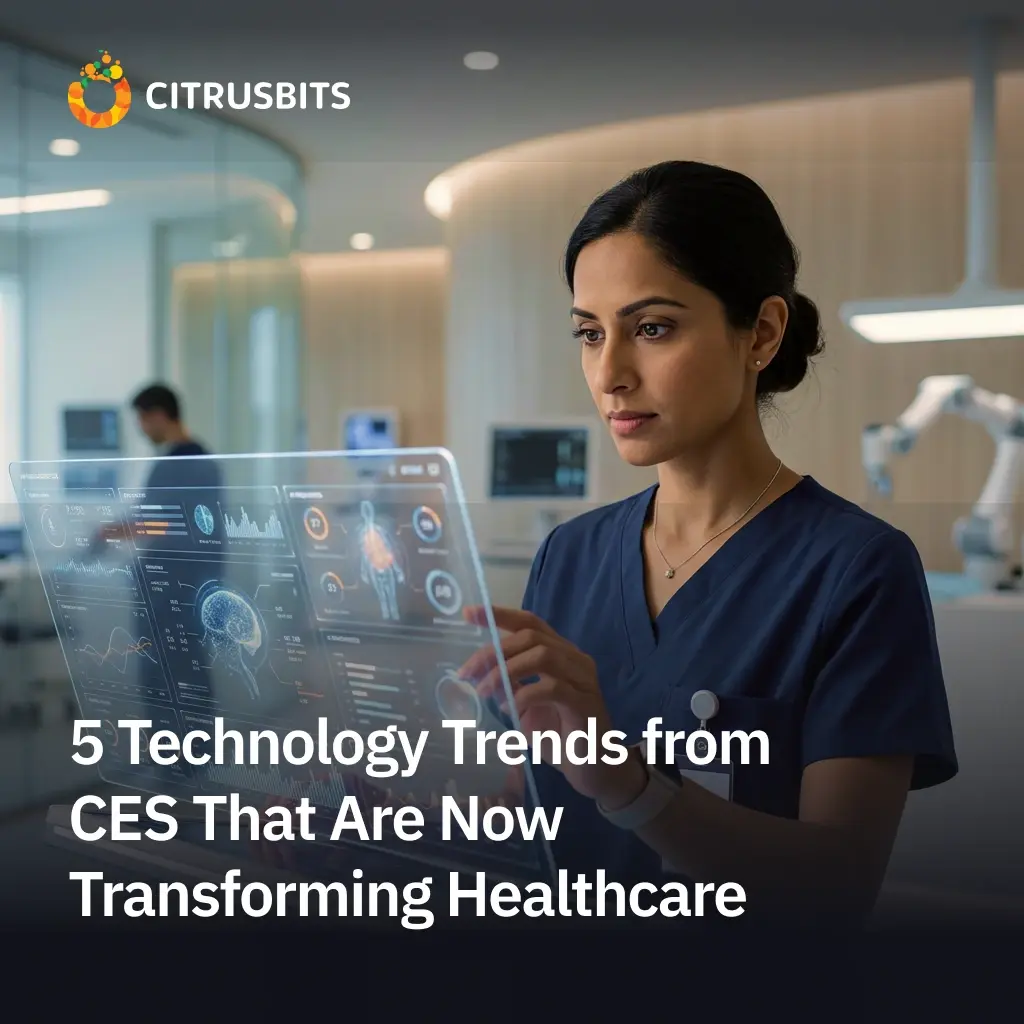
Every year, CES introduces technologies that hint at where innovation is heading, but what’s often overlooked is how these early signals evolve into real-world, mission-critical systems.
Technologies that once powered smart homes, immersive gaming, and consumer wearables are now being re-engineered to solve some of healthcare’s most complex challenges, from improving clinical decision-making with AI to enabling remote patient monitoring through connected devices. The shift isn’t just incremental, it’s architectural.
At CitrusBits, we’ve seen this transition firsthand. What began as experimental technologies showcased at CES have matured into scalable digital health solutions that demand robust engineering, regulatory awareness, and seamless user experience design. For healthcare organizations, understanding this evolution is no longer optional; it’s essential for staying competitive in an increasingly digital-first care ecosystem.
Why CES Trends Matter for Healthcare Innovation?
CES has traditionally been a launchpad for consumer technology, but its real value lies in identifying early-stage innovations before they reach enterprise and clinical environments. Many of today’s healthcare technologies did not originate in hospitals or research labs. They started as consumer-facing solutions focused on convenience, connectivity, and user engagement.
What makes this evolution significant is the shift from experimentation to clinical-grade implementation. Technologies such as artificial intelligence, extended reality, and connected devices have moved beyond prototypes and are now being integrated into healthcare systems that require high reliability, data security, and regulatory compliance.
For healthcare organizations, CES is not just a showcase of gadgets. It is a preview of the next wave of digital health infrastructure. The challenge is not just understanding these trends, but knowing how to translate them into scalable, compliant, and user-centered healthcare solutions.
5 Technology Trends Transforming Healthcare
1. Extended Reality (XR) From Consumer Immersion to Clinical Applications
Extended reality, including AR, VR, and MR, was one of the most talked-about innovations at CES. Initially positioned for gaming and entertainment, XR has now found serious applications in healthcare.
Today, XR is being used for surgical simulations, medical training, pain management, and rehabilitation. These systems provide immersive environments that allow clinicians to practice complex procedures and enable patients to engage in therapy programs with higher levels of interaction and adherence.
From a technical perspective, building XR healthcare solutions requires more than just visualization. It involves real-time rendering, spatial computing, hardware integration, and performance optimization across devices. Additionally, these solutions must meet strict usability and accessibility standards to ensure effectiveness in clinical settings.
For healthcare providers, XR represents a shift toward experiential care delivery, where interaction and engagement directly impact outcomes.
2. Artificial Intelligence From Automation to Clinical Intelligence
Artificial intelligence was heavily featured at CES across multiple industries. In healthcare, AI has evolved from simple automation tools to advanced systems that support clinical decision-making.
AI is now being used to analyze medical imaging, predict patient outcomes, optimize workflows, and assist in diagnostics. Machine learning models can process large volumes of healthcare data to identify patterns that would be difficult for human clinicians to detect in real time.
However, implementing AI in healthcare is technically complex. It requires data pipeline architecture, model training, validation, and integration with existing healthcare systems such as EHRs. There is also a strong need for explainability, data privacy, and compliance with healthcare regulations.
Organizations that successfully leverage AI are not just improving efficiency. They are fundamentally enhancing the accuracy and speed of care delivery.
3. Connected Devices From Wearables to Remote Patient Monitoring
Connected devices and IoT ecosystems have been a staple at CES for years. In healthcare, these technologies are now enabling continuous monitoring outside traditional clinical environments.
Wearables and connected medical devices are being used to track vital signs, manage chronic conditions, and support telehealth initiatives. This shift allows healthcare providers to move from reactive care to proactive and preventive models.
The technical challenge lies in building secure, scalable systems that can handle real-time data streams from multiple devices. Interoperability is critical, as these devices must communicate with healthcare platforms, mobile applications, and clinical systems.
Data accuracy, latency, and compliance with healthcare standards such as HIPAA also play a crucial role in the success of these solutions.
Connected healthcare is redefining how and where care is delivered, making it more accessible and continuous.
4. Advanced UX and UI From Consumer Simplicity to Patient-Centric Design
User experience has always been a key focus at CES, but in healthcare, it has taken on a new level of importance. Poorly designed interfaces in healthcare applications can lead to user frustration, reduced adoption, and even clinical errors.
Modern healthcare platforms require intuitive, accessible, and highly responsive interfaces that cater to both patients and providers. This includes mobile health apps, patient portals, clinician dashboards, and telemedicine platforms.
From a technical standpoint, designing healthcare UX involves understanding complex workflows, ensuring accessibility compliance, and optimizing performance across devices. It also requires a deep understanding of user behavior and cognitive load, especially in high-pressure clinical environments.
Organizations that prioritize UX are seeing higher patient engagement, better adherence to treatment plans, and improved overall satisfaction.
5. Ecosystem Integration From Smart Devices to Interoperable Healthcare Systems
CES has long emphasized connected ecosystems where devices seamlessly interact with each other. In healthcare, this concept has evolved into the need for fully integrated and interoperable systems.
Healthcare applications can no longer operate in isolation. They must integrate with electronic health records, third-party APIs, diagnostic systems, and other digital health platforms.
This requires robust backend architecture, API development, data standardization, and secure data exchange protocols. Standards such as HL7 and FHIR are critical for enabling interoperability across systems.
The ability to integrate and unify data across platforms allows healthcare providers to gain a comprehensive view of patient health, leading to more informed decision-making.
For organizations, building interoperable systems is not just a technical requirement. It is a strategic necessity for delivering connected and efficient care.
What This Means for Healthcare Organizations
The convergence of these technologies is reshaping the healthcare landscape at a fundamental level. Organizations are no longer just adopting digital tools. They are building entire ecosystems that support continuous care, data-driven decision-making, and enhanced patient experiences.
This shift introduces new challenges. Healthcare companies must navigate complex regulatory requirements, ensure data security, and maintain system scalability while delivering seamless user experiences.
At the same time, the opportunity is significant. Organizations that invest in the right technology stack and development partners can accelerate innovation, reduce operational inefficiencies, and create differentiated healthcare solutions.
The focus is no longer on isolated features. It is on building integrated, scalable, and future-ready digital health platforms.
How CitrusBits Helps Build Next-Gen Healthcare Solutions
At CitrusBits, we specialize in designing and developing digital health solutions that align with these emerging technology trends. Our approach combines technical expertise with a deep understanding of healthcare workflows and user behavior.
We work with healthcare organizations to build:
- Scalable healthcare mobile applications tailored for patient and provider use
- AI-powered platforms that enable data-driven insights and automation
- XR-based solutions for training, therapy, and patient engagement
- Connected device ecosystems for remote patient monitoring
- Intuitive UX and UI systems designed for real-world healthcare environments
Our development process focuses on performance, security, and compliance, ensuring that every solution meets industry standards while delivering a seamless user experience.
By bridging innovation with execution, we help healthcare companies turn emerging technologies into practical, impactful solutions.
The Future of Healthcare Innovation Starts Now
The technologies showcased at CES are no longer just indicators of future possibilities. They are actively shaping the present and defining the next generation of healthcare solutions.
As digital health continues to evolve, organizations must move beyond observation and take action. The ability to design, develop, and scale technology-driven healthcare solutions will determine long-term success in an increasingly competitive landscape.
The future of healthcare belongs to organizations that can translate innovation into real-world impact.
About the Author

CitrusBits
Content Writer
Related blogs