


Blog
Custom XR Platforms for Clinical Training: Strategic Benefits, ROI & Use Cases
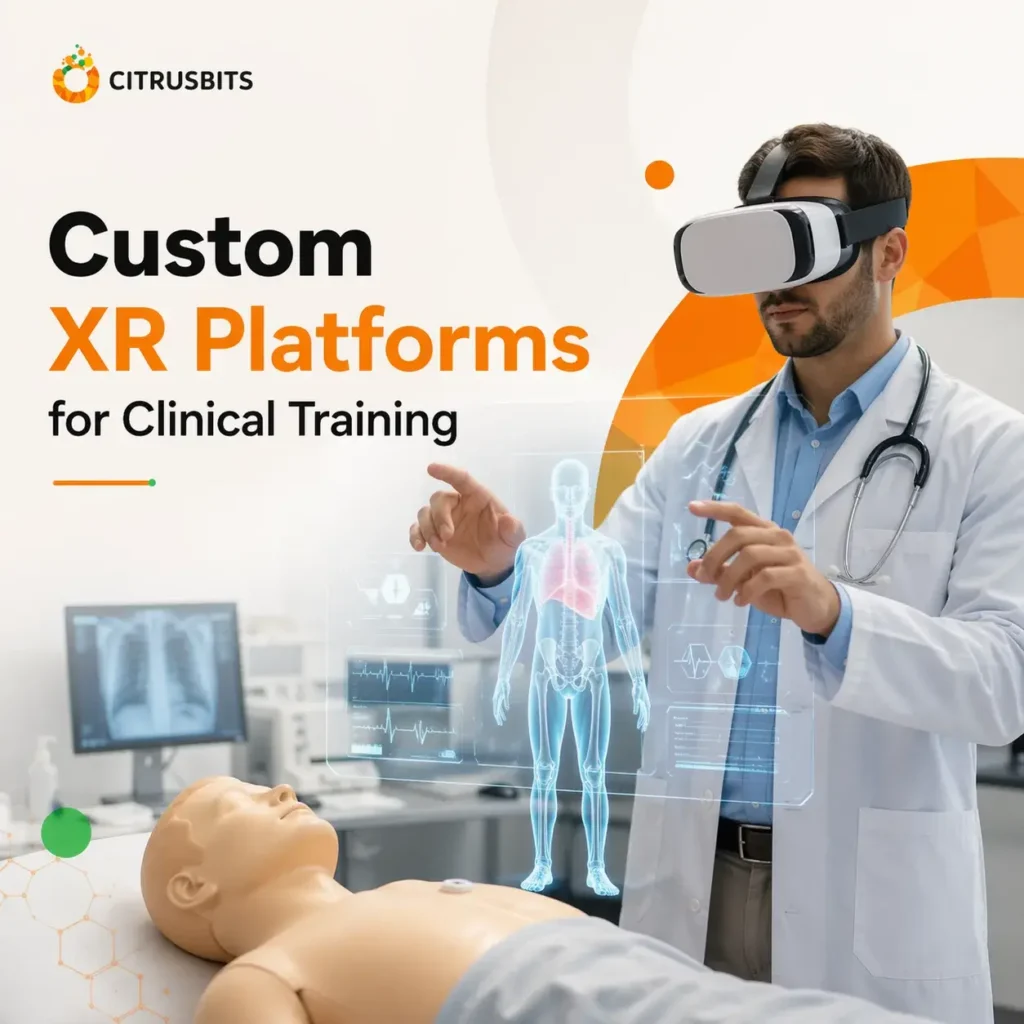
Clinical training is no longer just an operational necessity; it’s a strategic differentiator. For MedTech companies, healthcare providers, and digital health innovators, the ability to train clinicians efficiently, accurately, and at scale directly impacts product adoption, patient outcomes, and revenue growth.
Yet, most organizations are still relying on outdated training models or generic XR solutions that fail to reflect real-world clinical complexity. The result? Slower onboarding, inconsistent performance, and missed opportunities in an increasingly competitive healthcare landscape.
This is where custom XR (Extended Reality) platforms are redefining the game. By combining immersive technologies like VR, AR, and MR with device-specific workflows and regulatory-aware design, custom XR solutions enable organizations to deliver highly contextual, scalable, and measurable training experiences.
The Hidden Cost of Ineffective Clinical Training
Clinical training is often viewed as a necessary expense, but for leading MedTech companies and healthcare organizations, it’s far more than that. It’s a direct driver of product adoption, clinical outcomes, and revenue growth.
And when it’s ineffective, the consequences compound quickly.
- Delayed product adoption due to poorly trained clinicians
- Increased risk of errors in high-stakes environments
- High training costs tied to in-person sessions, equipment, and travel
- Inconsistent learning outcomes across teams and geographies
According to research on immersive learning effectiveness from , simulation-based and immersive training significantly improves clinical performance and retention compared to traditional methods. Yet, many organizations still rely on outdated or disconnected approaches.
The reality is simple:
If your clinical training isn’t scalable, measurable, and tailored to your product and workflows, you’re not just losing efficiency, you’re losing competitive advantage.
This is exactly where custom XR platforms begin to shift from “nice-to-have innovation” to a strategic necessity.
A Closer Look at Custom XR Platforms in Clinical Training
Extended Reality (XR) combines Virtual Reality (VR), Augmented Reality (AR), and Mixed Reality (MR) to create immersive, interactive training environments where clinicians can safely practice real-world scenarios.
But the real distinction isn’t XR itself, it’s how it’s built and applied.
Custom XR platforms are purpose-built solutions designed specifically for:
- Your medical devices or software (SaMD)
- Real-world clinical workflows and environments
- Regulatory and compliance requirements
- Integration with your existing systems (LMS, analytics, device data)
Unlike generic XR tools, which offer pre-built and often irrelevant scenarios, custom platforms replicate the exact conditions clinicians will face in practice.
Generic XR Tools | Custom XR Platforms |
One-size-fits-all simulations | Device-specific, workflow-driven training |
Limited adaptability | Fully customizable experiences |
No compliance framework | Built with regulatory alignment |
Standalone tools | Integrated into your ecosystem |
This level of customization is especially critical for organizations across your ICP:
- Medical Device Manufacturers: Device training & surgical simulations
- AI MedTech Platforms: Clinical decision-making scenarios
- Connected Health Devices: Real-time interaction training
- Digital Health & Virtual Care: Patient engagement simulations
If you’re exploring how this can be implemented in your organization, take a look at your XR development capabilities. The demand is only accelerating. Industry insights highlight XR as a key driver in the future of medical training and operational efficiency.
Why Off-the-Shelf XR Solutions Are Failing Healthcare Organizations
At first glance, off-the-shelf XR platforms appear to offer a fast and cost-effective entry into immersive training. But in healthcare, where precision, context, and compliance are non-negotiable, these solutions often fall short.
And the cost of that gap is high.
Lack of Clinical Context
Generic XR platforms are built for broad applicability, not for the complexity of real clinical environments.
- No alignment with actual hospital workflows
- Limited realism in patient scenarios
- No adaptation for specialty-specific training
Result: Clinicians struggle to transfer learning into real-world practice.
Inadequate Device-Specific Training
For MedTech companies, training must go beyond theory; it must reflect the exact behavior of the product.
Off-the-shelf XR cannot accurately simulate:
- Device interfaces
- Data outputs
- Critical edge-case scenarios
Result: Slower adoption, increased support burden, and potential misuse.
No Integration with Healthcare Systems
Modern healthcare ecosystems rely on data and interoperability.
Yet most generic XR tools:
- Don’t integrate with LMS platforms
- Don’t provide performance analytics
- Don’t connect with the device or clinical data
Result: No measurable ROI from training initiatives.
Compliance and Regulatory Limitations
Healthcare training must align with strict regulatory standards.
However, generic XR platforms rarely support:
- SOP-based training frameworks
- Audit-ready tracking
- Compliance documentation
For reference, regulatory bodies like emphasize the importance of validation and traceability in digital health solutions, something generic tools often lack.
Result: Increased compliance risk and operational gaps.
Limited Scalability for Enterprise Growth
As organizations grow, training complexity increases.
Off-the-shelf solutions struggle with:
- Multi-location deployment
- Role-based training customization
- Continuous updates
Result: Fragmented training experiences across teams.
7 Strategic Benefits of Custom XR Platforms for Clinical Training
Custom XR platforms are not just an upgrade to training; they fundamentally reshape how healthcare organizations scale knowledge, reduce risk, and accelerate growth. For MedTech companies, hospitals, and digital health innovators, the impact goes far beyond learning; it directly influences adoption, efficiency, and competitive positioning.
1. Accelerated Product Adoption for MedTech Companies
One of the biggest challenges MedTech companies face is not building innovative products, but ensuring those products are adopted quickly and correctly by clinicians.
Custom XR platforms solve this by creating device-specific, immersive training environments where clinicians can interact with your product in realistic scenarios before ever using it in practice. This significantly reduces hesitation and builds confidence.
Instead of relying on static manuals or in-person demos, organizations can deliver hands-on, repeatable training experiences that mirror real-world usage.
The result is clear:
- Faster onboarding of physicians and clinical staff
- Reduced dependency on sales-led training
- Shorter sales cycles and quicker market penetration
For companies in SaMD, connected devices, or diagnostic systems, this becomes a powerful lever for scaling adoption without scaling training costs.
2. Faster and More Efficient Clinical Training
Traditional clinical training is resource-heavy, time-consuming, and often inconsistent across teams. Custom XR platforms introduce a self-paced, immersive learning model that dramatically improves efficiency.
Clinicians can train anytime, anywhere, without needing physical equipment or instructor-led sessions. More importantly, they can repeat complex procedures multiple times, which is critical for skill mastery.
This shift leads to measurable improvements:
- Reduced training time by up to 40–60%
- Lower operational costs tied to trainers and facilities
- Standardized training across global teams
3. Improved Knowledge Retention and Reduced Clinical Errors
In clinical environments, knowledge gaps don’t just slow things down—they introduce real risk. That’s why retention is one of the most important metrics in training.
Custom XR platforms leverage experiential learning, allowing clinicians to actively engage in procedures rather than passively observe them. This creates stronger cognitive connections and better long-term retention.
Research highlights that immersive and simulation-based training significantly improves both skill acquisition and retention.
By enabling clinicians to practice in a safe, controlled virtual environment, organizations can:
- Reduce errors during real procedures
- Improve clinical decision-making
- Increase overall confidence and competence
Ultimately, this leads to better patient outcomes, which is the core objective of any healthcare system.
4. Scalable Training Across Locations and Teams
Scaling clinical training has always been a logistical challenge. Coordinating instructors, equipment, and facilities across multiple locations is both expensive and inefficient.
Custom XR platforms remove these barriers by creating a digitally scalable training infrastructure.
Once developed, XR training modules can be deployed globally with minimal incremental cost. Whether you’re onboarding a new hospital system or expanding into a new market, training can scale instantly.
This is especially valuable for:
- Hospitals with multiple locations
- MedTech companies expanding internationally
- Digital health platforms onboarding new users
Instead of fragmented training experiences, organizations can deliver consistent, high-quality training at scale, without the traditional overhead.
5. Built-In Compliance and Regulatory Alignment
In healthcare, training is not just about knowledge; it’s about accountability and compliance. Organizations must ensure that clinicians are trained according to standardized procedures and that this training can be audited when required.
Custom XR platforms can be designed with compliance at their core, embedding:
- Standard Operating Procedures (SOPs)
- Step-by-step guided workflows
- Performance tracking and assessment
This makes it easier to maintain alignment with regulatory frameworks such as those outlined in.
By integrating compliance directly into the training experience, organizations can:
- Ensure consistent adherence to protocols
- Maintain audit-ready training records
- Reduce regulatory risk
This is particularly critical for MedTech and SaMD companies operating in highly regulated environments.
6. Seamless Integration with Existing Healthcare Systems
Training should not exist in isolation; it should be part of a connected ecosystem. One of the biggest advantages of custom XR platforms is their ability to integrate seamlessly with existing systems.
This includes:
- Learning Management Systems (LMS) for tracking progress
- Clinical data systems for realistic simulations
- Analytics platforms for measuring performance
For AI-driven MedTech companies, this opens the door to data-driven training optimization, where insights from user behavior can continuously improve training effectiveness.
Explore how integrated solutions can be built: https://citrusbits.com/
The ability to connect training with real-world data transforms XR from a static tool into a dynamic, evolving system that improves over time.
7. Long-Term Cost Reduction and Strong ROI
At first glance, custom XR platforms may seem like a significant investment. But when viewed strategically, they deliver substantial long-term ROI.
Traditional training costs include:
- Instructor fees
- Travel and logistics
- Physical equipment and maintenance
- Opportunity cost of downtime
Custom XR platforms reduce or eliminate many of these costs while improving outcomes.
Additionally, organizations benefit from:
- Faster time-to-market for new products
- Reduced error-related costs
- Increased efficiency across training programs
Insights from immersive technologies like XR are expected to drive significant productivity gains across industries, including healthcare.
The key shift is this:
Custom XR is not a cost center; it’s a scalable infrastructure investment that compounds in value over time.
Custom XR vs Off-the-Shelf XR Platforms: What Decision Makers Need to Know
At some point in the evaluation process, every CTO, product leader, or innovation head asks the same question:
“Should we build a custom XR platform or use an off-the-shelf solution?”
On the surface, off-the-shelf tools appear faster and cheaper. But in healthcare, where training quality directly impacts outcomes, the long-term implications tell a very different story.
Custom XR platforms are designed as strategic infrastructure, while off-the-shelf tools are typically short-term utilities.
Here’s how they truly compare:
Criteria | Custom XR Platforms | Off-the-Shelf XR |
Training Relevance | Fully tailored to your devices & workflows | Generic, limited scenarios |
Clinical Accuracy | High | Moderate to low |
Compliance Readiness | Built-in | Often missing |
Integration | Seamless (LMS, data, systems) | Minimal or none |
Scalability | Enterprise-ready | Limited |
Long-Term ROI | High | Declines over time |
The key difference lies in alignment.
Off-the-shelf XR solutions force your training to adapt to the tool. Custom XR platforms are built to adapt to your business, your product, and your clinical reality.
For healthcare organizations, that distinction is not optional; it’s critical.
This is why companies operating in high-stakes environments, especially across MedTech, SaMD, and connected devices, are increasingly choosing custom-built XR ecosystems over generic tools.
Applications of Custom XR Across MedTech & Healthcare
To truly understand the value of custom XR platforms, it’s important to look at how they apply across different segments of your ICP. The use cases are not theoretical—they are already driving measurable impact across the industry.
Medical Device Companies: Training That Drives Adoption
For medical device manufacturers, one of the biggest barriers to growth is clinical adoption. Even the most advanced device can struggle in the market if clinicians are not properly trained.
Custom XR platforms enable organizations to simulate:
- Device usage in real clinical scenarios
- Surgical procedures involving the device
- Troubleshooting and edge-case situations
This allows clinicians to build confidence before interacting with the actual product.
The impact is significant:
- Faster onboarding of surgeons and specialists
- Reduced reliance on in-person demos
- Increased product utilization rates
AI MedTech & Digital Health Platforms: Simulating Clinical Decision-Making
For AI-driven healthcare platforms, training isn’t just about “how to use a tool,” it’s about how to make decisions using that tool.
Custom XR platforms can simulate:
- Patient interactions
- Diagnostic scenarios
- Decision-making under uncertainty
This creates an environment where clinicians can safely explore outcomes and understand how AI insights translate into real-world care.
For companies in this space, XR becomes a way to:
- Increase trust in AI systems
- Improve adoption among clinicians
- Reduce friction in implementation
Rehabilitation & Therapeutics: Enhancing Patient-Centric Training
In rehabilitation and therapeutic technology, training often involves both clinicians and patients. Custom XR platforms can bridge this gap by creating guided, interactive environments.
These platforms can simulate:
- Physical therapy exercises
- Patient progress tracking
- Real-time feedback mechanisms
This not only improves clinician training but also enhances how therapies are delivered and experienced.
Companies in this segment can use XR to:
- Standardize therapy protocols
- Improve patient engagement
- Deliver more consistent outcomes
Hospitals & Healthcare Systems: Scalable Workforce Training
Hospitals face a different challenge: training large, diverse teams across departments and locations.
Custom XR platforms allow hospitals to:
- Train staff on emergency scenarios
- Standardize onboarding across roles
- Simulate rare but critical situations
Instead of relying on periodic workshops, hospitals can implement continuous, on-demand training systems.
This leads to:
- Better preparedness
- Reduced training costs
- Improved consistency across teams
XR-Native Companies: Expanding Platform Capabilities
For companies already operating in the XR space, custom development allows them to go deeper into healthcare by building:
- Specialized medical training modules
- Industry-specific XR applications
- Integrated healthcare solutions
This is where partnering with an experienced team becomes critical.
If you’re exploring how to extend XR into healthcare-grade applications, working with a partner that understands both XR technology and clinical complexity makes all the difference.
How CitrusBits Builds High-Impact Custom XR Platforms for Clinical Training?
Building an effective XR platform for clinical training requires more than just technical execution; it demands deep alignment with clinical workflows, regulatory standards, and real-world usability. CitrusBits combines healthcare expertise with advanced XR capabilities to deliver solutions that are immersive, scalable, and built for measurable impact.
Discovery & Strategy
We begin by understanding your product, users, and clinical environment to identify training gaps and define clear outcomes.
Clinical Workflow Mapping
Real-world procedures are translated into accurate, scenario-based XR simulations to ensure relevance and usability for clinicians.
UX/UI for Healthcare Professionals
We design intuitive, low-friction interfaces tailored for medical users, ensuring seamless learning experiences even in complex environments.
XR Development & Integration
We build custom VR, AR, and MR environments and integrate them with LMS, analytics platforms, and healthcare systems.
Testing & Continuous Optimization
Every platform is validated with real users and continuously improved using performance data and feedback loops.
What Does a Custom XR Platform Cost? (And What’s the ROI?)
Cost is often the biggest question and understandably so.
But focusing only on upfront investment can be misleading. The real question decision makers should be asking is:
“What is inefficient training currently costing us?”
Understanding the Investment
Custom XR platforms vary in cost depending on:
- Complexity of simulations
- Level of interactivity
- Integration requirements
- Number of training modules
While the initial investment may be higher than off-the-shelf tools, it reflects the level of customization, accuracy, and scalability required in healthcare.
Where the ROI Comes From
The return on investment becomes clear when you look at the full picture.
Custom XR platforms help reduce:
- Costs associated with instructor-led training
- Travel and logistics expenses
- Equipment and physical simulation costs
- Time spent onboarding clinicians
At the same time, they drive:
- Faster product adoption
- Improved clinical performance
- Reduced error-related costs
- Increased operational efficiency
According to, immersive technologies are expected to unlock significant productivity gains across industries, particularly in training and development.
Short-Term Cost vs Long-Term Value
Off-the-shelf solutions may seem cost-effective initially, but they often lead to:
- Ongoing customization limitations
- Inefficiencies in training
- Hidden costs over time
Custom XR platforms, on the other hand, act as a scalable asset that continues to deliver value as your organization grows.
Summary
Custom XR platforms for clinical training provide immersive, device-specific simulations that improve learning retention, reduce costs, ensure compliance, and scale training across healthcare organizations, making them more effective than off-the-shelf solutions.
Ready to Transform Your Clinical Training with XR?
If you’re looking to move beyond traditional training and build a scalable, high-impact solution tailored to your organization, this is the moment to act.
Let’s design a custom XR platform that aligns with your clinical workflows, devices, and growth strategy.
Table of Contents
1) The Hidden Cost of Ineffective Clinical Training (Hook That Converts)
2) A Closer Look at Custom XR Platforms in Clinical Training
3) Why Off-the-Shelf XR Solutions Are Failing Healthcare Organizations
4) 7 Strategic Benefits of Custom XR Platforms for Clinical Training
5) Custom XR vs Off-the-Shelf XR Platforms: What Decision Makers Need to Know
6) Applications of Custom XR Across MedTech & Healthcare
7) How CitrusBits Builds High-Impact Custom XR Platforms for Clinical Training?
8) What Does a Custom XR Platform Cost? (And What’s the ROI?)
9) Summary
Innovate the Future of Health Tech
CitrusBits helps MedTech leaders build smarter apps, connected devices, and XR health solutions that truly make an impact.
